Monroe County father speaks out after 10-month-old daughter shot, killed
The father of 10-month-old Jamaya Austin is speaking out for the first time after she was fatally shot in a Monroe County custody dispute on Christmas Eve.
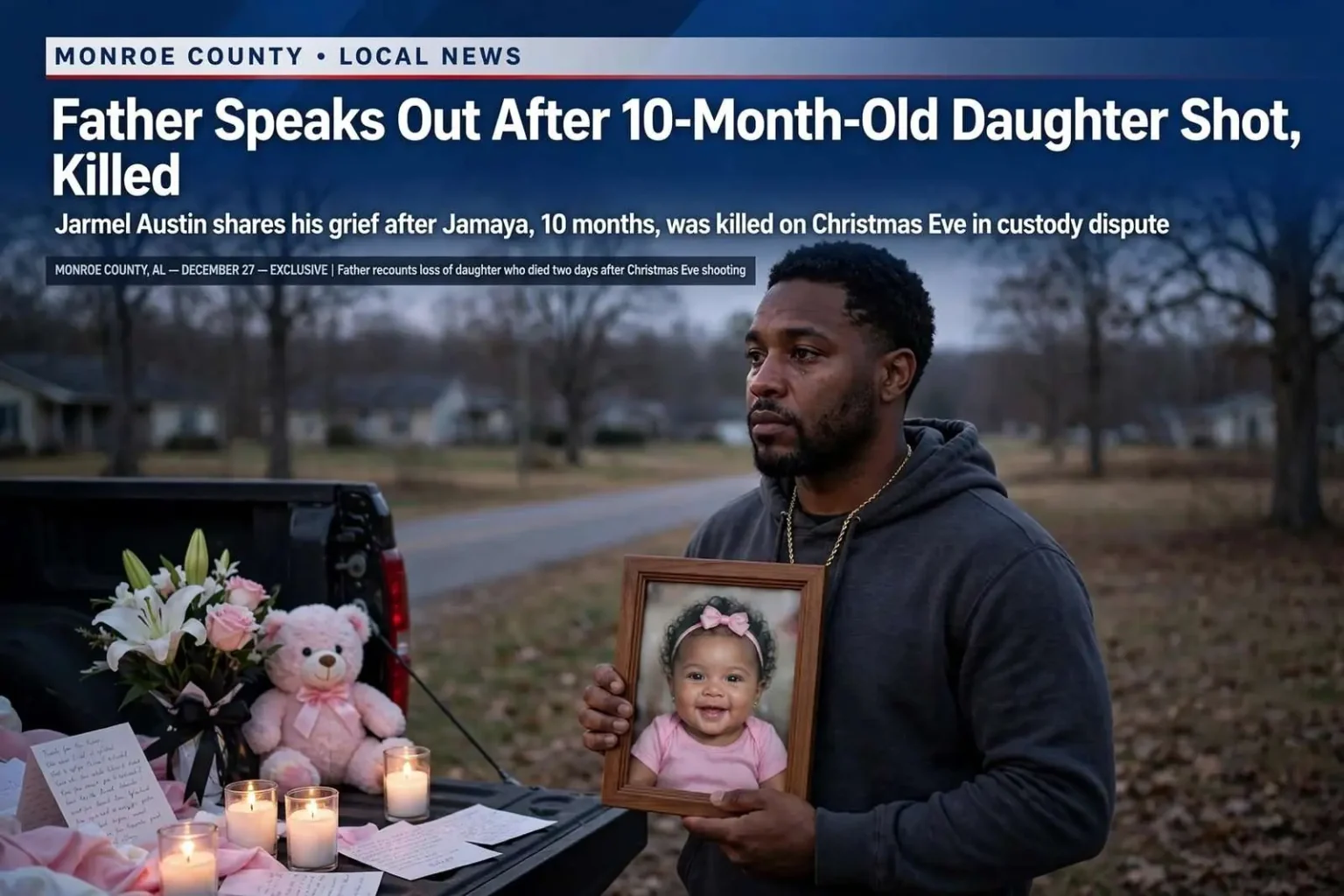
A Monroe County father is speaking publicly for the first time about the loss of his 10-month-old daughter, who was fatally shot on Christmas Eve in an incident he says grew out of a disagreement over custody. Jarmel Austin said he was in the car with his daughter, Jamaya Austin, when she was shot. The child died two days after the shooting, and the person charged in her death has since been released on bond, according to the father.
Austin described Jamaya as a smart, funny and attentive child who brought joy to everyone around her. He said the family is still struggling to come to terms with what happened on a holiday evening in rural southwest Alabama, when a celebration meant for family time turned into the worst day of their lives.
According to Austin, the suspect, Tamika Stallworth — who is the child’s great-aunt — demanded that Jamaya go with her. When Austin did not comply, she allegedly fired into their vehicle, according to the father. Jamaya was struck and later died from her injuries.
Stallworth was charged with murder the day after Christmas, Austin said, but has since bonded out of jail. News of the release has added to the family’s pain as they grieve a child who never reached her first birthday.
Grieving father shares his loss
The father of a 10-month-old girl fatally shot in Monroe County is speaking publicly about his loss for the first time, and his words carry the weight of a holiday season that will forever be marked by tragedy. Austin said his daughter was more than a baby in his care — she was the center of his world and a source of happiness for an extended family spread across the region.
“We have to think positive,” Austin said. “God had something in store for her. He had to get her, she was so precious, she was a little angel.”
Austin said the death has been devastating for both families, a point he emphasized as the case moves forward. When a violent act connects two branches of the same family, the grief does not split neatly in two — it compounds, leaving relatives on both sides mourning a child while also confronting criminal charges against one of their own.
In small communities across Monroe County, where families often span generations in the same towns, incidents like this one ripple quickly. Neighbors, church congregations and school communities frequently share ties with everyone involved, and the aftermath of a child’s death can reshape relationships across an entire community for years to come.
A quiet holiday shattered
Christmas Eve is typically one of the calmest nights of the year in Monroe County’s towns and rural crossroads. Families gather for church services and late dinners, and law enforcement calls tend to slow until the holiday rush resumes. The shooting that night stood out all the more for the setting in which it occurred, and for the age of the victim.
The loss of a child under one year old is among the rarest and most wrenching categories of violent death, and it tends to draw scrutiny well beyond the local area. Investigators in such cases typically move quickly in the first days, collecting statements from everyone present and securing any physical evidence before the scene changes.
For Austin, the timeline has its own cruelty: a shooting on Christmas Eve, a formal murder charge on the day after Christmas, and a child’s death two days after the shot was fired. Each of those dates now carries a separate weight for a family that had gathered, like thousands of others across Alabama, to mark the holiday together.
According to the father’s account, the confrontation that led to the shooting centered on custody of the little girl. Family law practitioners across Alabama have long identified custody exchanges as among the most volatile moments in a domestic dispute, because they bring parties in conflict into direct contact with the child at the center of the disagreement, often without neutral supervision.
Custody matters in Alabama are handled through the state’s family courts, where judges weigh the best interests of the child and can establish structured exchange arrangements, including supervised transfers and neutral meeting locations, when tensions between parents or relatives run high. Courts can also issue protective orders that set strict boundaries on contact when violence or threats have entered the picture.
Law enforcement agencies across the state routinely encourage parents involved in high-conflict disputes to conduct exchanges in public places — police department parking lots are a common choice — and, where appropriate, with a third party present. The goal is simple: remove the privacy and pressure that allow an argument to turn physical.
When a disagreement escalates to gunfire, the legal exposure changes dramatically. Firing into an occupied vehicle can support a range of serious charges under Alabama law, and when a victim dies, prosecutors may pursue murder charges regardless of whether the act is said to have been impulsive rather than planned.
The charges and what comes next
Stallworth was charged with murder the day after Christmas, according to Austin. In Alabama, murder is a Class A felony, the most serious classification short of capital offenses, and a conviction can carry a sentence of decades in prison. Under the state’s judicial system, a felony case typically moves from a district court probable-cause hearing to a grand jury review and, on indictment, to circuit court for arraignment and trial.
Bond in such cases is set by a judge and can vary widely depending on the circumstances of the offense, the defendant’s ties to the community and the positions of prosecutors. Austin said Stallworth has since bonded out of jail, which means the case will proceed through the courts on a timeline set by the local circuit rather than behind bars.
For the family, the court process will unfold slowly compared with the speed of the events themselves. Prosecutors in rural circuit courts often manage heavy dockets, and felony cases can take a year or more to reach resolution. Families of victims frequently describe that stretch of waiting as its own ordeal, requiring them to relive the loss at each hearing along the way.
The Monroe County Sheriff’s Office provides law enforcement across the county’s unincorporated areas and works alongside municipal departments in communities such as Monroeville, the county seat. Investigations into violent incidents typically involve gathering physical evidence, witness statements and, in cases involving vehicles, a forensic examination of the scene and the vehicle itself.
Custody disputes and the courts
The circumstances Austin described — a relative demanding that a child be handed over, and gunfire following a refusal — highlight the stakes that family court judges and domestic violence advocates try to defuse before they reach a crisis point. Advocates note that threats made during custody disputes should never be dismissed as ordinary family friction, and that courts have tools, from modified exchange protocols to no-contact orders, designed to keep children and parents safe during transfers.
In cases where a relative without custody demands access to a child, the legal path runs through the family courts, which decide custody and visitation based on evidence presented by the parties. Taking matters into one’s own hands, as prosecutors allege happened here, can convert a family disagreement into a felony prosecution with lifelong consequences for everyone involved.
Whether any prior court proceedings or protective measures were in place in this case has not been disclosed publicly. What is clear, according to the father’s account, is that a demand for the child was refused and shots were fired into the car where Jamaya was riding with her father on Christmas Eve.
The death of a very young child to violence draws particular attention across the Gulf Coast region, and news of this case has traveled through church networks, family connections and social media in the days since. Grief counselors and clergy in small Alabama towns often become the first line of support for families, well before formal services are arranged and long after the news cycle moves on.
Austin’s decision to speak publicly, he indicated, is part of how he is coping. Parents who lose children to violence frequently say that telling the child’s story keeps the memory alive and keeps attention on the case as it moves through the justice system, where outcomes depend on the persistence of investigators, witnesses and prosecutors alike.
He described Jamaya as a smart, funny and attentive child who brought joy to everyone around her — a description that echoes what family members across the region often say about the youngest among them, but one that carries special pain when a life is cut short before a first birthday, before first steps or first words could be fully celebrated and recorded in family photographs.
What families in similar situations should know
For families navigating custody conflicts in southwest Alabama, the case underscores the resources that exist before tragedy strikes. County family courts can modify existing custody orders when circumstances change, and circuit clerks’ offices can explain how to file the necessary petitions. Many counties also have domestic violence shelters and advocacy organizations that can advise on safety planning at no cost.
Alabama’s court system also offers access to family court services in many circuits, and judges can require that exchanges occur at supervised visitation centers where they are available. In rural areas where such centers are scarce, deputies sometimes allow exchanges to occur in their station parking lots precisely because of the risks these handoffs can carry.
Advocates emphasize that anyone who believes a child is in immediate danger should call 911 rather than attempting to resolve the situation directly, and that documenting threats — with texts, voicemails or witness accounts — strengthens both protective petitions and any later criminal prosecution.
Looking ahead
As the case proceeds through the Monroe County court system, both families will be watching a process that neither wanted. Austin’s message, in the meantime, is one of fragile faith: to think positive, and to trust that a precious little angel is in better hands.
The weeks ahead will bring hearings and procedural steps that will test the family’s endurance. Prosecutors will present the evidence gathered from the Christmas Eve shooting scene, and the defense will have every opportunity to respond, as the legal system requires. For the family, each of those dates will arrive with the knowledge that a 10-month-old girl who made everyone around her smile is not there to share them.
For now, a father’s words stand as the family’s public record of who Jamaya was: smart, funny and attentive, a little angel who brought joy to everyone around her. How the courts answer for her death will unfold in due course, in a rural Alabama county where everyone affected knows the cost of that night.