
More Than 200 Church Youth Volunteers Descend on Africatown for Week of Home Repairs
Church youth groups from four states joined Mission Serve to repair roofs and homes in Mobile's Africatown, one of the year's largest volunteer efforts.
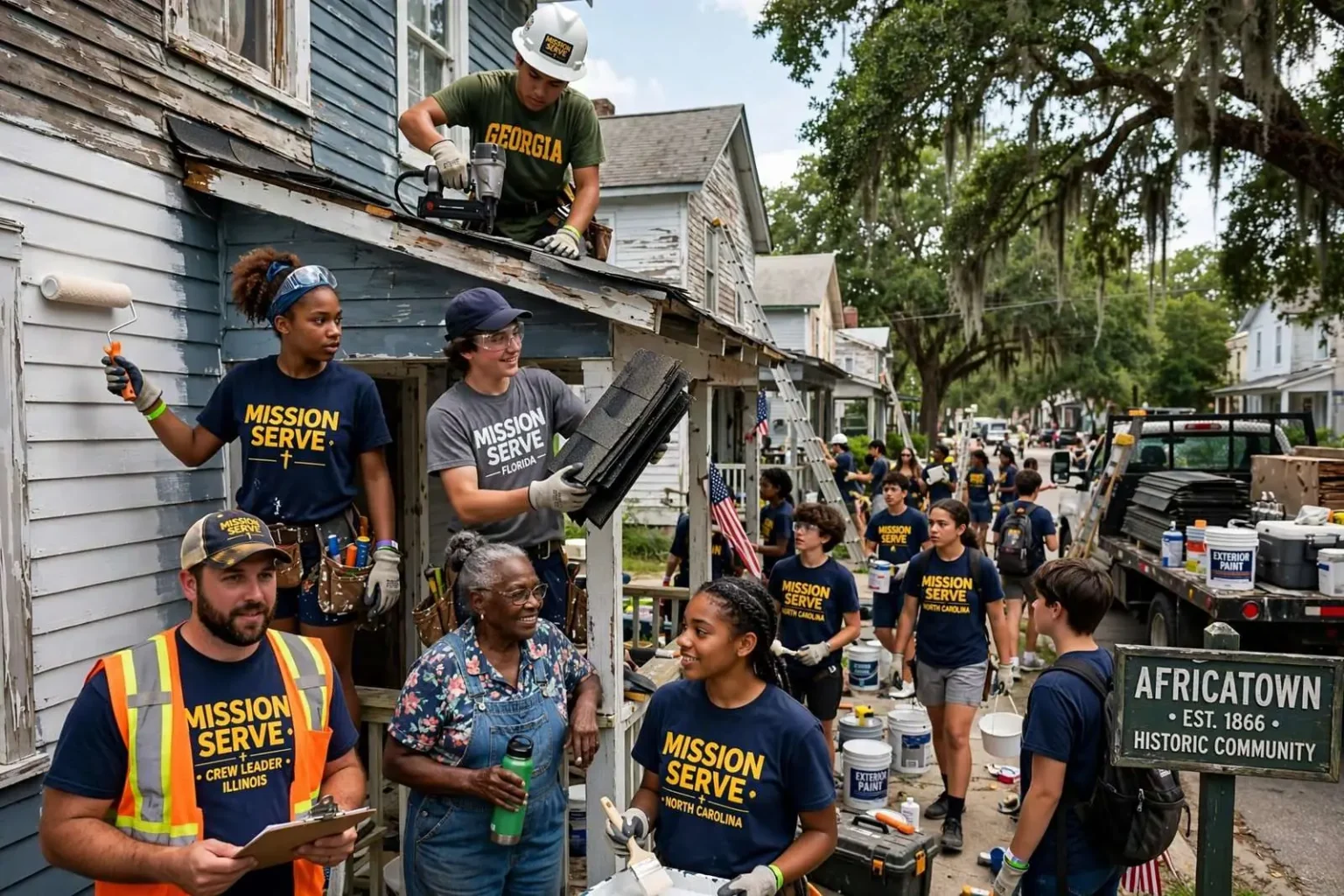
MOBILE, Ala. — More than 200 young volunteers fanned out across Africatown this week, scraping, painting and re-roofing homes for homeowners who could not afford the work themselves.
The effort is part of Mission Serve, a program that unites church youth groups from states including Georgia, Illinois, Florida and North Carolina. The teenagers and their adult leaders arrived with ladders, tools and a week’s worth of supplies, transforming a summer trip into labor that would otherwise cost homeowners thousands of dollars.
Before work began Monday morning, the crews gathered for prayer, then split off to several houses around the historic community north of downtown Mobile. By the end of the week, the work crews aimed to leave behind fresh paint, sound roofs and repaired porches on homes that needed all of it.
New Skills and a Bigger Purpose
For many of the teenagers, the trip doubles as a first introduction to trades like roofing. Under the supervision of adult crew leaders, students learned to tear off damaged shingles, lay underlayment, prime and paint siding — skills many of them had never held a hammer long enough to attempt. Organizers say that discovery is part of the design: a week on a roof teaches teenagers that skilled work is real, demanding and valuable, whether or not they ever take it up as a trade.
Volunteers traveling from Jacksonville, Florida said they came both to help the community and to grow in their faith. For church youth groups, mission trips have long served that double purpose — service that is also formation, a week in which teenagers discover that their time and sweat can materially change someone else’s life.
Chris Gillespie of Deermeadows Baptist Church, one of the participating congregations, said the lasting impact is on the homeowners themselves — people who cannot afford a new roof or a paint job receive it at no cost.
That is the arithmetic that makes volunteer repair work matter. A roof replacement on a modest home can run well into five figures, a sum far beyond the reach of many elderly homeowners on fixed incomes. When a roof fails, the damage compounds: a leak becomes rot, rot becomes structural trouble, and a home that could have been saved with shingles ends up condemned instead.
A Community With Deep Roots
Africatown carries a history unlike any other community in Alabama. It was founded after the Civil War by the men and women brought to Mobile aboard the Clotilda, the last known ship to deliver enslaved Africans to the United States, who built their own settlement north of the city after emancipation and preserved their language and traditions within it.
The neighborhood’s residents have spent decades working to preserve that legacy while contending with the pressures that surround it — industrial development, highway construction and the ordinary aging of a housing stock that in many cases dates back generations. The homes the volunteers are repairing belong to families who, in some cases, occupy houses built by their own ancestors.
Against that backdrop, a fleet of young volunteers with paint rollers and roofing nailers is more than a charity project; it is an infusion of help into a community that has learned to make the most of what comes its way. Residents have welcomed previous volunteer groups for the same reasons: the work is real, and it arrives exactly where it is needed.
The City Helps Steer the Effort
Mobile Mayor Sandy Stimpson greeted volunteers as they started work. The city helps coordinate visiting volunteer groups, directing them to homeowners who apply for assistance.
That coordination role is more consequential than it may sound. A visiting group with 200 willing workers needs projects matched to its skills and scale — houses that can absorb a week’s labor, materials staged in advance, and homeowners who have asked for help and are ready to receive it. The city’s pipeline of applications gives organizers a menu of eligible homes, connecting good intentions to actual addresses.
Stimpson noted that this same group had planned to come a year earlier but the trip was canceled because of COVID-19. The delayed visit made this week’s arrival a kind of recovery in its own right — evidence that the large-scale volunteer travel that shut down in the pandemic’s first year was finding its way back to Mobile.
Organizers called this one of the largest volunteer efforts to visit Mobile so far this year. For a city that regularly hosts mission groups during hurricane recovery, the return of that volume of volunteers carries economic and civic weight beyond the work itself: crews fill hotels, buy supplies locally and form connections that often bring them back.
What a Week of Work Leaves Behind
By the time the buses pull out, the measure of the trip is written on the houses: scraped and repainted siding that sheds the next storm, roofs that will carry another decade of Gulf Coast weather, porches made safe again for the grandchildren who visit on Sundays. Homeowners receive, at no cost, repairs that protect their largest asset and their independence.
For the homeowners, the benefit is financial and personal. Aging residents who have watched a roof deteriorate beyond their budget often face the choice of borrowing they cannot afford or living with the leak. A volunteer crew removes that choice, and the gratitude that follows is, by every account from such trips, the part the teenagers remember longest.
For the volunteers, the week leaves something less visible: an introduction to the trades, a deeper experience of community and a picture of Mobile — its history, its neighborhoods and its needs — that no tour could provide. Many of the students who came from Georgia, Illinois, Florida and North Carolina will carry the story of Africatown home with them, and some will come back.
Mission Serve’s Model
Mission Serve operates on a model that has become a backbone of church-based volunteer work across the Southeast: assemble youth groups from multiple states, place them where the need is documented, and organize the week so that unskilled teenagers can accomplish genuinely skilled results under trained supervision. Crew leaders with construction experience direct the work, materials are pre-ordered, and the schedule is built so that each house has a team matched to its tasks.
The multi-state composition of this week’s crews — groups from Georgia, Illinois, Florida and North Carolina — reflects the program’s reach and the draw of Mobile’s needs. Organizers say the mixing of groups is deliberate: students who arrive as strangers from different states end the week as crews that have prayed together, labored together and learned together.
The scale of this visit — more than 200 volunteers deployed across several houses at once — places it among the largest such efforts the city has hosted in a year still shaped by pandemic disruptions. Hosting it required weeks of planning between the program’s organizers and city staff, from lodging and meals to permits and material deliveries.
A Historic Community’s Ongoing Renewal
The repairs come at a moment of renewed attention to Africatown. The confirmation of the Clotilda’s remains in the Mobile River brought international focus to the community, along with heritage tourism, new signage and long-discussed plans for an Africatown heritage house and museum. Residents have worked to ensure that attention translates into tangible improvements — and well-maintained homes are among the most tangible of all.
Community advocates have long argued that the neighborhood’s future depends on its residents being able to stay: elderly homeowners remaining in houses that are safe and dry, families investing in properties with confidence that the community around them will hold. Volunteer repair efforts feed directly into that stability, one roof at a time.
For the week ahead, the crews’ schedule is simple: gather, pray, work and repeat until the houses are done. The city, the program and the homeowners each bring something to the arrangement — coordination, labor and trust — and by Friday the combination should leave Africatown visibly better than the volunteers found it.
The week also underscores how vital volunteer labor has become to housing preservation in older neighborhoods. Federal and city repair programs exist, but their waiting lists and funding limits leave many eligible homeowners unserved; church-based crews like Mission Serve’s fill a gap that public programs alone cannot, arriving with labor that requires no appropriation and no paperwork beyond the application the city keeps on file.
City officials have said that pairing visiting groups with homeowner applications is now a standing practice — one that treats each volunteer week as a scheduled maintenance event for the neighborhoods that need it most. Groups that return year after year, as many do, build relationships with the same streets and the same families, turning a one-time paint job into long-term care.