More Than 500 Lots — From Vehicles to an Airplane Fuselage — in Alabama State Surplus Online Auction
ADECA's online state surplus auction runs Jan. 30-Feb. 5 on GovDeals: vehicles, electronics, furniture and even an airplane fuselage.
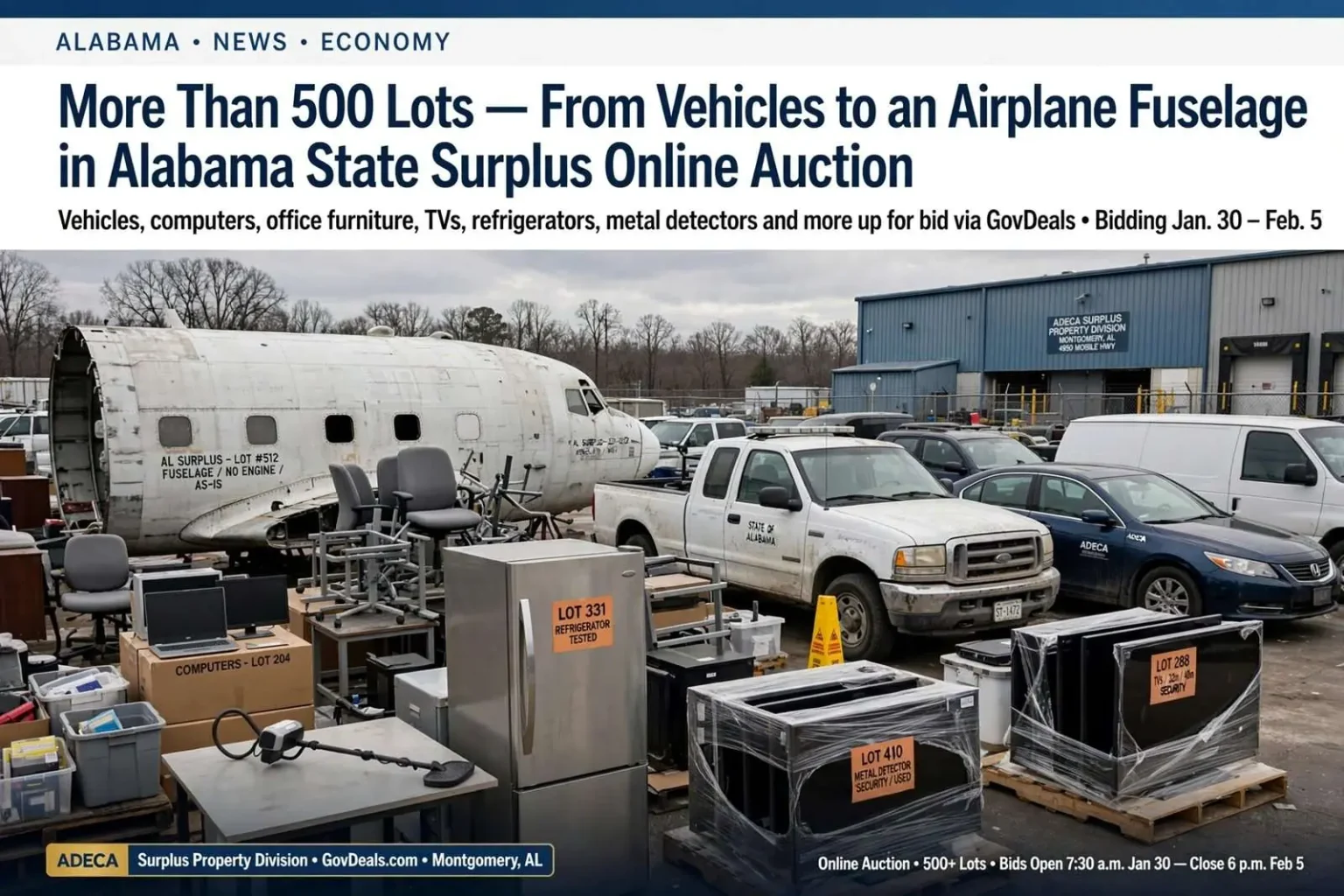
Vehicles, computers, office furniture, TVs, refrigerators, metal detectors and even an airplane fuselage are among the more than 500 lots up for bid in the Alabama state surplus property auction this week.
The Surplus Property Division of the Alabama Department of Economic and Community Affairs (ADECA) is hosting the online auction through GovDeals.com, with bidding opening at 7:30 a.m. Thursday, Jan. 30 and closing at 6 p.m. on Feb. 5. Items can be viewed at the GovDeals Alabama page once the auction opens, and details on becoming an authorized bidder are available through ADECA’s public sales site.
The sale is one of the state’s periodic chances for the public to buy equipment straight from government fleets and warehouses, often at prices well below retail. Lots in auctions like this one typically attract a predictable mix: used-car shoppers hunting reliable sedans and trucks, small businesses furnishing offices on a budget, hobbyists looking for unusual inventory, and resellers who make a living moving government surplus through secondary markets. With more than 500 lots in play, the catalog spans everything from routine to remarkable.
From Fleet Trucks to a Fuselage
The headlining oddity in this sale — an airplane fuselage — illustrates the range the auctions can reach. A fuselage without wings or engines is not something a private buyer encounters every day, and unusual lots like it tend to draw attention from fabricators, training programs, sign makers, and collectors who see raw potential in oversized salvage. The rest of the catalog is more grounded: sedans, pickups and vans retired from state fleets, laptop and desktop computers cycled out of agency offices, furniture, televisions, refrigerators, and metal detectors previously used in security settings.
In addition to property no longer needed by state and federal agencies, ADECA acquires items abandoned voluntarily at airports across the Southeast — one reason the inventory ranges from routine office equipment to oddities like a fuselage. Federal law requires airlines and airports to dispose of unclaimed property in a structured way, and state agencies designated to handle surplus take on that role, funneling items into public sale rather than storage. That pipeline is why Alabama bidders occasionally find themselves bidding on luggage, electronics, and in this case airframe material with no connection to any state agency’s daily work.
For bargain hunters, the practical appeal of government surplus comes down to condition and price. Vehicles sold at surplus auction are typically sold as-is, with maintenance histories that vary by agency, but the absence of dealer markup keeps the floor prices low. Electronics and office goods may be several years old but functional, which makes them staples for nonprofits, startups, and families furnishing home offices. Successful bidders pay for their purchases online and pick them up at the warehouse within the stated removal window.
How It Works
The auction runs on GovDeals.com, one of the largest online marketplaces for government surplus, which hosts sales for thousands of public agencies across North America. Bidders create a free account, register for the Alabama sale, and place bids on individual lots during the open window. The platform’s format resembles familiar auction sites: bidders can set maximum bids, watch the clock tick down, and receive notice if they are outbid. As is typical of online surplus sales, lots close on a staggered schedule as the Feb. 5 deadline approaches, and standard auction extensions apply when last-minute bids arrive.
Anyone planning serious bidding should review the listing details carefully. Each lot carries its own description, condition notes, and photographs, and surplus property is sold as-is with no warranty. Payment is handled through the platform, and buyers are responsible for removing their purchases within the pickup window the listing specifies — a step that matters for the sale’s larger items, where bringing the right vehicle and help is part of the plan.
Bidders who want to inspect items in person can do so at the Surplus Property Division’s Montgomery warehouse at 4950 Mobile Highway from 8 a.m. to 3 p.m. on Jan. 31. For vehicles especially, an in-person look at the Jan. 31 inspection can make the difference between a smart purchase and a mistake; buyers can check titles, note wear, and confirm that a lot matches its photos before committing to a bid.
About ADECA and the Surplus Property Division
ADECA is one of Alabama’s most versatile state agencies, administering federal grant funds and state programs that touch local governments in nearly every corner of the state. Based in Montgomery, the department oversees programs spanning community development, law enforcement support, children’s affairs, energy, water resources, and economic planning. Its Surplus Property Division plays the specialized role of moving unneeded government property out of storage and into productive use — either by selling it to the public or by placing it with organizations that can use it.
ADECA holds these online public auctions periodically each year, but surplus items are available year-round to municipal and county governments, state agencies and qualified nonprofit organizations. That year-round channel matters for small towns and cash-strapped nonprofits: a volunteer fire department can acquire equipment through surplus programs at a fraction of commercial cost, and cities can replace fleet vehicles without going through competitive retail purchasing. The federal surplus property program that underpins part of this system has operated for decades, designed so that public assets circulate within the public sector before being offered to private buyers.
The division also administers grant programs for law enforcement, traffic safety, economic development, energy conservation, water resource management and recreation across Alabama. Through those programs, ADECA passes federal funding through to police departments for equipment, to highway safety initiatives, to industrial recruitment efforts, to local energy projects, to watershed improvements, and to parks and recreation construction. The surplus auctions and the grant administration sit on opposite ends of the same mission: making sure public resources — whether money or merchandise — reach the communities that need them.
Tips for First-Time Bidders
First-time participants in the state surplus auction should take a few preparatory steps before the bidding opens at 7:30 a.m. Thursday, Jan. 30. Registering as an authorized bidder in advance through ADECA’s public sales site avoids the last-minute scramble on opening morning, and reviewing the full lot list on the GovDeals Alabama page allows time to research the items that matter most. Bidders who plan to inspect in person should mark the Jan. 31 warehouse window on the calendar and bring questions — division staff can clarify condition notes and pickup requirements.
A few practical habits serve surplus bidders well. Set a ceiling for each lot and stick to it, since the competitive nature of online auctions makes it easy to overpay for excitement. Factor removal into the budget: a cheap lot that requires renting a trailer to haul away may cost more in the end than it appears. And read the sale terms, including payment deadlines and pickup windows, before the auction closes rather than after winning.
For buyers in Mobile and south Alabama, the Montgomery warehouse location means the auction rewards planning. The roughly three-hour drive to the capital makes the Jan. 31 inspection day impractical for casual browsing but worthwhile for anyone bidding on vehicles or large equipment. Successful online bidders will still need to arrange pickup from Montgomery, so shipping and hauling logistics deserve a place in the bidding decision.
Why the Surplus Auctions Matter
Beyond the bargains, the state surplus program performs an accountability function that often goes unnoticed. Every item sold at auction is public property that has completed its useful life in government service, and the auction process converts it back into revenue for the state rather than letting it age in a warehouse. The open, competitive bidding format ensures that taxpayers get fair value and that disposal decisions happen in daylight rather than through informal channels.
The auctions also democratize access to government equipment. A commercial equivalent of the vehicles and electronics in this sale would carry dealer margins; the surplus format lets a small business, a nonprofit, or an individual family compete for the same inventory. With more than 500 lots spanning everything from a retired fleet pickup to an airplane fuselage, the current sale offers one of the widest windows yet into the sheer variety of what Alabama’s public agencies buy, use, and eventually release.
Bidding runs through 6 p.m. on Feb. 5, and with staggered lot closings, the final hours will decide where the sale’s oddities and workhorses end up. Whether the winners are resellers, nonprofits, or neighbors hunting a used truck, the auction will have done its job: turning surplus public property into private usefulness, one lot at a time.
The timing of the sale also works in buyers’ favor. Late winter is traditionally a slow season for secondhand retail, which means less competition for desirable lots than a summer auction might draw. Bidders who have watched past Alabama surplus sales know that patience and a firm ceiling tend to win out over early enthusiasm, and that the lots overlooked in the first hours of bidding are often the ones that close at the steepest discounts.