
Morris Minor Drops Two New Songs Ahead of Six-Track EP
Mobile band Morris Minor released two new tracks, 'Life Is So Strange' and 'Ides of March,' as it works toward a six-song EP recorded in-house.
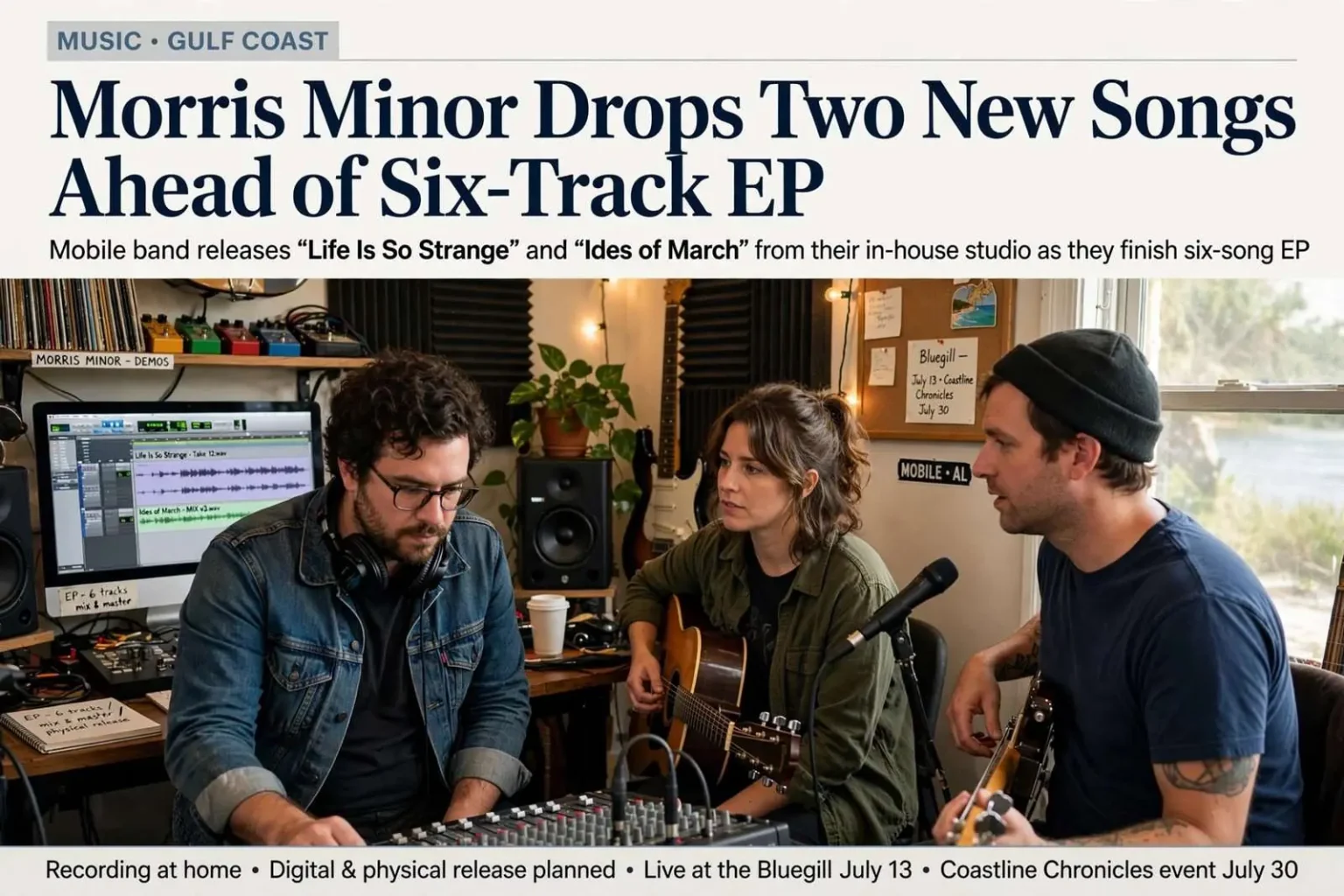
Mobile-based band Morris Minor released two new songs, “Life Is So Strange” and “Ides of March,” as it works toward finishing a six-song EP recorded in the group’s own studio. Band member Greg Nobles handled engineering duties for the sessions, and the group said it planned to master the remaining tracks for both digital and physical release.
The two-song drop is a window into how independent bands work now. Rather than waiting for a finished record, Morris Minor is putting material out as it reaches the finish line — building an audience song by song while the EP takes shape in the background. The titles suggest the band’s range: “Life Is So Strange” points toward the observational, everyday strangeness that fuels a lot of Gulf Coast songwriting, while “Ides of March” leans classical and ominous. Together they give listeners the first real taste of where the six-song project is headed.
Recording and producing music in-house has let the band control the pace of the project rather than working around a commercial studio’s schedule, a common approach among independent acts along the Gulf Coast. Owning the process has practical payoffs that go beyond money: sessions can run long when a take is working and stop when it isn’t, overdubs can wait for the right idea rather than the next block of booked studio time, and the band can revise a mix weeks later without paying for the privilege. For a group balancing music against day jobs — as most working Mobile bands do — that flexibility is often the difference between finishing a record and stalling out halfway through.
Doing It Themselves
The home-studio route also changes what the music sounds like. Tracks built slowly in a band’s own room tend to carry more layers and experiments than the same songs cut against a studio clock, and the engineer’s ear matters enormously — which is where Nobles’ role comes in. Engineering your own band’s record demands a split personality: the musician listening for feel and the engineer listening for problems, both working the same session. Bands that manage it come out the other side with a record that is genuinely theirs, decisions and all.
The do-it-yourself model has deep roots along the Gulf Coast. Mobile’s independent music scene has long run on home studios, borrowed gear and bands that press their own CDs and book their own tours, a culture born partly of geography — two hundred miles from the nearest major-label orbit — and partly of the region’s self-reliant streak. The result is a network of acts that record on their own terms and release on their own labels, with Morris Minor’s EP arriving squarely in that tradition.
Beyond the new songs, Morris Minor also intended to remix and master earlier recordings that had never received a proper release, giving older material a chance to reach listeners in improved form. Every band accumulates this catalog — songs recorded in bursts, mixed hastily, released into the void or never released at all. Revisiting them with better tools and better ears is both an act of housekeeping and a second chance for material that deserved more than it got the first time around.
For fans, the remastered backlog is often the most interesting part of a project like this. Older songs show a band’s development — earlier influences, rougher edges, ideas that later material refined — and a properly mastered version gives them a permanent place in the catalog instead of a degraded file passed around between friends. Digital distribution has made that release easy in one sense, but mastering remains a craft: levels, EQ and dynamics tuned so the songs sit alongside everything else in a listener’s library rather than sticking out as basement recordings.
The band’s plan for digital and physical release reflects the same dual thinking. Streaming puts music in front of the widest possible audience at no marginal cost, but physical product — CDs at the merch table, the occasional vinyl run — still does the work of making a band real: something to buy at a show, something to hand a promoter, something that proves the project exists beyond a webpage. Independent Gulf Coast bands have traditionally treated the merch table as their record store, and Morris Minor’s plan covers both halves of that reality.
The Mobile Scene They Came Up In
The band has been active in the Mobile music scene for several years, playing local shows regularly along with occasional trips out of town, and members said they hoped to expand their touring reach in the future.
Longevity is its own credential in a scene like Mobile’s. The city’s original-music circuit — club rooms downtown, listening venues, festival stages and the steady churn of local bills — rewards bands that keep showing up: writing, rehearsing, taking opening slots, and building an audience one show at a time. Several years in, Morris Minor sits in the layer of acts that have outlasted the usual band lifespan, and the new EP is the kind of project that separates the bands that were passing through from the ones that are building something.
The scene itself has been through its cycles. Venues come and go along Dauphin Street and beyond, but the supply of Gulf Coast bands writing original material has held steady for decades, supported by regional festivals, college-radio and internet radio outlets, and the neighborhoods of musicians who trade gear, studio time and stage gigs. A band recording its own EP in its own studio, then planning a physical release, is the scene’s backbone working exactly as designed.
Upcoming Shows
Fans could catch the band live on July 13 at the Bluegill, followed by an appearance at the July 30 Coastline Chronicles release event. Both dates offered opportunities for local audiences to hear the new material performed live as the EP neared completion.
The Bluegill, on the Causeway across Mobile Bay, is one of the area’s most beloved rooms — a former fish camp turned restaurant and music venue where the stage sits close enough to the tables that local bands play to an up-close, listening crowd. A July date there puts the new songs in front of exactly the audience that follows the band: the regulars who come for the music as much as the seafood. The Causeway itself, running along the northern edge of the bay between Mobile and the Eastern Shore, has become a destination of its own, and bands that play it well tend to inherit a following from the room.
The July 30 appearance at the Coastline Chronicles release event ties the band to a distinctly Mobile institution. Coastline Chronicles has documented the Gulf Coast’s original-music scene from the inside — covering local releases, writing about the bands who live here, and pulling the community together around events like release showcases that give the scene a place to gather. A slot on a release event bill is both a show and a signal: the compilation’s organizers considered Morris Minor part of the coast’s current chapter, and the audience that turns out for those events is the same audience a local EP is made for.
Playing new material live before the record is finished completes the loop. Songs that have only existed in the studio get tested in front of an audience — arrangements tighten, weak bridges reveal themselves, and the response to “Life Is So Strange” and “Ides of March” gives the band real feedback while there is still time to act on it in the mastering stage. The July dates, spaced just over two weeks apart, bracket the EP’s final stretch neatly: two nights of the new material, one on the Causeway and one at a community release event, while the record itself moves toward its digital and physical release.
The Bigger Picture
Morris Minor’s continued output reflects the steady presence of homegrown acts in Mobile’s music scene, where bands recording and self-releasing music in local studios have become an established part of the area’s independent music culture.
The model the band is following — record at home, release incrementally, play the local rooms, master the backlog, aim for wider touring — is the realistic path for an original band on the Gulf Coast in the streaming era. Labels rarely come looking, but the tools of the industry now fit in a spare bedroom, and the audience that matters can be built show by show in the rooms that already exist: the Bluegill on the Causeway, the clubs downtown, the release events where the scene celebrates its own. Morris Minor’s six-song EP, arriving one finished song at a time, is Mobile’s independent music culture doing what it does best — making the record anyway.


