
Most members of Alabama Toll Authority have ties to Gov. Ivey as bridge vote looms
Five of nine members of the Alabama Toll Road Bridge and Tunnel Authority are tied to Gov. Kay Ivey as the board prepares to vote on I-10 bridge tolls.
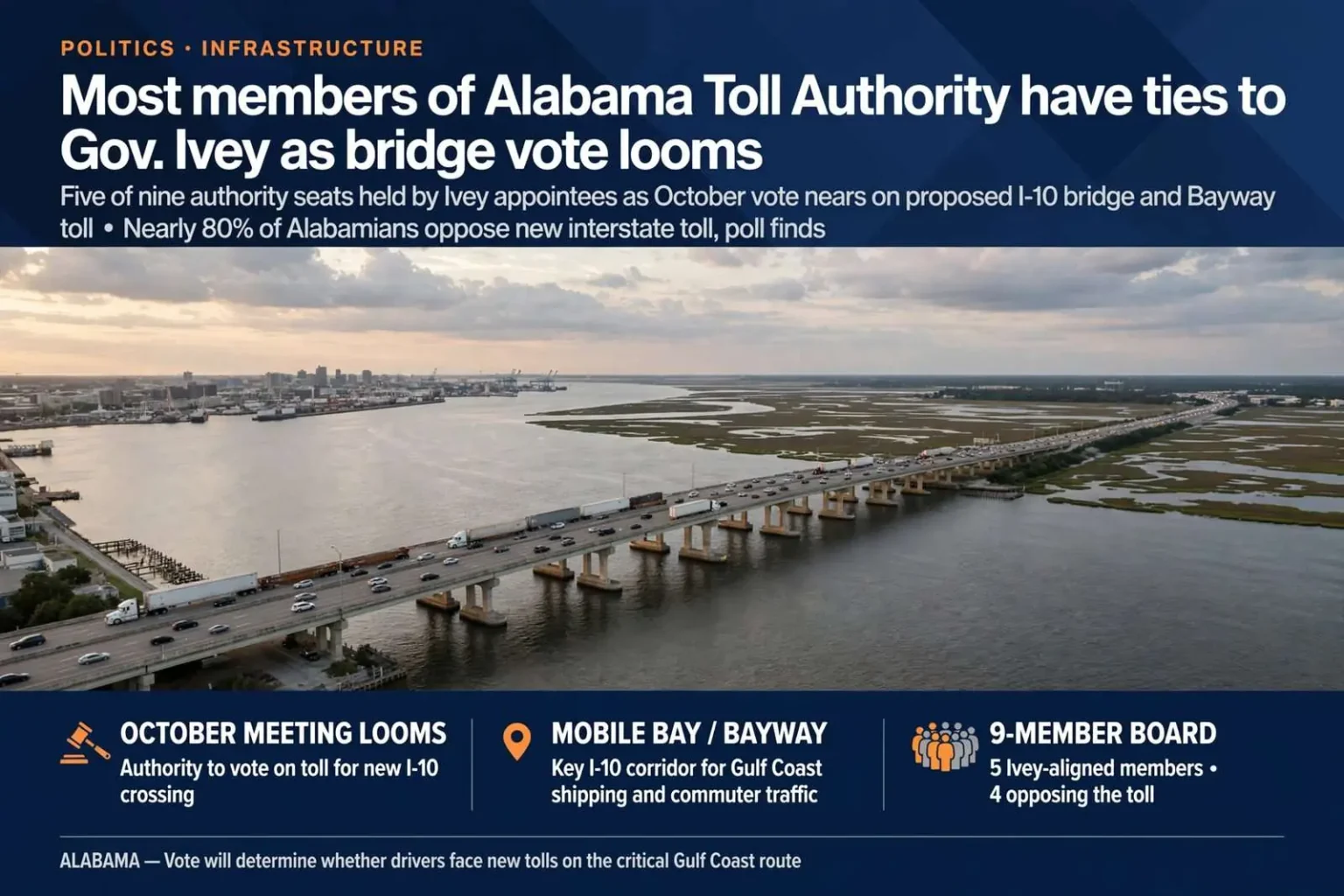
Those hoping to avoid tolls on a proposed new I-10 bridge and Bayway project are unlikely to find relief when the Alabama Toll Road, Bridge, and Tunnel Authority meets in October.
Five of the nine seats on the authority are held by appointees or officials tied to Gov. Kay Ivey, who has made clear she supports the toll. Ivey said last week that it would be wonderful if a toll period were not necessary, but that is not reality.
Ivey sits on the board herself, as do her chief of staff, former Congressman Jo Bonner, and her deputy chief of staff, Liz Filmore. Two additional members — State Finance Director Kelly Butler and Alabama Department of Transportation Director John Cooper — hold positions appointed by the governor.
The arithmetic matters for anyone hoping the authority will block or shrink the toll. With the governor and her two top staffers holding votes outright, and the state’s finance and transportation directors holding two more, a majority is effectively in place before the debate begins. The October meeting will not be a neutral hearing on whether to toll the crossing; it will be a vote among officials whose branches of state government developed the project.
The four votes on the other side
The four remaining members may be more open to a reduced toll or none at all. Lt. Gov. Will Ainsworth publicly came out against the toll this week, and his opposition carries institutional weight: he presides over the Senate and was elected on a platform that included opposing new taxes and fees.
State Sen. Greg Albritton, who lives in Conecuh County but represents part of northern Baldwin County, also serves on the authority, as does House Speaker Mac McCutcheon of Madison County and Ways and Means Committee Chairman Steve Clouse of Ozark. Albritton’s district gives him a direct constituency in the affected area, and his seat on the Senate’s budget committee makes him one of the few members who can pair a vote on the toll with influence over the money that would flow from it. Clouse chairs the House budget committee, meaning the chamber’s chief budget writer also holds a vote. McCutcheon’s district is far from Mobile Bay, but as speaker he speaks for a House whose members from south Alabama have absorbed much of the public backlash.
Even so, a four-vote bloc can only shape the outcome, not control it. If the five Ivey-aligned members hold together, the authority can approve a toll structure over their objections, and the opposition’s practical leverage would shift to the Legislature’s power of the purse and to whatever federal approvals the project still requires.
A statewide backlash with local roots
The toll question has drawn broad opposition across the state. A poll released this week, commissioned by Orange Beach businessman Dean Young, found nearly four in five Alabamians oppose tolling interstates.
The strength of that number reflects more than Gulf Coast geography. Tolling an interstate that carries coast-to-coast traffic strikes drivers who never touch Mobile Bay, and opponents have framed the issue as a question of whether Alabama should charge Alabamians to drive on a road their federal taxes already built. The Eastern Shore communities that sit along the Bayway have organized the most vocal resistance, but the poll suggests the sentiment reaches far inland, into districts whose legislators have taken notice.
Local governments have joined the opposition as well. The Baldwin County legislative delegation and municipal leaders along the Eastern Shore have passed resolutions and spoken against the toll, arguing that it penalizes the very residents whose daily commutes and property taxes support the region’s growth. Spanish Fort, Daphne and other communities nearest the Bayway bear the brunt of both the congestion and the proposed charge, and their councils have made the project a standing agenda item throughout the year. The cumulative effect has turned a regional infrastructure question into one of the most closely followed issues of the legislative interim.
The bottleneck behind the project
For coastal residents and businesses, the issue extends beyond convenience. One official noted the bottleneck on the bay bridge and tunnel affects companies that ship goods along I-10 to Mississippi, Louisiana, Texas and beyond.
The congestion is real and measurable to anyone who has driven the corridor at rush hour. The Wallace Tunnel and the aging Bayway compress interstate traffic into a narrow passage between Mobile and Baldwin counties, and wrecks on either span can stall commerce for hours. Freight companies routing goods along I-10, the principal east-west artery for the Gulf Coast, build that delay into their schedules, and planners in both counties have warned for years that projected growth on the Eastern Shore will make the problem worse without additional capacity.
ALDOT’s answer is a new bridge and an expanded Bayway, financed by tolls collected from the drivers who use them. The agency has argued that a tolled, modern crossing solves the congestion problem faster than any funding alternative available to the state, since Alabama’s fuel taxes are already committed and federal grant programs alone cannot cover the scale of the work. Critics reply that the state should fund the project as it funds other interstates, and that charging a daily fee to cross the bay amounts to a new tax on the region’s commuters.
What happens at the October meeting and after
The authority’s vote would set the stage for the remaining steps in the project. Tolling an interstate requires federal approval, and the U.S. Department of Transportation must sign off before a single toll booth, gantry or camera goes up. That review gives the project’s opponents a second forum after the state’s vote, though federal reviewers generally defer to a state’s judgment on how it finances its own highways.
The Legislature retains its own lever. Members have discussed whether state law can require a referendum, cap the rates or redirect other money to buy the toll down, and budget leaders like Clouse and Albritton are positioned to act on any of it. Ainsworth’s office has floated the idea of legislative action as well, though nothing that would bind the authority has yet passed.
For the residents of Baldwin and Mobile counties, the October meeting is the clearest checkpoint yet in a fight that has run for months. The vote will not end the argument, but it will show whether the state’s structure of boards and appointees, designed to insulate infrastructure decisions from election-year politics, produces the outcome the governor wants or the one four in five Alabamians say they do not.
How the authority works
The Alabama Toll Road, Bridge, and Tunnel Authority exists to finance, build and operate toll facilities for the state, and it was created in part so that Alabama could pursue major projects through revenue bonds rather than direct appropriations. Revenue from tolls pays the debt on the financing, which is why the authority’s composition matters so much: the board decides what gets tolled, at what rates, and on what schedule the debt is repaid.
The board’s makeup also illustrates how state government distributes power. The governor’s seat and her staff appointees give the executive branch a working majority, while the legislative leaders and the lieutenant governor hold the minority, a balance that mirrors the separate roles the Legislature and the governor play in funding state projects. When a board structured that way confronts a contested issue, the vote tends to track the branches of government more than the regions affected, which is largely what opponents of the I-10 toll expect in October.
Jo Bonner’s presence on the board is itself a study in Gulf Coast politics. A former congressman who represented southwest Alabama for a decade before moving into state government, he knows the I-10 corridor and its politics as well as anyone in Montgomery, and his position gives the governor’s office a member who can speak to the district’s concerns firsthand. Liz Filmore and Finance Director Kelly Butler round out the administration’s financial team, and John Cooper brings the Department of Transportation’s engineering and financing staff behind the proposal.
Against that lineup, the opposition’s four votes are led by a lieutenant governor who has made opposition to the toll a signature issue, two legislative budget chairmen who control the state’s checkbook, and a senator whose district includes part of the affected area. It is a strong bloc on paper, but it is a minority, and everyone watching the authority’s October meeting understands what the count means.
Whatever the authority decides, the decision will echo in future infrastructure debates. If the I-10 project proceeds, the authority becomes a permanent actor in Alabama transportation policy; if the toll is stopped or reduced, legislators will have demonstrated that the appointee process can be checked, and both outcomes will shape how the state approaches the next megaproject on its list.


