Motorcyclist Thrown From Bike After Colliding With Van on I-65 Off-Ramp in Mobile
A motorcyclist was thrown from his bike and hospitalized after colliding with a van on the Airport Boulevard off-ramp of I-65 in Mobile, police say.
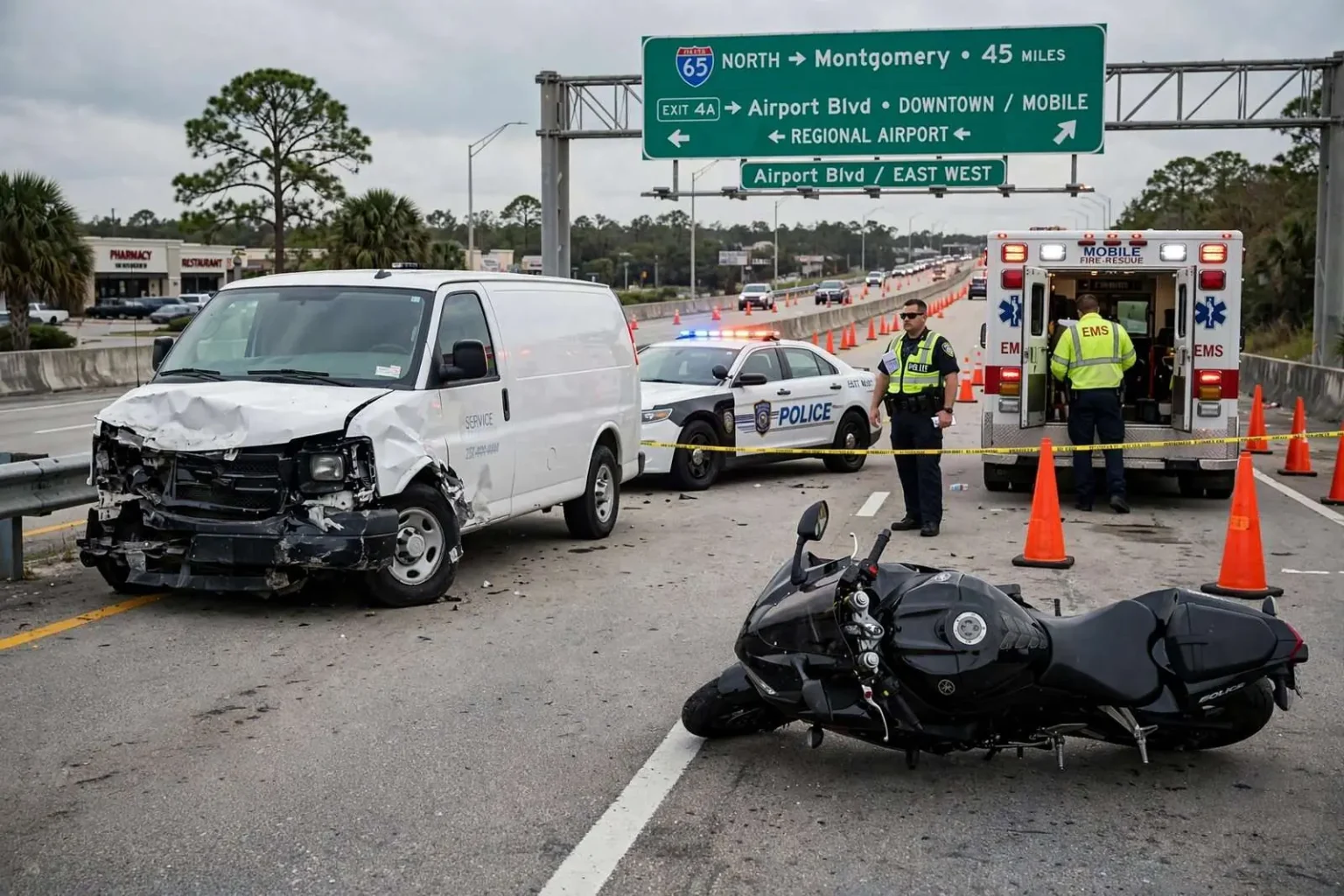
A motorcyclist was hospitalized Friday afternoon after crashing into a van on an Interstate 65 off-ramp in Mobile, according to the Mobile Police Department. The collision happened on the Airport Boulevard off-ramp along the northbound lanes of I-65, and the force of the crash threw the rider from his bike, police said. Emergency crews responded to the scene and transported him to a nearby hospital for treatment. As of Friday evening, authorities had not released an update on his condition.
The crash occurred at a merge point where vehicles slow to exit the interstate onto Airport Boulevard, one of Mobile’s busiest east-west corridors. Police said the motorcycle and the van collided at the ramp, though the department has not said what led up to the collision or whether any citations have been issued. Investigators also have not identified the motorcyclist or the driver of the van, and no further details about the sequence of events were available Friday night.
The stretch of interstate where the wreck happened carries heavy commuter and commercial traffic through the heart of the city. I-65 serves as one of the primary north-south arteries for the Mobile area, connecting the city to Baldwin County via the Mobile Bay area’s interstate network and continuing north toward Montgomery and beyond. Airport Boulevard, meanwhile, is lined with retail centers, restaurants, medical offices and residential neighborhoods, drawing steady local traffic on top of the vehicles exiting the interstate. The combination of high-speed interstate traffic funneling onto a surface road creates one of the more demanding driving environments in the city, particularly during afternoon rush hours.
Why off-ramps are common crash points
Off-ramps like the one where Friday’s crash occurred are familiar trouble spots for interstate wrecks, since they require faster-moving traffic to slow quickly while merging with cross traffic. Drivers coming off a highway often carry excess speed into the ramp’s curve, and they must judge gaps in traffic on the surface street below at the same time. Distraction, following too closely and sudden braking by the vehicle ahead all raise the risk of a rear-end or sideswipe collision in the confined space of a ramp.
Motorcyclists face particular risk in those situations because they have less protection than passengers in a car or van if a collision occurs. A rider thrown from a motorcycle in a crash absorbs the impact directly, and the injuries that follow can be severe even at moderate speeds. Riders are also smaller and harder for other drivers to see in mirrors and blind spots, which matters at merge points where a driver’s attention is split between the ramp ahead and traffic alongside. Safety officials routinely urge both groups to take extra care at interchanges: riders are encouraged to position themselves where they are most visible and to anticipate that drivers may not yield, while drivers are reminded to check twice for motorcycles before changing lanes or merging at ramp terminals.
Friday’s wreck also highlights the routine work of Mobile’s first responders at crash scenes along the interstate network. Police units secure the roadway and begin documenting the scene, while fire and EMS crews assess injuries and arrange transport to area hospitals. Even a two-vehicle collision at a ramp can disrupt traffic flow for a stretch of time, as lanes are narrowed and onlookers slow to pass the scene.
The Airport Boulevard interchange in context
The Airport Boulevard exit is one of several interchanges that tie I-65 into Mobile’s central commercial districts. The corridor takes its name from the Mobile Regional Airport area to the west, and the road runs east toward some of the city’s most heavily traveled shopping and dining zones. Drivers exiting I-65 northbound at the ramp encounter a curve and a merge with local traffic that includes commuter vehicles, delivery trucks and buses. Conditions there change with the time of day, and the ramp sees its heaviest use in the late afternoon when commuters head home from downtown and from job centers along the interstate.
Mobile’s position as a Gulf Coast port city means its interstates also carry substantial commercial traffic. Freight haulers moving between the Port of Mobile, the industrial facilities along the Mobile River and destinations across the region share the roadway with local commuters, and the mix of vehicle types adds to the complexity at merge points. A van and a motorcycle interacting at a ramp is exactly the kind of encounter where differences in acceleration, braking and visibility come into play.
Motorcycle traffic in south Alabama tends to rise with the region’s long warm season, which extends riding weather across most of the calendar year. The Mobile area’s mild winters mean riders are a routine part of traffic even in months when northern states see few motorcycles on the road. Local riding groups and safety advocates have long emphasized awareness campaigns around intersections and interchanges, where the majority of serious motorcycle collisions occur.
What happens next in the investigation
As of Friday evening, Mobile police had not released an update on the rider’s condition, and the department had not identified either the motorcyclist or the driver of the van. Police also had not said whether any citations have been issued. In crashes of this kind, investigators typically reconstruct the sequence of events from physical evidence at the scene, statements from those involved and any witnesses, and damage patterns on the vehicles. That process can take days, particularly if a hospital stay prevents investigators from interviewing one of the parties.
Depending on what investigators find, the case could close with no charges, or it could produce citations or criminal referrals if evidence shows a violation. Until the department issues an update, many questions about the crash remain unanswered, including which vehicle was entering the ramp and which was already on the surface street, and whether speed, visibility or another factor played a role.
For drivers who use the interchange daily, the crash is a reminder of the habits that reduce risk at ramps: slowing to the posted ramp speed before the curve, keeping a following distance that allows for sudden braking, signaling early, and checking mirrors and blind spots for motorcycles before merging. For riders, the guidance is to assume they have not been seen, to avoid lingering alongside vehicles at merge points, and to use lane position and lighting to stay visible.
Motorcycle safety across the region
Collisions involving motorcycles remain a persistent concern on Alabama roadways, and law enforcement agencies across the state regularly publicize safety reminders aimed at both riders and drivers. The state’s helmet law requires all riders to wear approved helmets, and riders are also subject to the same right-of-way and speed rules as other motorists. Even with those protections in place, the physics of a two-wheel vehicle in a collision leave riders far more exposed than occupants of enclosed vehicles, which is why injury outcomes in motorcycle crashes tend to be more serious relative to the speeds involved.
Interchanges and ramps present a specific set of hazards that safety materials have described for years. Traffic on a ramp is transitioning between two very different speeds, sight lines are often limited by barriers, guardrails and curve geometry, and the merge point itself concentrates decision-making into a few seconds. A driver who misjudges a gap or a rider who enters a driver’s blind spot can find themselves with no room to maneuver. Rain, common along the Gulf Coast through the warm months, makes the painted lines and metal expansion joints found on ramps especially slick, further reducing the margin for error.
Emergency response at interstate crashes in Mobile involves close coordination among agencies. Police handle traffic control and the investigation, fire units manage hazards and assist with extrication when vehicles are pinned, and ambulance crews prioritize rapid transport for anyone with traumatic injuries. Riders thrown from their machines are often evaluated for head, spine and limb injuries regardless of whether a helmet was worn, and a hospital transport such as the one in Friday’s crash is standard practice when a rider has been ejected.
The Mobile Police Department’s traffic investigation work in these cases typically follows the collision through to a documented conclusion, whether that is a report closed without enforcement action or a case forwarded for citations. Drivers who witnessed the crash or who have dashcam footage from the area around the time of the incident can provide that information to investigators, and such accounts often help clarify how a collision at a merge point unfolded.
Friday’s crash remains under review, and the department has said additional details will be released when they become available. This story will be updated if further information is provided by the Mobile Police Department. In the meantime, the incident stands as a reminder to drivers across Mobile that the seconds spent slowing down at an off-ramp, checking mirrors and giving motorcycles room are among the cheapest safety measures on the road, and for riders that visibility and defensive positioning at interchanges can make the difference between a close call and a hospital stay.