
MPD: Driver in Fatal Bayway Crash Was Going Wrong Way, Under the Influence
Mobile Police say Shawn Wright was driving the wrong way and under the influence when his vehicle struck and killed Kaytrielle Jones in a Bayway crash.
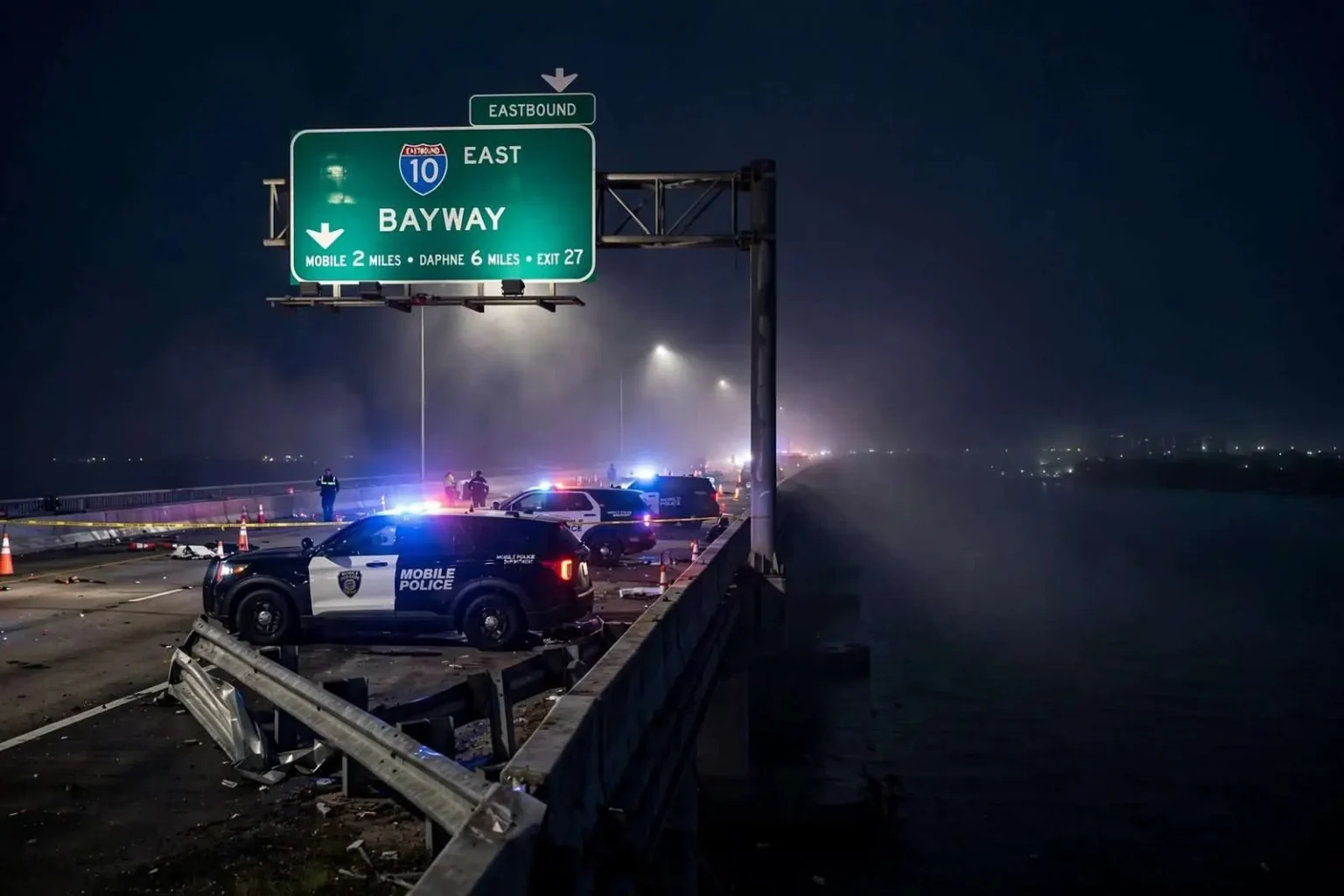
MOBILE, Ala. — Mobile Police have confirmed new details nearly four months after a wrong-way crash on the Bayway killed two people, including a 24-year-old woman whose death drew wide attention to the dangers of the interstate crossing over Mobile Bay. Investigators say Shawn Wright was driving the wrong way when he struck and killed 24-year-old Kaytrielle Jones in the early-morning collision, and they now say Wright was driving under the influence at the time of the crash.
The crash happened around 1:30 a.m. on Jan. 7 in the eastbound lanes, according to the Mobile Police Department, a time of night when the Bayway’s traffic is thin but its risks are at their height. The confirmation of wrong-way travel and impairment came after months of investigative work, nearly four months of which had passed since the collision itself. Police said the investigation remains ongoing, leaving open the possibility of additional findings and, potentially, charges as the case moves through the system.
The Bayway — the long, low bridge that carries Interstate 10 across Mobile Bay — is one of the region’s most vital and most dangerous stretches of highway. Its sweeping curves, its high crosswinds, its frequent fog, and the sheer volume of traffic that funnels across it daily make it a perennial site of serious crashes. But wrong-way collisions are among the rarest and deadliest kinds of highway crashes anywhere, and when they occur at highway speeds in the pre-dawn darkness, the results are almost always catastrophic.
How wrong-way crashes happen
Transportation safety researchers have studied wrong-way driving for decades, and the findings are consistent: impairment is the leading factor. The great majority of wrong-way drivers are under the influence of alcohol or drugs, often severely so, and many wrong-way crashes occur in the late-night and early-morning hours when drivers leaving bars, restaurants, and parties are behind the wheel. Disorientation plays its part — a driver who takes a ramp the wrong direction or turns against the flow of divided traffic — but intoxication is what turns that disorientation deadly.
The victims in these crashes rarely have any chance to avoid the collision. Head-on crashes at combined highway speeds leave occupants with almost no survivable space, and the closing speed of two vehicles approaching each other at 65 miles per hour or more can exceed 130 miles per hour. That physics is why wrong-way crashes, though a tiny fraction of total collisions, account for an outsize share of highway fatalities.
Police said the Jan. 7 crash unfolded in the eastbound lanes, meaning a vehicle traveling against the flow of traffic met oncoming cars head-on in the dark. The around-1:30 a.m. timing fit the pattern that safety researchers have documented: the hours between midnight and 3 a.m. produce a disproportionate share of wrong-way crashes nationwide. In the darkness, an approaching pair of headlights in your own lane may not register as a threat until it is far too late to react.
Months of investigative work
The nearly four months between the crash and the confirmation of these details reflects the pace of major-collision investigations. Investigators must document the scene, reconstruct the crash from physical evidence, and await toxicology results — a process that routinely takes weeks or months before findings are made public. Toxicology testing in particular is slow, passing through certified laboratories, and its results often supply the decisive facts in impairment cases. Only after those results and the reconstruction are complete do investigators confirm publicly what they believe happened.
Driving under the influence in Alabama is a serious offense on its own, and when a DUI driver causes a fatal crash, the potential charges escalate dramatically. Alabama law allows homicide charges arising from vehicle crashes involving impairment, and prosecutors weigh the toxicology findings, the reconstruction, and the driver’s history in deciding what to charge. Those decisions belong to the district attorney’s office, and until charges are filed and tested in court, police statements about a crash remain investigative findings rather than judicial conclusions.
For the family of Kaytrielle Jones, the confirmation of the new details marked a painful milestone — a fuller accounting of what happened in the darkness on the Bayway, four months after the night that took her life. Families of crash victims often follow the investigative process closely, pressing authorities for answers and for accountability, and the finding that a suspected impaired driver was traveling the wrong way gives the case a clear direction as it moves forward.
The Mobile Police Department said the investigation remains ongoing, and further details will be released as they are confirmed. In the meantime, the case stands as another entry in the region’s long effort to understand and prevent the deadly combination of impairment, darkness, and highway speed — a combination that on Jan. 7, on the Bayway over Mobile Bay, cost two people their lives.
The Bayway’s safety record has been the subject of attention for years. The bridge and its approach spans carry not only the daily commute between Mobile and the Eastern Shore but also the heavy freight traffic of Interstate 10, the primary east-west route across the Gulf South. Fender-benders and multi-vehicle chain-reaction crashes are routine occurrences, particularly in fog events and holiday traffic, and the Alabama Department of Transportation has over the years implemented safety measures ranging from signage and lighting to traffic management during low-visibility conditions.
Wrong-way prevention has become a specific focus of highway agencies across the country. Departments of transportation have installed enhanced wrong-way signage, radar-equipped warning systems that flash alerts when a vehicle enters an exit ramp against the flow, and pavement markings designed to catch a disoriented driver’s attention. Research has shown that some wrong-way drivers self-correct before reaching oncoming traffic — the warning systems aim to reach them in that window — but once a wrong-way vehicle is on the mainline at speed, other drivers and the seconds remaining offer little hope of prevention.
The human toll
Behind every such case stands a family and a community processing a loss that arrived without warning. A 24-year-old with her life ahead of her, killed by a driver heading the wrong way in the dark — the fact pattern repeats across Alabama and the nation with grim regularity, and each instance renews the calls from safety advocates and grieving families for stronger enforcement of DUI laws and more aggressive prevention of impaired driving.
Law enforcement agencies in the Mobile area conduct DUI enforcement continuously — patrols, checkpoints, and saturation details timed to the hours and seasons when impaired driving peaks. Yet enforcement, however vigorous, works after the fact of impairment. The finding that the Bayway crash driver was under the influence underscores the gap that enforcement alone cannot close: the decision to drive impaired is made in the moments before the keys are picked up, and no roadside checkpoint can reach a person who never encounters it.
Mobile police officials have encouraged anyone who witnessed the crash or who may have recorded dash-camera or phone video from the Bayway that night to contact investigators or the department’s tip lines. In major-collision cases, fragments of video from passing motorists frequently supply the detail that reconstructs cannot, and investigators treat every additional source of information as worth pursuing, no matter how much time has passed since the incident.
The case also illustrates the patience the justice system demands of victims’ families. An ongoing investigation, followed by charging decisions, then the slow machinery of the courts, can stretch the path to accountability across years. Families in similar cases across Alabama have spoken of that period as a second ordeal — the first the loss itself, the second the long wait for the system to weigh what happened.
A warning that recurs
Every wrong-way crash on a major Gulf Coast highway produces the same public reminders: never drive impaired, plan a safe ride before the night begins, and if you encounter a vehicle coming toward you on the highway, move to the right shoulder — most wrong-way drivers, disoriented, stay in what they believe is the right lane, which to oncoming traffic is the left. Safety experts teach drivers that falling to the right at the sight of wrong-way headlights offers the best chance of escape.
For now, the facts confirmed by Mobile Police stand: a wrong-way driver, under the influence, around 1:30 a.m. on Jan. 7, in the eastbound lanes of the Bayway, and two people dead — among them Kaytrielle Jones, 24. The investigation continues, and the department has asked anyone with further information about the crash to come forward as the case proceeds toward whatever resolution the evidence supports.
As the region absorbs another deadly night on the Bayway, the case joins the region’s long ledger of impaired-driving tragedies — and its lesson is the one that every such crash repeats: the difference between an ordinary night and a catastrophe can be a single wrong turn made by a driver who should never have been behind the wheel at all.