Undisclosed Second Autopsy Report at Center of Murray Lawrence’s Rule 32 Petition
An undisclosed second autopsy of Brandon Hastings is the basis of a Rule 32 petition challenging Murray Lawrence's conviction; the state calls it harmless error.
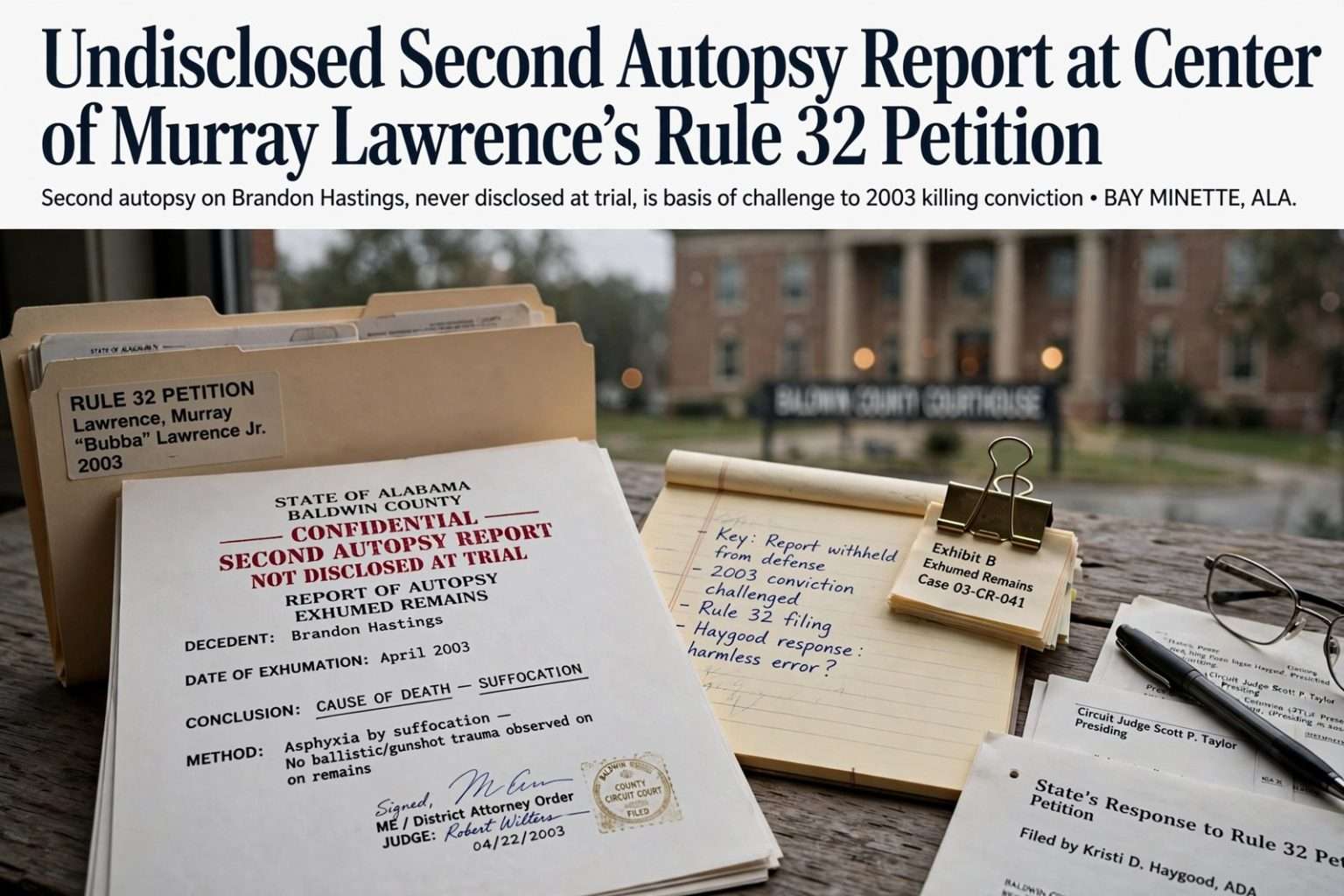
BAY MINETTE, Ala. — A second autopsy report on Brandon Hastings that was never disclosed at the trial of Murray “Bubba” Lawrence Jr. is the basis of a Rule 32 petition challenging Lawrence’s conviction in Hastings’ 2003 killing.
Lawrence was sentenced to life without parole more than 18 years ago and has been in prison for about 20 years. Advocates working on his behalf located the report, which concerns Hastings’ exhumed body. It was ordered by the district attorney and signed by the judge overseeing the case but was not revealed during the trial.
Lawrence’s supporters contend the report supports suffocation, rather than a gunshot, as the cause of death. The state disputes that the omission affected the outcome.
Officials involved in the original case
The judge in Lawrence’s trial was Robert Wilters, who is now the Baldwin County district attorney. Hoss Mack, now the Baldwin County sheriff, was the lead investigator, and David Whetstone was the prosecutor.
Circuit Judge Scott P. Taylor is assigned to the petition. A Rule 32 petition, filed under Rule 32 of the Alabama Rules of Criminal Procedure, allows a person to challenge a conviction in the court where it occurred, generally after appeals have become final.
The state’s response
The state’s response was filed by Kristi Deason Haygood, an assistant district attorney in Wilters’ office.
“(I have) no explanation for why this report was not disclosed. It was certainly a violation of the discovery order in this case for the state not to disclose this second autopsy report,” Haygood stated in the state’s objection. The state characterized the failure to disclose the report as harmless error.
Haygood noted in the response that when the Alabama Court of Criminal Appeals reviewed the case, it found that co-conspirator testimony against Lawrence was corroborated and that additional circumstantial facts indicated Lawrence shot Hastings.
The response also cited trial testimony, including:
- A witness who testified that Lawrence showed her a pistol the day before the April 5, 2003, killing and said he was going to shoot it the following night and kill somebody.
- Witnesses at an apartment complex who testified they saw Lawrence drive up and retrieve a pistol from his trunk.
- A witness who told law enforcement that Lawrence had told her Jarius McNeil had been charged with murder and that a weapon had been given to a neighborhood youth to hide.
Supporters dispute the state’s account
Lawrence’s supporters dispute several points in the response. They say Lawrence had a permit for his weapon and that no gun was identified as the murder weapon. They say the trial transcript shows Lawrence went to the apartment complex on the Sunday night after the killing, not the night of the killing.
They also say the weapon referenced in the witness’s statement about a neighborhood youth was a gun stolen in Fairhope that was unconnected to the killing, and that Lawrence’s father retrieved it and turned it over to Fairhope police at their request.
Traffic stop and lineup identification
Supporters also point to a Fairhope police traffic stop at 5:01 a.m. on the night of the killing. A woman who was stopped testified that she saw Lawrence at around 4:30 to 4:45 a.m., before the stop. Prosecutors had said Lawrence and McNeil drove to Mississippi to dispose of the body, a round trip of about three hours and 15 minutes. The officer who made the stop, Wendall Thomas, did not testify at trial.
Supporters further say a co-worker of Hastings in Foley identified McNeil in a lineup as being with Hastings in Hastings’ car at about 1:30 a.m. on April 5, but that she did not testify at trial.
The court has not ruled on the petition.