
Museum Nights Turns the Mobile Museum of Art Into a Comedy Club
The Mobile Museum of Art's March 2011 Museum Nights featured free improv comedy from ICU in the Grand Lakefront Lobby, with Palette Cafe table service.
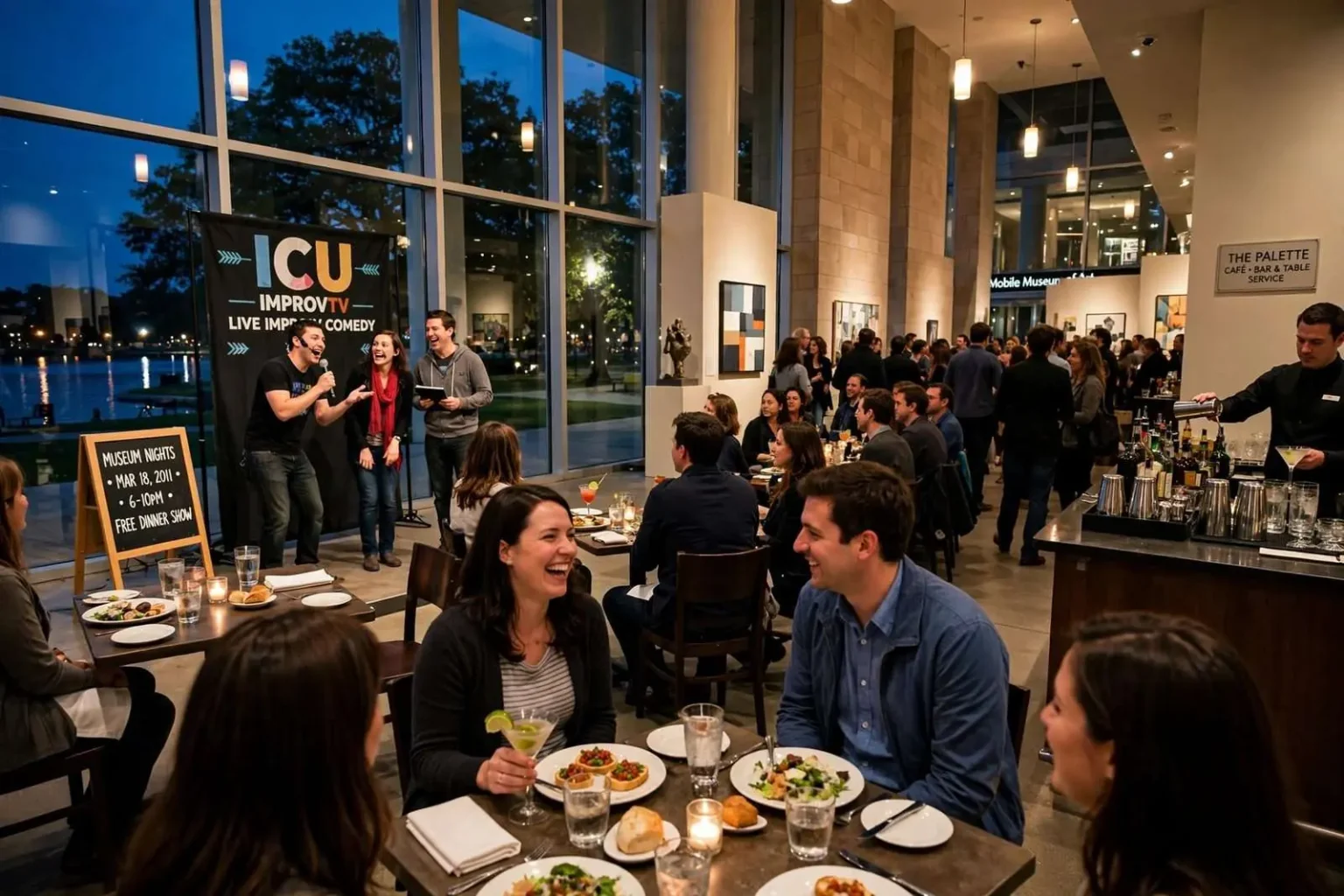
The Mobile Museum of Art traded quiet galleries for unscripted laughter as its Museum Nights series returned with an improv comedy show on Friday, March 18, 2011, from 6 to 10 p.m. at the museum’s Langan Park campus at 4850 Museum Drive. The evening marked the second installment in the series, which the museum uses to pull after-dark crowds into a building that has long anchored the cultural life of west Mobile. Rather than an opening reception or an evening lecture, guests this time got something considerably looser: a seated dinner show built around comedy made up entirely on the spot, staged against the backdrop of the museum’s lakefront views.
Museums across the country have spent the past decade working to shed the perception of the art museum as a strictly daytime, look-but-don’t-touch institution, and the Mobile Museum of Art has been no exception. Evening programming such as Museum Nights is designed to reach an audience that might never wander into the galleries during regular hours — young professionals, couples looking for a night out, and residents who think of Langan Park as a place for picnics and paddle boats rather than paintings. By pairing the collection with social events, the museum gives first-time visitors a low-pressure reason to walk through the doors, and regulars a new way to experience a familiar space. The improv night followed that formula exactly: art first, but entertainment close behind.
The choice of comedy for the series’ second outing was a deliberate change of pace. Where a typical museum evening might center on an exhibition or an artist talk, an improv show turns the audience into collaborators, and the format lent itself to the casual, social atmosphere organizers wanted. Visitors could arrive after work, settle in with a plate of food and a drink, and watch a full performance unfold without ever stepping onto a rigid schedule. For a museum that sits in the middle of one of Mobile’s most heavily used public parks, the event doubled as a reminder that the campus is a gathering place for the whole community, not just for devoted art patrons.
A Dinner Show on the Lakefront
Admission to the event was free, with food and drink available for purchase — a structure the museum has used repeatedly for its evening programs, since it removes the ticket barrier while still letting guests support the institution through their orders. The show itself was staged in the museum’s Grand Lakefront Lobby, one of the most distinctive spaces on the campus, which looks out over the water at the heart of Langan Park. The lobby’s open floor plan made it a natural fit for a seated dinner show, allowing tables to be arranged with sightlines to the performers while keeping the relaxed feel of a supper club rather than a formal theater.
The museum’s on-site restaurant, The Palette Café, handled the food service for the night, offering table service with a menu of appetizers and entrees. For regulars at museum events, the café is a familiar amenity — it operates inside the facility and serves both day visitors and special-event crowds, which means guests at Museum Nights could order a full meal without leaving the building. Table service during a performance is a step beyond the usual museum café counter, and it reinforced the dinner-show framing: attendees were encouraged to settle in for the evening, eat, drink, and watch the show at their own pace rather than grab a quick snack between gallery visits.
A cash bar rounded out the hospitality, pouring a lineup that included specially created martinis mixed for the night. Signature cocktails have become a staple of museum fundraising and social events nationally, giving organizers a small branding opportunity and guests something to talk about, and the Mobile Museum of Art embraced that tradition with the custom martini menu. The combination of a full bar, a working restaurant, and a lakefront setting put the evening closer to a night out in downtown Mobile than to a typical museum function — which was precisely the point for a series built around changing who shows up at the museum and when.
ImprovTV Takes the Stage
The comedy came courtesy of improv troupe ICU, whose members performed using a format called ImprovTV. The premise is a demanding one even for experienced improvisers: the performers undertake to build an entire 60-minute television program on the spot, with nothing scripted in advance. As the show unfolds, they weave random suggestions shouted out by the audience into the material, turning whatever the crowd offers — occupations, phrases, situations, oddball one-word prompts — into segments of the imaginary broadcast. The result plays out less like a stand-up set and more like a channel-surfing session through a late-night lineup that exists only in the room, with the troupe flipping from one improvised segment to the next while keeping the overall program coherent.
Formats of this kind put a premium on the ensemble’s ability to listen and to commit. In a typical improv performance, a troupe takes a single audience suggestion and builds a scene from it; in a program-length format like ImprovTV, the performers must sustain an hour of material, callback to earlier jokes, and keep track of the fictional TV show’s internal logic as audience suggestions keep arriving. That marathon quality is part of the appeal for spectators, who effectively co-author the show. No two performances of an audience-driven format are alike, which gives regulars a reason to come back and gives the troupe a way to perform for the same crowds repeatedly without the material going stale.
For Mobile audiences, the appearance of a dedicated improv troupe inside the museum also highlighted the health of the city’s live comedy scene at the time. Improv thrives on proximity — troupes need regular stage time, willing audiences, and venues flexible enough to host unscripted shows — and cultural institutions such as the Mobile Museum of Art provided exactly that kind of platform. Staging the performance in the Grand Lakefront Lobby rather than a conventional theater space also blurred the line between performer and spectator; without a raised stage or house lights, the audience suggestions came from tables only a few feet from the action, and the performers worked the room as much as they worked the format.
Why a Museum Hosts a Comedy Night
Programming like Museum Nights reflects a broader shift in how mid-sized American museums approach their communities. Institutions that once counted success in school-tour headcounts now measure it in repeat visits from adults across every age group, and the most reliable way to reach those visitors is through events that feel like entertainment first. A comedy night costs a museum relatively little to stage — the performers, the lobby, the café, and the bar were already in place — yet it introduces the institution to hundreds of people who may never have considered a museum an evening destination. Once inside, those guests are surrounded by the permanent collection on their way to the show, which is exposure no advertisement can buy.
The timing of the March 18 event also made practical sense for Mobile. A Friday evening slot from 6 to 10 p.m. captured the after-work crowd and left the rest of the weekend free, and the early spring calendar put the event ahead of the city’s heavy festival season, when competing events crowd every weekend. For a museum situated in Langan Park, well west of the downtown entertainment districts, drawing a Friday-night audience required giving people a reason to make the drive — and a free improv dinner show with table service was designed to do exactly that.
Planning an Evening at the Museum
The event was limited to guests 18 and up, a restriction that signaled the adults-only tone of the evening and kept the dinner-show atmosphere distinct from the museum’s family programming. While reservations weren’t required, seating in the lakefront lobby was limited, and the museum strongly encouraged booking ahead by phone — a common arrangement for free events, which otherwise fill on a first-come basis and can leave late arrivals without seats. The combination of free admission, an adults-only crowd, and limited seating created the kind of intimate setting that suits improv best, where performers feed off a room they can see and hear in its entirety.
The setting itself is part of the museum’s draw. The Mobile Museum of Art sits on the shore of the lake at Langan Park, the 720-acre municipal park in west Mobile that also holds playgrounds, walking paths, picnic areas, and the city’s environmental studies areas. The museum, which traces its roots to the early 1960s and has grown into the Gulf Coast region’s largest art museum between New Orleans and Tampa, houses a collection that spans centuries and continents, from American paintings to European works and decorative arts. That scale makes it unusual among Gulf Coast cultural institutions, and it gives events like Museum Nights a setting no nightclub or restaurant in the area can replicate.
For the museum, the second Museum Nights installment served as both entertainment and experiment. If the improv format drew the crowds organizers hoped for, it would earn a place alongside the exhibitions, classes, and receptions that already fill the museum’s calendar, and it would shape what future installments of the series looked like. Either way, the March 18 show made the case the series exists to make: that an evening at the Mobile Museum of Art can compete with any night out in the city — with the added bonus that, on this occasion, the entire program was invented on the spot, by performers and audience together, one shouted suggestion at a time.


