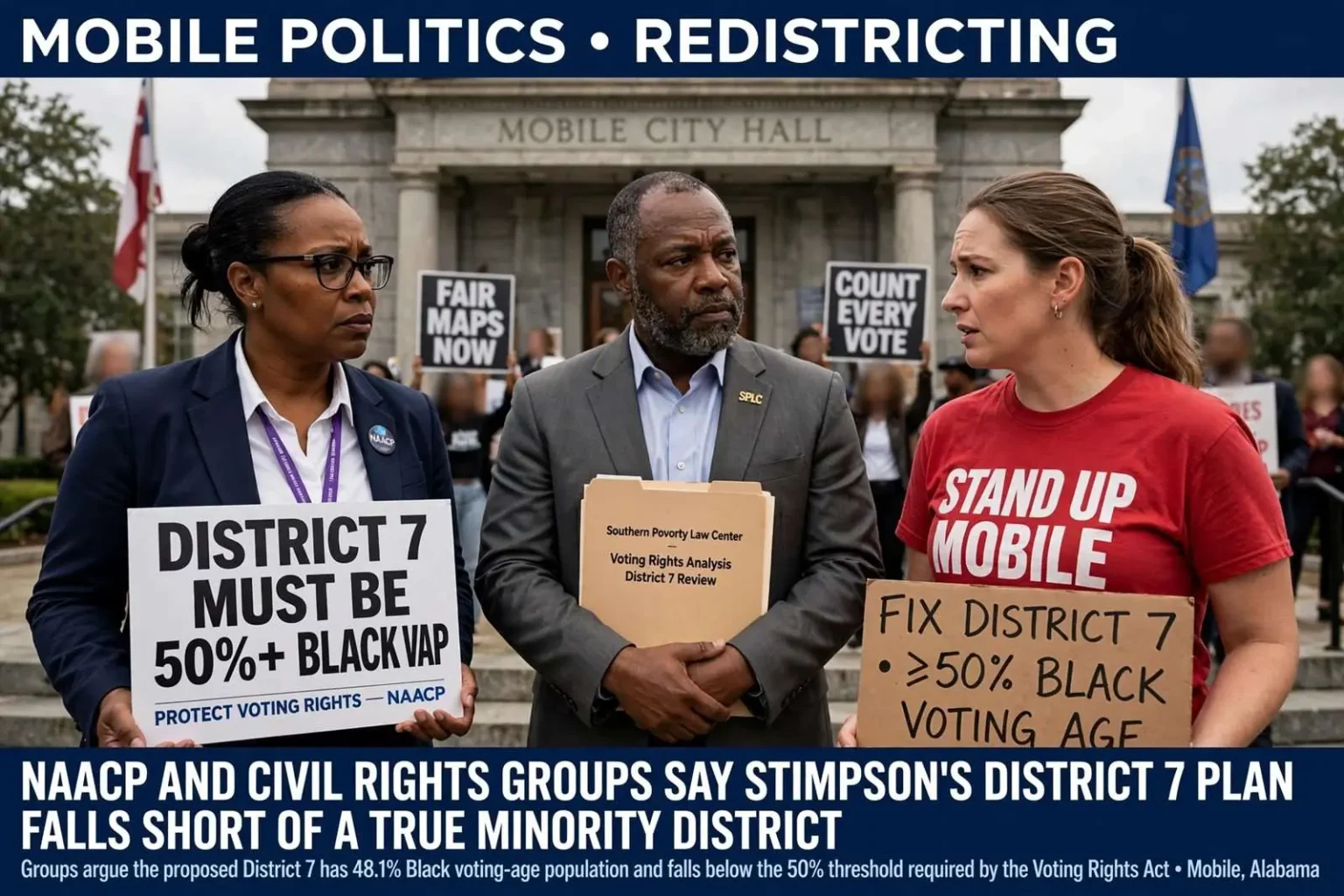
The Mobile NAACP has joined the Southern Poverty Law Center and Stand Up Mobile in opposing Mayor Sandy Stimpson’s proposed redistricting plan, arguing that the plan’s proposed fourth Black-majority district does not meet the legal threshold for minority representation.
Every ten years following the U.S. Census, Mobile must redraw the boundaries of its seven city council districts to reflect updated population data. According to the latest Census count, the city is more than 51% Black and almost 44% white. Among voting-age residents, 48.4% are Black and 44.4% are white.
Stimpson’s plan calls for four of the seven districts to have more Black voters than white voters, which the mayor said would ensure that the city council, for the first time ever, would have four Black representatives and three white representatives.
Groups Say District 7 Falls Short of Voting Rights Act Requirements
The major point of contention is District 7, which the mayor identified as the proposed fourth Black district. Under Stimpson’s latest proposal, District 7 would have a voting-age population of 48.1% Black and 45.4% white. African American and voting rights groups said the Black population should be at least 50% in District 7 to comply with the Voting Rights Act.
“Under 50% is not compliant with the Voting Rights Act,” said Beverly Cooper with Stand Up Mobile, noting that she was referring to 50% of the voting-age population. The NAACP cited the U.S. Supreme Court’s ruling in Bartlett vs. Strickland, which held that minorities must constitute at least 50% of a district’s voting-age population for it to be considered a majority-minority district.
Cooper added that because Black voter turnout in Mobile has historically been lower than white turnout, the percentage may need to be even higher — potentially 52% to 55%.
The turnout point gets at the difference between a district’s population and its actual electorate. A district where Black residents make up 48.1% of voting-age adults but turn out at lower rates can still produce a white-majority electorate on election day, which is the practical test that decides who wins the seat. That is why voting rights advocates treat the Census percentages as a floor rather than a guarantee, and why they argue a truly competitive Black district needs a cushion above the 50% line to absorb year-to-year differences in turnout.
Supporters of the mayor’s plan note that District 5, considered a “white” district, actually has a higher African American population at 42.5% compared to 46.6% Black in District 7. They argue that the plan’s overall numbers — four districts with Black population majorities and a map that concentrates rather than dilutes Black voting strength — represent a good-faith reading of the Census data and a step forward for a council that has never seated four Black members.
How the Redistricting Fight Fits the Law
The legal framework behind the dispute dates to the 1980s, when the Supreme Court set out the test for minority vote dilution claims under Section 2 of the Voting Rights Act. A group challenging a districting plan must generally show that the minority group is large and geographically compact enough to constitute a majority in a district, that it is politically cohesive, and that white voters vote sufficiently as a bloc to defeat the minority’s preferred candidates. Bartlett vs. Strickland, the ruling the NAACP cited, resolved the first of those factors: without a numerical majority of voting-age population, the claim generally cannot proceed, no matter how close the numbers come.
That requirement is what makes District 7’s precise percentages the heart of the debate. A map that creates a fourth district at 48.1% Black voting-age population looks, to the groups opposing it, like a district that could not survive a legal challenge if it were the only route to representation — and a district that might not elect a Black candidate at all in a typical election. To the plan’s supporters, the same numbers represent the best achievable alignment given where the city’s population actually sits.
Redistricting fights of this kind play out in cities across the South each decade, and the pattern is familiar: population shifts leave once-solid districts scrambling, and the question of how many effective minority districts a map must contain gets argued in public hearings before it is ever argued in court. Mobile’s seven single-member districts each elect one council member, so the drawing of each line directly determines who can realistically run and win in every part of the city.
The Stakes for City Government
The composition of the council shapes everything that follows from it — the budget, zoning decisions, policing priorities, and the appointment of boards that run the city’s utilities and port-related assets. Mobile’s mayor and council share power over those decisions, and district lines determine not only who is elected but how neighborhoods are grouped together in coalition once they are. A council with four Black members for the first time would mark a historic shift in a city whose population is now majority Black; whether the proposed map would actually deliver that outcome at the ballot box is the precise question the opposing groups are raising.
City leaders have historically pointed to growth in minority representation on the council over the decades as evidence of progress, while civil rights groups have pointed to the same history to argue that only district lines with genuine Black majorities have ever produced and sustained that representation. The disagreement over District 7 is, at bottom, a disagreement about which reading of the law should govern this decade’s map.
For now, the opposition groups are pressing their case in the public process that surrounds any redistricting plan, arguing that the mayor’s proposal should be revised before it is adopted. The alternatives they point to are concrete: adjust the District 7 boundaries to lift the Black voting-age population comfortably above 50%, or accept a map with three such districts. The outcome will set the shape of Mobile’s council districts — and, very likely, the composition of its government — for the next ten years.
The coalition lining up against the plan is notable for its breadth. The Mobile NAACP brings the nation’s oldest civil rights organization and its history of litigation over local election systems; the Southern Poverty Law Center, headquartered in Montgomery with deep experience in voting rights cases across the Deep South, brings legal muscle; and Stand Up Mobile brings a grassroots city presence rooted in the neighborhoods whose lines are being drawn. Groups with that combination have historically been able to keep redistricting disputes alive well past the map’s adoption, through administrative challenges and, if necessary, federal court.
The Census numbers underneath the fight also explain why the stakes feel so high this decade. A city that is barely majority Black by total population, and roughly evenly split among its voting-age adults, sits near the tipping point where small boundary shifts decide whether the map yields three Black districts or four — and, by extension, which coalition controls the council. Cities in that position tend to see every subsequent question, from annexation to development patterns, through the lens of what it does to the next decade’s map.
What Each Side Wants Next
The opposing groups have asked that District 7 be redrawn before the plan moves forward, and their stated benchmark is unambiguous: a Black voting-age population above 50%, and preferably well above it once historical turnout is considered. They have framed the issue not as opposition to Black representation but as opposition to a map that manufactures the appearance of it — a district that counts as majority-Black on a spreadsheet but not at the polls.
Mayor Stimpson’s office, for its part, has presented the plan as an honest response to the new Census figures and a historic opportunity, noting that no Mobile council has ever seated four Black members and that the proposed map would make that possible for the first time. Supporters have also argued that the districts’ shapes follow recognizable neighborhood and geographic boundaries, which they present as evidence the map was drawn in good faith rather than gerrymandered to any political end.
Between those positions sits the practical reality of the redistricting calendar. Council districts must be finalized in time for the next round of municipal elections, and every month of public debate compresses the schedule for qualifying and campaigning. That time pressure cuts both ways: it gives map opponents leverage to demand changes before adoption, and it gives the plan’s supporters an argument that the city cannot afford to restart the process from scratch.
The fight also echoes beyond the council chambers. Mobile County’s school board, commission, and legislative districts are all drawn with an eye toward the same population data, and a legal standard established in the city’s map fight would shape how those bodies draw their own lines. Civil rights groups have historically treated municipal redistricting as the proving ground for the region’s broader election-law disputes, and the arguments being made about District 7 — population percentages, turnout history, and the Bartlett vs. Strickland threshold — are the same ones that appear in county and state map fights across Alabama.
For Mobile residents, the practical takeaway is that the shape of District 7 is not a technical detail but the difference between a council that reflects the city’s population and one that falls short of it, depending on which side’s reading of the law prevails. The groups opposing the plan have committed to continuing their challenge, and the mayor’s office has defended its map as compliant and historic. The final lines will decide not just this decade’s map but who holds power in the city through the one that follows.