One month out: Gulf Shores counts down to the 53rd National Shrimp Festival
The 53rd National Shrimp Festival runs Oct. 8-11 in Gulf Shores with free admission and, for the first time, an all-domestic seafood menu. The City Council urged residents to get involved, and volunteer spots remain open.
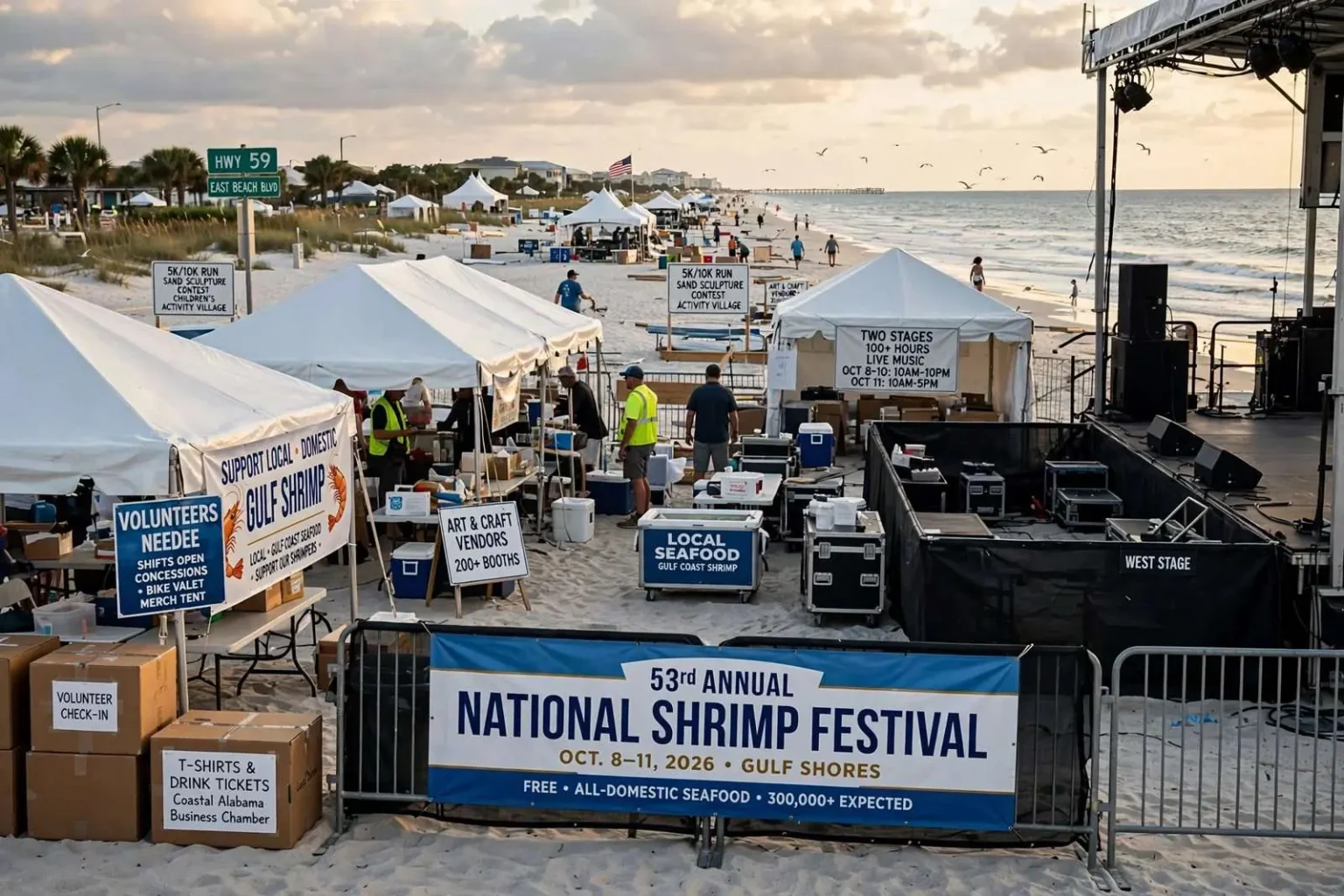
GULF SHORES, Ala. — The countdown is on. In one month, the public beach at the intersection of Highway 59 and East Beach Boulevard will fill with tents, stages, art booths and the smell of frying seafood as the 53rd Annual National Shrimp Festival takes over the sand.
The festival runs Thursday through Sunday, Oct. 8–11, 2026. It is free, it lasts four days, and organizers are preparing to welcome more than 300,000 visitors — a figure that puts a crowd larger than any city in Alabama onto a stretch of public beach over a single long weekend.
It is billed as Alabama’s original beach party, and it has earned the description. But the festival did not begin as a party. It began as an answer to a problem, and understanding that problem is the best way to understand why an event like this exists at all.
Latest developments: All-domestic seafood, a council push and open volunteer spots
With the festival a little more than a week away, organizers and city leaders have added several new details for visitors and residents.
Every plate of seafood will be domestic
For the first time, the festival has committed to a food lineup built entirely on domestic seafood. The festival’s food chairman confirmed that all seafood served this year will be locally sourced and domestic, a step organizers describe as a way to better support local suppliers. Food vendors will serve shrimp prepared a variety of ways, along with other seafood dishes and plenty of non-seafood options for those who prefer them.
The pledge carries particular weight at an event founded to honor the commercial shrimpers working Alabama’s coast. Domestic shrimpers along the Gulf have long competed with lower-priced imported shrimp, which makes up the large majority of the shrimp eaten in the United States. Alabama law already requires restaurants and other food service businesses to tell customers when the seafood they serve is imported, and keeping the festival’s menu domestic puts the event’s buying power behind the same fleets it was created to celebrate.
City Council encourages residents to get involved
The Gulf Shores City Council spotlighted the festival during its regular meeting on Sept. 28. Council members urged residents to take part, and city officials described the festival as one of Gulf Shores’ most significant annual initiatives.
More on the program
The festival grounds sit at 101 Gulf Shores Parkway, at the intersection of Highway 59 and East Beach Boulevard, and admission remains free. Beyond the food and the two entertainment stages, which will feature country, classic rock, jazz and other genres, this year’s program includes:
- A 5K and 10K run and walk
- The Sand Sculpture Contest
- A Children’s Activity Village
- A bike valet for attendees who pedal to the beach
- The Miss Shrimp Festival Pageant
- Art and shopping vendors offering paintings, sculpture, jewelry and handmade crafts
The Coastal Alabama Business Chamber, which runs the festival, relies on hundreds of local volunteers to staff it, and volunteer spots are still open for residents who want to help.
Update: Festival hours and music lineup announced
With the festival days away, organizers have released gate hours and the highlights of this year’s entertainment schedule.
Gate hours
- Thursday, Oct. 8, through Saturday, Oct. 10: 10 a.m. to 10 p.m.
- Sunday, Oct. 11: 10 a.m. to 5 p.m.
The festival grounds sit at the Gulf Shores Public Beach, where Highway 59 meets the Gulf of Mexico. Beyond the seafood, organizers point to the festival’s children’s activities, fine arts and crafts vendors, a retail marketplace and live entertainment as major draws.
Two stages, more than 100 hours of music
Organizers have scheduled more than 100 hours of entertainment on two stages, one at the east end of the grounds and one at the west end. Music starts when the gates open at 10 a.m. and runs until 10 p.m. on Thursday, Friday and Saturday. As in past years, the lineup spans blues, Motown, Southern rock, jazz, Americana and country.
- Regional acts: Dr. Zarr’s Funk Monster, Bag of Donuts and The Molly Ringwalds are on the schedule.
- Saturday headliner: The Velcro Pygmies take the stage at 8 p.m. Saturday, Oct. 10. “The Velcro Pygmies are the old Van Halen for a new generation,” frontman Cameron Flener said.
- Sunday finale: Local bands The Groovinators and the Veronica Jean Trio, which is scheduled for 3:30 p.m., will close out the festival on Sunday.
Volunteer shifts are also still available in concessions, bike valet, the merchandise tent, the 5K Run/Walk and the information tent. Volunteers receive a Shrimp Festival poster T-shirt and two drink tickets, and tips collected by concession volunteers go to local nonprofits.
The original preview follows.
The basics
Here is the essential information for anyone planning to go:
- What: The 53rd Annual National Shrimp Festival
- When: Oct. 8 through Oct. 11, 2026 — four days
- Where: The public beach at the intersection of Highway 59 and East Beach Boulevard in Gulf Shores
- Cost: Free admission
- Who runs it: The Coastal Alabama Business Chamber
- Expected turnout: More than 300,000 visitors
The location is not incidental. Highway 59 is the road that carries traffic south into Gulf Shores, and it ends at the beach. Putting the festival at that intersection places it at the literal terminus of the route most visitors take to reach the coast — the point where the drive stops and the Gulf begins.
A fishing village with an empty calendar
To understand the National Shrimp Festival, you have to go back to the early 1970s. Gulf Shores then was a fishing village — small, closely bound together, and living on an economy that ran hard for part of the year and barely at all for the rest.
The seasonality was the whole difficulty. Once school started in September, the town faced a quiet, difficult stretch that people in the tourism business call the shoulder season — the weeks after the summer crowds go home and before the next wave arrives. In Gulf Shores at that time, virtually no revenue came in until spring break.
That is a brutal calendar for a small community. A business that earns its living in a compressed summer has to carry itself through the rest of the year on what it made in those months. Employees who work full time in July have nothing to do in October. Property that generates income in the summer sits idle. The problem is not that money is scarce overall; it is that the money arrives all at once and then stops.
The shoulder-season gap is a structural feature of seasonal coastal economies, not a temporary downturn. It does not fix itself by waiting. The only way to address it is to give people a reason to come during the months when they otherwise would not — which is precisely what a festival held in October is designed to do.
A clipping, a conversation and a question
The spark came in 1970, and the origin story is unusually specific for an event of this size.
A Gulf Shores resident named Lillian Bemis visited the Blessing of the Fleet in Bayou La Batre, the long-standing ceremony held in Alabama’s shrimping community across Mobile Bay. What struck her was the crowd: 20,000 people had turned out.
Bemis brought a clipping about the event to Bill Prime, director of the local Tourist Association Board, and suggested that Gulf Shores do something similar. As the conversation developed, the group noted that other coasts had built festivals around their own seafood — clam festivals, mullet festivals — and arrived at the obvious conclusion.
“Well, then we should have a shrimp festival,” the group asked.
The reasoning was sound in a way that has held up for more than half a century. A festival works best when it is about something real. Gulf Shores did not need to invent a theme; it had commercial shrimpers working out of its waters, and it had a product that people would drive to eat.
Volunteers, 1971
The first festival was put on in 1971 by a committed group of volunteers from the community.
It was established to recognize the commercial shrimpers working locally — the people whose labor held up the coast’s economy. That framing is worth sitting with, because it distinguishes the National Shrimp Festival from an event that simply sells seafood. The festival was conceived as recognition of a working industry and the people in it — the boats, the crews and the families whose income came off the water.
Commercial shrimping is demanding, weather-dependent work. It involves long hours, significant capital tied up in vessels and gear, and a catch whose value is set by markets far from the dock. In a village where that industry was the economic foundation, a festival honoring shrimpers was a statement about who the community was.
What started as a volunteer-run local gathering is now a national celebration of enormous scale, managed by the Coastal Alabama Business Chamber.
What the festival has become
Shrimp remains the star of the show, but the modern festival is a multi-sensory affair with several distinct programs running at once.
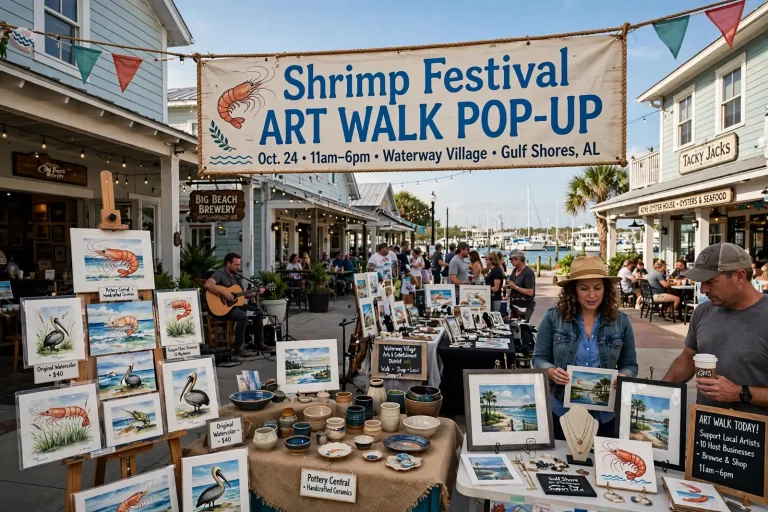
Art and craft booths. The festival hosts between 200 and 300 fine art and craft booths. That is a substantial juried marketplace by any measure, and for many attendees it is a primary draw independent of the food. For the artists and makers who work the circuit, a four-day event drawing a crowd of this size is a significant date on the calendar.
Live music. The festival features more than 100 hours of live music across multiple stages, with both national and local acts. A hundred hours across four days means music running essentially continuously in multiple places at once — a scale that changes how the event feels. There is no single main-stage moment that defines the weekend; there is a soundtrack that plays across the grounds from open to close.
The Shrimp Festival Run. The Annual Shrimp Festival Run dates back to 1977, making it a tradition nearly as old as the festival itself. Road races attached to festivals tend to draw a different crowd than the festival proper — participants who plan travel around a race calendar — and a run with that much history accumulates its own regulars.
Sand sculpture. The Sand Sculpture Contest, presented with Sand Castle University, puts the beach itself to work as a medium. It is one of the few festival activities that could not be relocated anywhere else.
National recognition
The combination of heritage, cuisine and coastal atmosphere has drawn notice beyond the region. For 2026, the National Shrimp Festival was named the sixth Best Specialty Food Festival in the nation in a national readers’ choice awards program.
Readers’ choice rankings are, by design, popularity contests rather than expert evaluations. That is not a knock on them — it is what makes them meaningful in this context. A high placement in a national readers’ poll indicates that an event has an audience willing to vote for it, which for a festival built on drawing visitors is close to the metric that matters most.
It is also a marker of reach. Placing sixth nationally in a specialty food category means a festival on a stretch of Alabama beach registered against events from every coast and region in the country.
The gap the festival was built to fill
The most striking thing about the National Shrimp Festival is how closely its modern form still matches its founding purpose.
The event was created because Gulf Shores had a revenue gap between the end of summer and the arrival of spring break. Fifty-three years later, the festival still lands in October — squarely inside the window that once emptied out. The founders’ basic insight, that a community could manufacture a reason for people to visit during a month when they otherwise would not, remains the operating logic of the event.
The scale of the response has changed enormously. What began as a volunteer effort in a fishing village now expects more than 300,000 visitors and is administered by a regional business chamber. The four-day format, the free admission, the hundreds of vendor booths and the continuous music are all mechanisms for keeping people on the coast for multiple days rather than a single afternoon.
The connective tissue between 1971 and 2026 is the shrimper. The event exists because Gulf Shores had working commercial fishermen to recognize, and it carries the name it does because the town had something authentic to build a celebration around.
What visitors should know
A few practical notes drawn from what has been announced:
- Admission is free. There is no ticket to buy for entry to the festival itself.
- It is four days, not one. Oct. 8 through Oct. 11 gives visitors flexibility, and spreading a visit across days is one way to see more of the art booths and catch more of the music.
- The site is the public beach. The festival occupies the beach at Highway 59 and East Beach Boulevard, which is the busiest access point in Gulf Shores under normal conditions.
- Expect company. With more than 300,000 visitors anticipated across the weekend, arrival timing and patience are part of the experience.
What to watch next
Between now and Oct. 8, the details that typically firm up in the final weeks are the ones most worth tracking. The music lineup and gate hours have now been announced (see the update above); still to watch are registration information for the Shrimp Festival Run, and the particulars of the Sand Sculpture Contest with Sand Castle University.
Also worth watching is the weather. An outdoor festival held on a Gulf beach in October sits inside a season when coastal conditions can shift, and any event of this scale plans accordingly.
For now, the clock is running. A month from now, Gulf Shores will do what it has done each fall since 1971 — pay tribute to the industry it grew up around, gather its community on the sand, and throw the beach party that started them all.