Neil Young to Play Saenger Theatre Sept. 26, Tickets Support Gulf Oil Spill Food Relief
Neil Young plays Mobile's Saenger Theatre Sept. 26, with Tyson Foods donating 100,000 pounds of chicken to Gulf oil spill hunger relief.
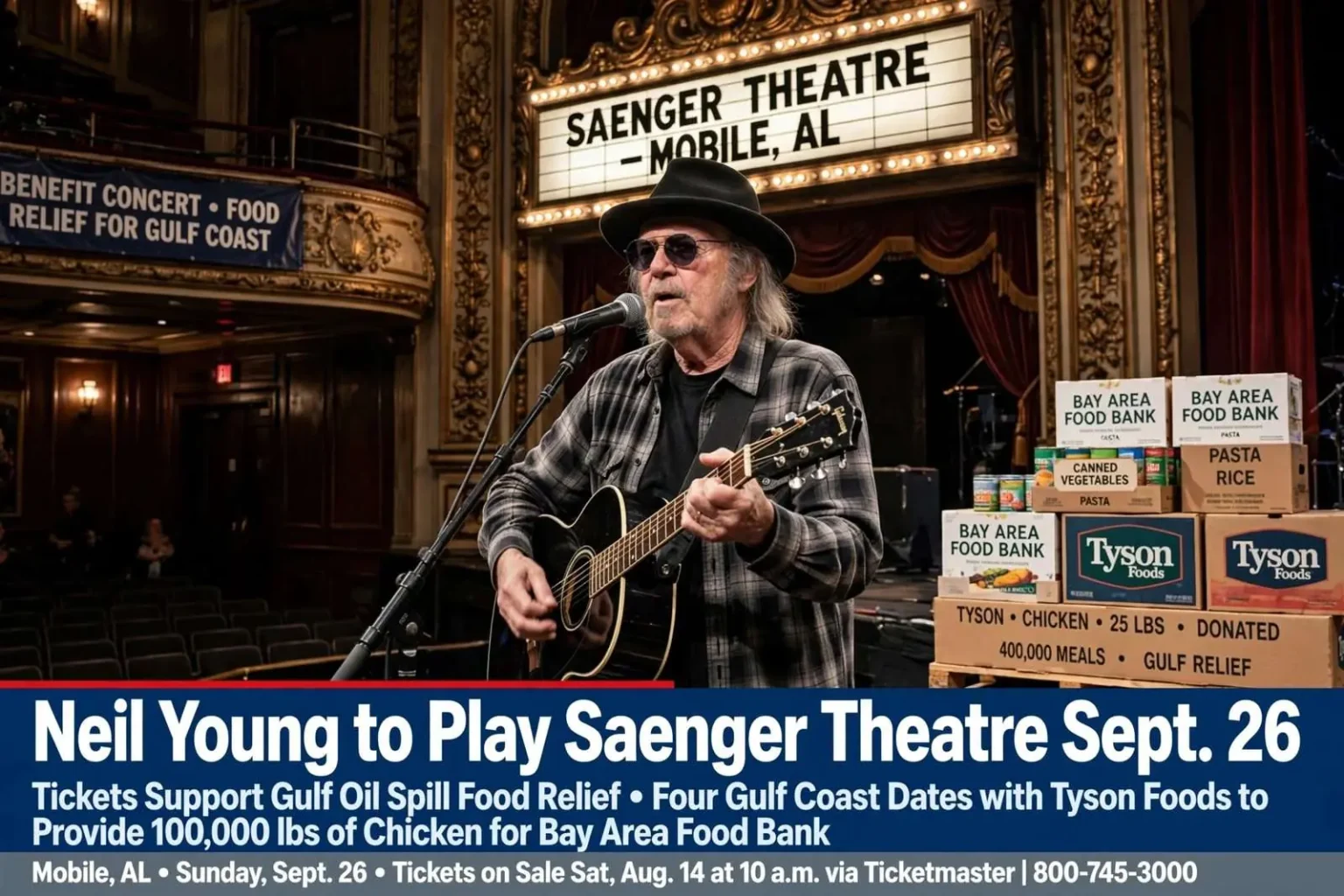
Rock veteran Neil Young will bring his tour to Mobile’s Saenger Theatre on Sunday, Sept. 26, in a concert tied to hunger relief efforts for communities still recovering from the Deepwater Horizon oil spill. Tickets go on sale Saturday, Aug. 14 at 10 a.m. through Ticketmaster, by phone at 800-745-3000, or at the Saenger Theatre box office. The pairing of a major touring artist with a regional food drive is an unusual arrangement for downtown Mobile, and organizers hope it will translate directly into meals for families along the coast.
The Mobile show is one of four Gulf Coast dates Young has scheduled for late September, along with stops in Panama City and Pensacola, Florida, and Biloxi, Mississippi. The routing keeps the entire run inside the region most affected by the spill, a deliberate choice that reflects the purpose behind the concerts. Young has a long history of benefit performances, and the four-date swing gives residents of three states a chance to attend without traveling far from home.
The concerts grew out of a long friendship between Young and Tyson Foods chairman John Tyson, who are teaming up to address hunger in Gulf Coast communities hit hard by the spill’s economic fallout. The two men have worked together on hunger issues before, and the tour gave them a chance to put a national spotlight on a problem that has persisted in coastal towns since the spring. Both men said they see the concerts as a way to do more than raise money for a single night.
Tyson Pledges Four Truckloads of Chicken
As part of the partnership, Tyson Foods plans to donate roughly 100,000 pounds of chicken products — about four truckloads, or the equivalent of nearly 400,000 meals — to the Bay Area Food Bank, which distributes food to communities across Alabama, Florida and Mississippi along the Central Gulf Coast. The donation is large even by the standards of corporate food giving, and food bank workers note that protein items like chicken are among the hardest products to keep in steady supply. Shelf-stable goods dominate most donation drives, which makes a protein donation of this size particularly valuable to pantries trying to stretch complete meals for families.
“Millions of people who live along the Gulf Coast struggle with hunger, and the economic impact of the oil spill has only made matters worse,” Young said in a statement announcing the shows. “I appreciate the willingness of John Tyson and his company to get involved by helping the regional food bank help feed those in need.” Young’s statement framed the concerts as a continuation of work rather than a one-time gesture, an approach that matches the slow recovery still unfolding in fishing villages and beach communities from Louisiana to the Florida Panhandle.
Tyson said the two men wanted to combine Young’s reach as a musician with the company’s existing hunger-relief work. “We decided it made sense to combine Neil’s widely-known musical talents with our company’s ongoing commitment to hunger relief,” Tyson said. The Arkansas-based company is one of the world’s largest processors of chicken, beef and pork, and it has a long record of donating protein to food banks across the country. For Tyson, the Gulf Coast effort puts that corporate muscle behind a region where demand on charitable food programs has climbed sharply since the spill began.
Why Hunger Relief After an Oil Spill
The connection between an offshore oil disaster and hunger may not be obvious at first, but along the Gulf Coast the two are closely linked. The Deepwater Horizon rig exploded in April, killing 11 workers and eventually releasing millions of barrels of crude into the Gulf of Mexico before the well was capped in mid-July. In the weeks that followed, federal officials closed broad expanses of fishing grounds, and tourism along the coast sputtered as images of oiled water and tar balls circulated nationally. For communities that depend on commercial fishing, seafood processing and summer tourism, those closures and cancellations meant lost paychecks.
Lost income shows up quickly at food pantries. When charter boat captains, deckhands, restaurant workers and hotel staff see their hours cut or their seasons evaporate, many turn to charitable food programs for the first time in their lives. Food banks across the Gulf reported rising demand during the spill months, even as normal donation patterns were disrupted. The Bay Area Food Bank sits at the center of that safety net for the central Gulf Coast, moving donated and purchased food out to pantries, shelters, churches and after-school feeding programs in communities across Alabama, Florida and Mississippi.
Hunger relief organizations have long noted that the Gulf Coast carried elevated rates of food insecurity even in good times, with many households working seasonal or service jobs that offer little cushion. An event like the spill compresses years of economic stress into a few months, and the effects linger long after national headlines move on. That reality is what Young and Tyson said they hoped to address — not just the immediate shortage on pantry shelves, but the longer recovery period when out-of-town donations tend to taper off while local needs remain high.
How Concertgoers Can Help
Organizers are asking concertgoers to bring non-perishable food items to the show, which will also be passed along to the Bay Area Food Bank. Items such as canned vegetables, peanut butter, rice, pasta and canned fruit are staples that food banks can distribute quickly, and collection points will be set up for fans arriving at each venue. The drive turns a night of music into a tangible act of restocking shelves at a time of year when summer donations traditionally slow down and school-year feeding programs ramp back up.
Limited-edition Neil Young T-shirts will be sold exclusively at the concerts, with all proceeds from those sales going to the food bank as well. Merchandise sales are typically a significant revenue stream on any tour, and routing the proceeds from the special shirts to hunger relief gives fans a direct way to contribute beyond the price of admission. Organizers said every dollar raised through the shirts and every can left at the door stays in the region, feeding neighbors a short drive from the concert halls.
Young and Tyson also encouraged fans traveling to the shows to spend money at local businesses along the way, part of a broader push to support Gulf Coast economies still working to rebound from a summer that saw tourism and fishing industries disrupted by the spill. The message to concertgoers was straightforward: fill the gas tank, eat at local restaurants, stay in area hotels and shop in the towns they pass through. Tourism officials across the coast have spent months urging visitors to return, and a four-night concert run through the region offers thousands of fans a ready-made reason to book a Gulf Coast trip.
A Historic Stage for a Modern Cause
The Mobile stop takes place at the Saenger Theatre, the 1927 movie palace on Joachim Street in downtown Mobile that has served as the city’s premier performing arts hall for decades. Restored in 2000 after years of decline, the theater hosts touring productions, concerts, comedians and civic events, and its grand, roughly 1,900-seat house gives the Young concert an intimate setting unusual for an artist of his stature. Downtown restaurants and parking operators typically see a noticeable bump on theater nights, and a Sunday show tied to a food drive is expected to draw an especially engaged crowd.
For Mobile, the concert also lands at a moment when the city has worked to reposition itself as a cultural destination on the central Gulf Coast. The Saenger anchors a downtown district that has seen steady reinvestment in recent years, and events that fill the theater ripple outward to nearby businesses. Civic leaders have long argued that arts attractions and tourism recovery go hand in hand, and a nationally known artist choosing Mobile for a benefit date is the kind of endorsement local promoters like to point to when they pitch the city as a tour stop.
The Rest of the Gulf Coast Swing
After the Mobile date, the tour moves on to Panama City and Pensacola, Florida, and Biloxi, Mississippi, completing a run that traces the coastline affected by the spill. Panama City and Pensacola sit in the heart of the Panhandle’s beach tourism economy, where summer reservations fell away during the spill months, while Biloxi’s casino resort corridor on the Mississippi Sound has also worked to reassure visitors that the coast is open for business. Choosing these communities over larger inland markets underscores the benefit focus of the dates and puts the music where the need is.
Tickets for the Mobile show go on sale Saturday, Aug. 14 at 10 a.m. through Ticketmaster, by phone at 800-745-3000, or at the Saenger Theatre box office. Fans planning to attend are encouraged to bring non-perishable food donations with them, and the limited-edition benefit T-shirts will be available at each of the four venues. Full details on showtimes, ticket prices and the other tour stops are available through Neil Young’s official tour site.
For the Bay Area Food Bank and the charities it supplies, the weeks ahead offer both a boost in inventory and a raise in visibility. Four truckloads of chicken, a theater full of canned goods and a national audience hearing about coastal hunger in the same stretch of days add up to a meaningful contribution to a region still counting the cost of the spill. Organizers hope the concerts will also plant a longer-term habit among Gulf Coast residents: giving to the food bank in good times, not only in crisis, so the shelves are stocked before the next hard season arrives.