New $157 Million Gulf Shores High School Opens Its Doors
The new $157 million Gulf Shores High School has opened, welcoming about 1,000 students to a 287,000-square-foot campus with advanced labs, arts and athletic facilities.
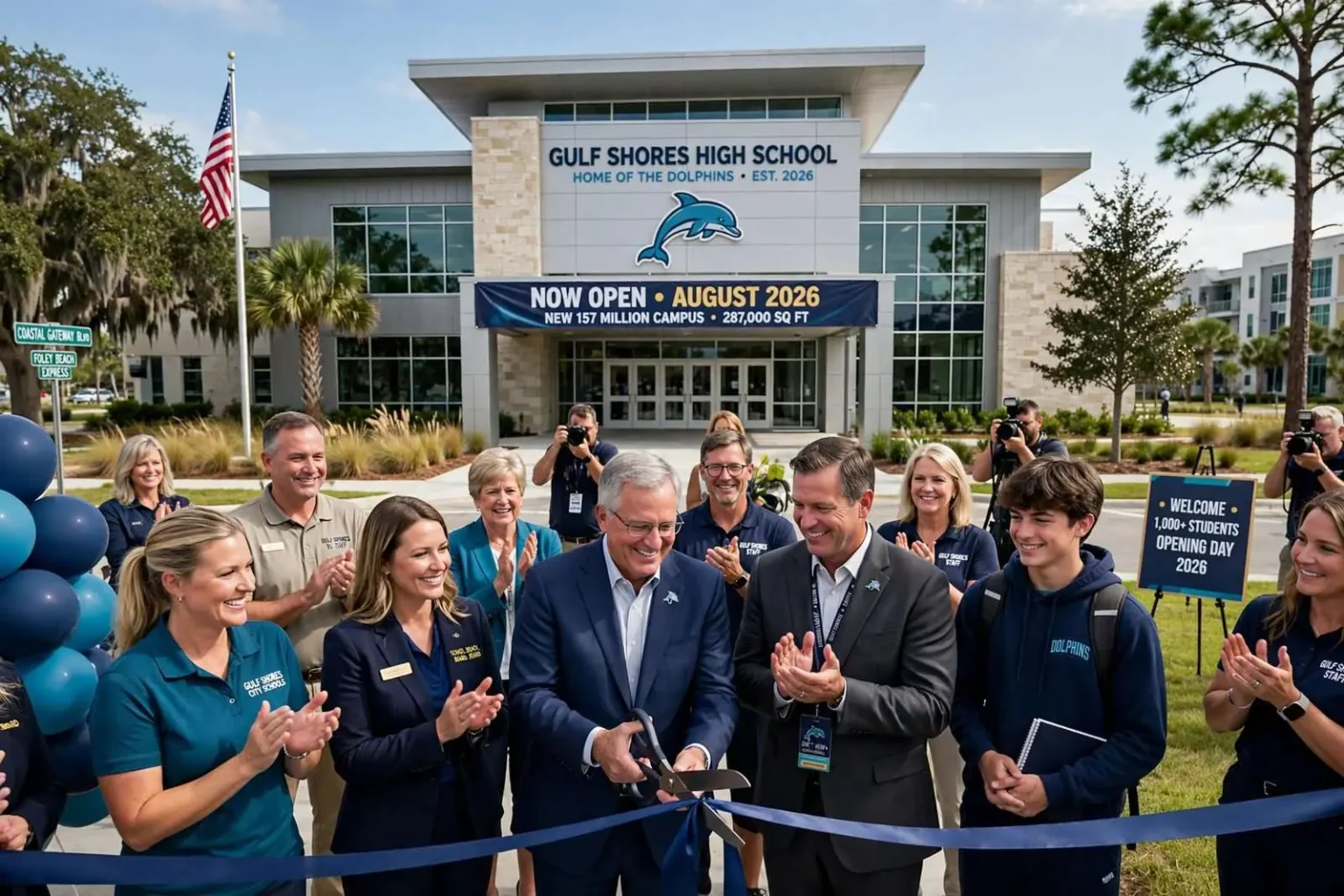
GULF SHORES, Ala. — The new Gulf Shores High School is now open, welcoming its roughly 1,000 students to a sprawling campus built with state-of-the-art academic and athletic facilities, innovative learning spaces, advanced technology and a performing arts complex. The building has room for nearly twice as many students if needed.
The 287,000-square-foot facility sits at the intersection of the Foley Beach Express and Coastal Gateway Boulevard, on land donated by the family foundation of Gulf Shores Mayor Robert Craft. Its total cost topped $157 million.
The campus is the physical centerpiece of the city school system Gulf Shores carved out of the Baldwin County district in 2019, a split that gave the beachfront city control of its own classrooms for the first time. Six years later, the system’s growth has carried it from borrowed buildings to what is now one of the most expensive and most closely watched school construction projects in Alabama.
A Vision for the Future
“This new high school represents our community’s commitment to creating a world-class educational environment for our students. It’s an investment in the future of Gulf Shores, and we are proud to open a facility that reflects the energy, ambition, and spirit of our city,” Craft said during the ribbon-cutting ceremony.
“The purpose was to create the kind of education our children deserve and help them be all that they can be. We’re doing that, not just with this facility, but everything we offer within this program,” he added.
Matt Akin, superintendent of Gulf Shores City Schools, echoed the mayor. “Our teachers, staff, and students deserve the very best, and this new campus was designed with that vision in mind. We look forward to the incredible work and innovation that will take place within these walls,” he said.
City leaders have framed the school as more than a building: it is the anchor of an effort to make Gulf Shores a destination for families, not just tourists. A city of roughly 16,000 year-round residents that swells to many times that number in summer, Gulf Shores has poured tourism-driven revenue into schools, infrastructure and quality-of-life projects, betting that a top-tier school system will keep young families rooted in the community.
Inside the Campus
The school includes science and engineering labs and classrooms that can expand and compress. Its central hallway, which will serve as a gathering space and cafeteria, has already been named “The Sandbar.”
In addition to 28 standard classrooms, 11 collaborative flex spaces and six science labs equipped with integrated audio/video technology and retractable walls, the school features a kitchen for culinary classes, a robotics classroom, a wrestling gym that doubles as a tornado shelter, outdoor learning areas, a nursery, a hydroponic garden, and a broadcast and recording studio.
The labs will also support marine biology, chemistry, finance and aerospace/aviation programs, and the engineering lab measures 4,250 square feet. The mix is deliberately wide: school officials wanted a building that could support a student bound for an engineering degree and a classmate headed into the coastal tourism or culinary trades with equal seriousness.
Some of the programming leans on the school’s own backyard. Marine biology students are minutes from Little Lagoon, the Gulf of Mexico and the Bon Secour River watershed, giving classroom lessons a field component few inland schools can match. The hydroponic garden and culinary kitchen connect directly as well, with students able to grow and then cook what they harvest.
Akin said Gulf Shores students have already earned scuba certification through the school and will participate in underwater science research this semester. The school is also taking part in the Little Lagoon Preservation Society oyster harvesting program.
“You just don’t see that everywhere,” he said.
The oyster program ties classroom science to one of the coast’s most tangible restoration challenges. Little Lagoon’s oyster beds are part of a broader Gulf Coast effort to rebuild bivalve populations that filter water, stabilize shorelines and support marine life, and students who work the program graduate having done real restoration work, not just read about it.
The tornado-shelter gym answers a practical need as well. Baldwin County sits in a state where violent spring and fall storms are a fact of life, and the wrestling gym is engineered to shelter students when warnings strike during the school day — a feature that has become standard in the newest wave of Alabama school construction and that families in a coastal county notice immediately.
Athletics and the Arts
The campus includes two competition-size gymnasiums, tiered meeting rooms, multiple athletic training rooms and an 18,000-square-foot field house complete with an athletic performance center. It connects to a covered 110-yard practice pavilion that will provide year-round training for Dolphin athletes and the band.
The covered pavilion is a signature feature for a coastal program. Afternoon thunderstorms and August heat routinely wipe out outdoor practice across the Gulf Coast, and a shaded, covered full-length field lets football, band and other programs train through the weather that once cost them weeks of preparation every fall.
Ground was broken on the facility in April 2024 with an anticipated $137 million price tag. Additions and upgrades, including the covered practice field, were later approved by the City Council, pushing the final total past $157 million by the time doors opened.
The Performing Arts Center, Health Professions Center and Sports Concourse are named for Dr. Gaylon and Susan Nomberg McCollough in recognition of their gift to the school. The renowned plastic surgeon and former Alabama football All-American was also Bear Bryant’s personal physician. Susan McCollough is an accomplished painter who has exhibited on four continents and was named 1818 Artist of the Year.
The McCollough name bridges the two halves of the campus the naming honors. Gaylon McCollough’s football career at Alabama in the early 1960s and his subsequent medical career embody the athlete-scholar combination the school promotes, while Susan McCollough’s international painting career mirrors the performing and visual arts wing that carries the family’s name.
A Design Years in the Making
The design took more than two years, with school officials visiting schools across the country to incorporate cutting-edge educational trends, including the numerous collaborative spaces and outdoor learning areas. The visits shaped the school’s most distinctive departures from traditional Alabama school layouts: classrooms without fixed walls, common spaces that double as teaching areas, and covered outdoor rooms that extend the school day into the coastal climate.
Planners also built the school for growth. With capacity for nearly double the current enrollment, the campus anticipates the population growth that has steadily pushed Baldwin County’s schools toward their limits. Gulf Shores, Orange Beach and the Foley corridor have been among the fastest-growing areas in Alabama, and a system that could not expand would have found itself crowded within a decade.
The design phase doubled as a community conversation. Teachers, coaches, students and parents were brought into the planning through the district’s stakeholder process, and the features that survive from that input — the gathering hall, the outdoor classrooms, the career-focused labs — reflect what the community asked for rather than a catalog floor plan.
From a 2019 Question to a 2026 Answer
“When Gulf Shores City Schools opened in August of 2019, we asked our stakeholders to imagine the future of learning in our school system. The new Gulf Shores High School is our pathway to the future,” Akin said.
That question — what should a school system born from a city’s split from Baldwin County look like? — has been answered in stages. The system opened with existing buildings, built out its identity in the years that followed, and now takes occupancy of a purpose-built high school designed around the programs it has developed. The roughly 1,000 students walking the halls this semester are the first class to experience the full vision.
For the city, the opening also closes out the most expensive chapter of a remarkable municipal story. Gulf Shores is one of the few cities in Alabama history to create a new city school system from scratch in recent decades, joining a wave that began with Saraland in Mobile County and reshaped how Alabama communities think about local control of education. Few of those systems, however, started with a tourist economy capable of funding a $157 million campus outright.
The school’s location at the Foley Beach Express and Coastal Gateway Boulevard also makes it a geographical statement. The site sits inland of the beach, on the corridor that connects Gulf Shores to the growing communities to the north, placing the school near the center of gravity of the city’s year-round population rather than its seasonal one.
What Students Will Find on Day One
Day-to-day, the campus is arranged around the idea that learning happens everywhere. Students can move from a six-lab science wing into the robotics room, cross The Sandbar for lunch, and end the afternoon in the broadcast studio or under the covered practice pavilion. The flex spaces with retractable walls let teachers merge two classes for a project or seal a room off for an exam, a flexibility older buildings across the county cannot match.
For the Dolphin athletic programs, the two gymnasiums, the field house and the performance center consolidate what was previously a scattered athletic footprint, and the tornado-rated wrestling gym doubles the campus’s severe-weather capacity. For the band, the pavilion means outdoor rehearsal without heat exhaustion or a rained-out morning.
School officials say the measure of the investment will come not on opening day but in the graduates it produces — marine biology students who have pulled oysters from Little Lagoon, engineering students who have worked in a 4,250-square-foot lab, and young filmmakers and broadcasters trained in a professional studio, all carrying Gulf Shores diplomas into a Gulf Coast economy that increasingly needs exactly those skills.