New AHSAA Format Ushers In a ‘Different’ Local Football Season
The 2026 high school football season opens with a new AHSAA public-private split, state title games in Mobile, eight new local coaches and top college prospects.
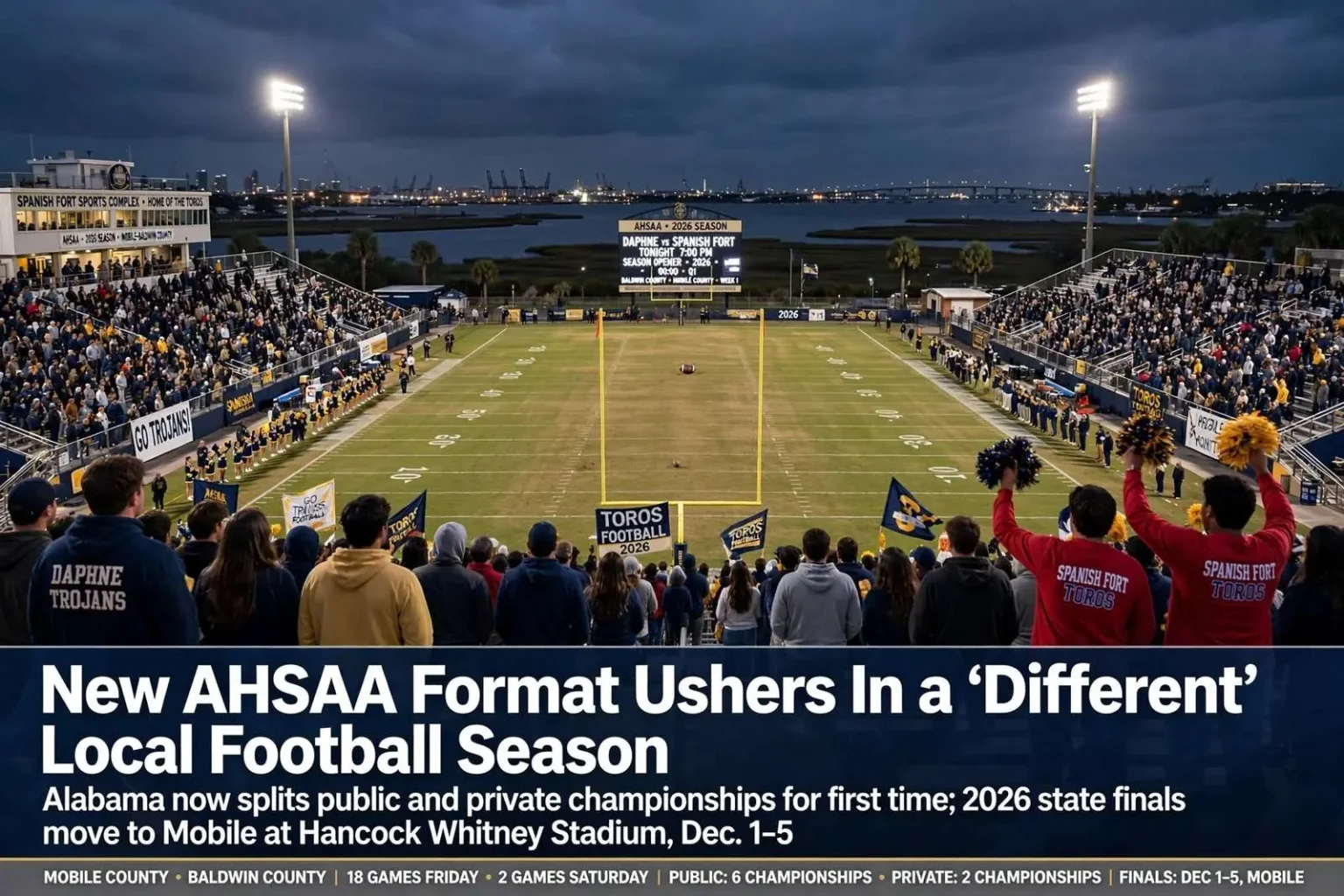
Thursday night, Daphne will visit Spanish Fort for a 7 p.m. kickoff, opening the 2026 high school football season for teams across the Mobile County-Baldwin County area. The following night, 18 games involving local teams are scheduled, with two more on Saturday — a full weekend slate that will send nearly every program in the two counties onto the field before the first week of school is out.
In many ways the season begins like recent ones, with excitement and the belief among players, coaches and fans that this could be their year. Two-county schedules, long bus rides down I-10 and the ritual Friday night exodus to stadiums from Prichard to Gulf Shores are all back on the calendar. But locally, this season will look markedly different from those before it, because the structure of championship football in Alabama has changed in ways that touch every school in the region.
A split for state titles
For the first time, the Alabama High School Athletic Association (AHSAA) has split state championship play between its public and private school teams. Public and private schools can still meet during the regular season, but at championship time the AHSAA will crown two private school champions and six public school teams will win blue maps, the trophies symbolic of a state title. The reorganization creates new championship categories for the private programs that have dominated several classifications in recent years, and it doubles the number of programs that can realistically chart a path to a trophy in December.
For the first time, the state championship games will also be played in Mobile. The Mobile Sports Authority and Executive Director Danny Corte led the city’s bid to join the rotation of host sites, winning a prize that other cities have guarded carefully. Bringing the finals to the Gulf Coast means area fans can drive to the title games instead of flying or making the long trip to north Alabama, and it puts the region’s stadiums, hotels and restaurants in front of every community that follows its team deep into the playoffs.
The championship format is changing too, expanding from three days to five — Tuesday, Dec. 1 through Saturday, Dec. 5 — with four flag football title games on Tuesday, the two private school title games on Wednesday and the public school title games played Thursday through Saturday. The longer window spreads crowds and costs across the week, gives flag football — one of the fastest-growing sports in the state — a marquee stage, and lets each classification’s final keep something of a headline slot rather than being buried in a weekend pile-up.
Local teams in the hunt
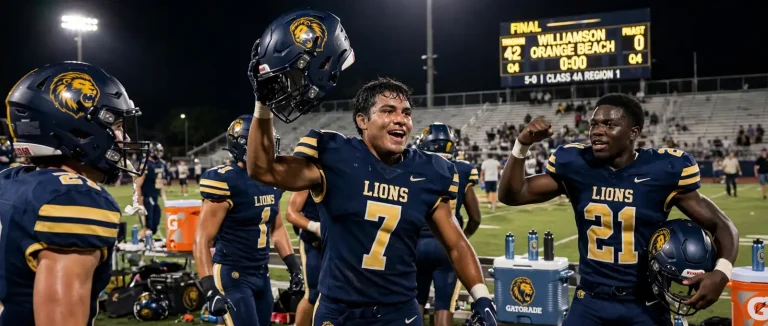
According to the Alabama Sports Writers Association (ASWA) preseason polls, several local teams are positioned to make a run at a championship at South Alabama’s Hancock Whitney Stadium. McGill-Toolen (Private Class AA), Bayside Academy (Private Class A) and Williamson (Class 4A) hold the No. 1 rankings, with Vigor (Class 4A), Saraland (Class 5A) and St. Michael (Private Class AA) ranked No. 2. Other teams to watch include Cottage Hill Christian (No. 4, Private Class A) and Mobile Christian (No. 5, Private Class A).
The prominence of private schools atop the new private categories is no accident. McGill-Toolen and UMS-Wright have together accounted for a remarkable share of Mobile-area state titles over the past decade, and Bayside Academy has built a volleyball-and-football-era dynasty in its own classification. The split means those programs will no longer meet public powers in the late rounds of the playoffs, and it gives teams like St. Michael — a younger program on a steep upward curve — a championship path calibrated to its size.
The season also brings eight new head coaches to area teams: Caleb Ross at Fairhope, Alex Page at Mary G. Montgomery, Gus Smith at Blount, Rick Cauley at St. Luke’s, Bryan Moore at Foley, Jonathan Mitchell at LeFlore, Jason Phillips at Satsuma and Randy Larson at Theodore. That many first-year coaches across a two-county area guarantees an autumn of scheme changes, roster reshuffles and evaluation periods, and it means several traditional rivalry games will be coached by men experiencing them for the first time.
Top prospects and rivalries
The region is rich with college talent. Three of the top four prospects in this year’s senior class, as rated by national recruiting analysts, play for area teams: St. Michael QB Gunner Rivers, a North Carolina State commit, is the top prospect, followed by Vigor LB Isaac McNeil (Auburn) at No. 2 and Vigor edge rusher Jabarrius “Chicken” Garror (Texas) at No. 4. For the second straight year, the Mobile-Baldwin corridor can claim a serious argument for the best player in the state, and college assistants have made the I-10 exit ramps as familiar as their own campuses.
The depth behind the headliners is notable as well. Williamson S Jaylen Scott (Oklahoma) is rated No. 12 in the class, Saraland QB Jamison Roberts (Oklahoma) No. 15, Williamson LB Ellis McGaskin (Florida) No. 23, Gulf Shores WR/KR Carter Davis (West Virginia) No. 34, McGill-Toolen DL AJ Pauley (Alabama) No. 36, Williamson CB Julian McDonald (Mississippi State) No. 40 and Vigor CB Miguel Wilson (Kentucky) No. 44. That is a dozen Division I signees-in-waiting concentrated in a pair of adjacent counties, and it explains why regional recruiting coverage has grown into a year-round beat.
Williamson’s cluster of SEC-bound defenders has made the Yellow Jackets’ practices a destination for visiting coaches, and it underlines the No. 1 ranking the program carries into the season. Vigor’s pair of top-four prospects gives the Wolves a similar gravitational pull in Prichard, where the program’s revival has run parallel to the city’s broader efforts around its schools. The concentration of talent also raises the stakes of the regular-season games between the ranked teams, several of which will double as region play with seeding implications.
The rivalry calendar
Rivalries remain a highlight of the schedule, and this season’s calendar reads like a tour of the area’s oldest grudges. The “Battle of Prichard” is set for Saturday night at Ladd-Peebles Stadium, the historic venue that has hosted generations of Mobile-area championship and showcase games. The “Battle of Old Shell Road” between St. Paul’s and UMS-Wright, to be played Oct. 16 at St. Paul’s, carries added meaning with both teams in the same classification and region (Private Class AA, Region 1) — a rivalry game that will now have direct playoff positioning consequences under the new structure.
The “Battle of West Mobile” between Baker and Mary G. Montgomery will be played Oct. 2 at Baker, and the “War on the Eastern Shore” between Fairhope and Daphne is set for Oct. 23 at Daphne. Longtime rivals Foley and Fairhope meet Sept. 4 at Fairhope, and Foley and Robertsdale meet Sept. 18 at Robertsdale, keeping alive the southern Baldwin County series that predate most of the area’s modern stadiums. Each of those games will double as a measuring stick for new coaches — including first-year men on both sidelines of the West Mobile and Eastern Shore contests.
One casualty of the reorganization stands out: the “Battle for the Cannon” between Murphy and McGill-Toolen, a series long scheduled around the city schools calendar, has been lost in the shuffle of the AHSAA’s public-private split. The game’s fate is a reminder that the championship split, whatever its competitive logic, also reorganizes the regular season — and that some traditions older than the classifications themselves will need deliberate protection if they are to survive it.
The changes also reshape travel for area fans. Under the old single-site format, families following a team to the finals often faced a multi-hour trip up the state; with the championship window landing in Mobile, schools can expect larger, more spontaneous crowds, and the Mobile Sports Authority has positioned the city’s downtown hotels and restaurants as part of the event itself. Local businesses that fill up on Mardi Gras weekends now have a December event of their own to plan around.
What to watch for
Preseason rankings, of course, are projections rather than promises, and every veteran coach in the area will spend the fall warning his team about exactly that. Injuries, region upsets and the adjustment periods of eight new head coaches will reorder the polls before October. But the raw material — a dozen major-college prospects, three No. 1 teams, and a championship week in the region’s own backyard — is more than the area has had in recent memory.
By December, the area will know whether the split helps or hurts its trophy haul. Mobile-Baldwin teams have regularly produced multiple state titles in a given year under the old format; the new structure gives the region a chance at up to eight — six public and two private — with Hancock Whitney Stadium hosting the deciding games a short drive from most of the contenders. Between Thursday night’s opener at Spanish Fort and the first week of December, the 2026 season offers the area’s fans a fuller calendar, a bigger stage and more plausible championship paths than any before it.