New Aldi Grocery Store Set to Open on Airport Boulevard in Mobile
Aldi will open its third Mobile-area store on Airport Boulevard on Sept. 21, continuing a wave of growth tied to the discount grocer's new Loxley distribution center.
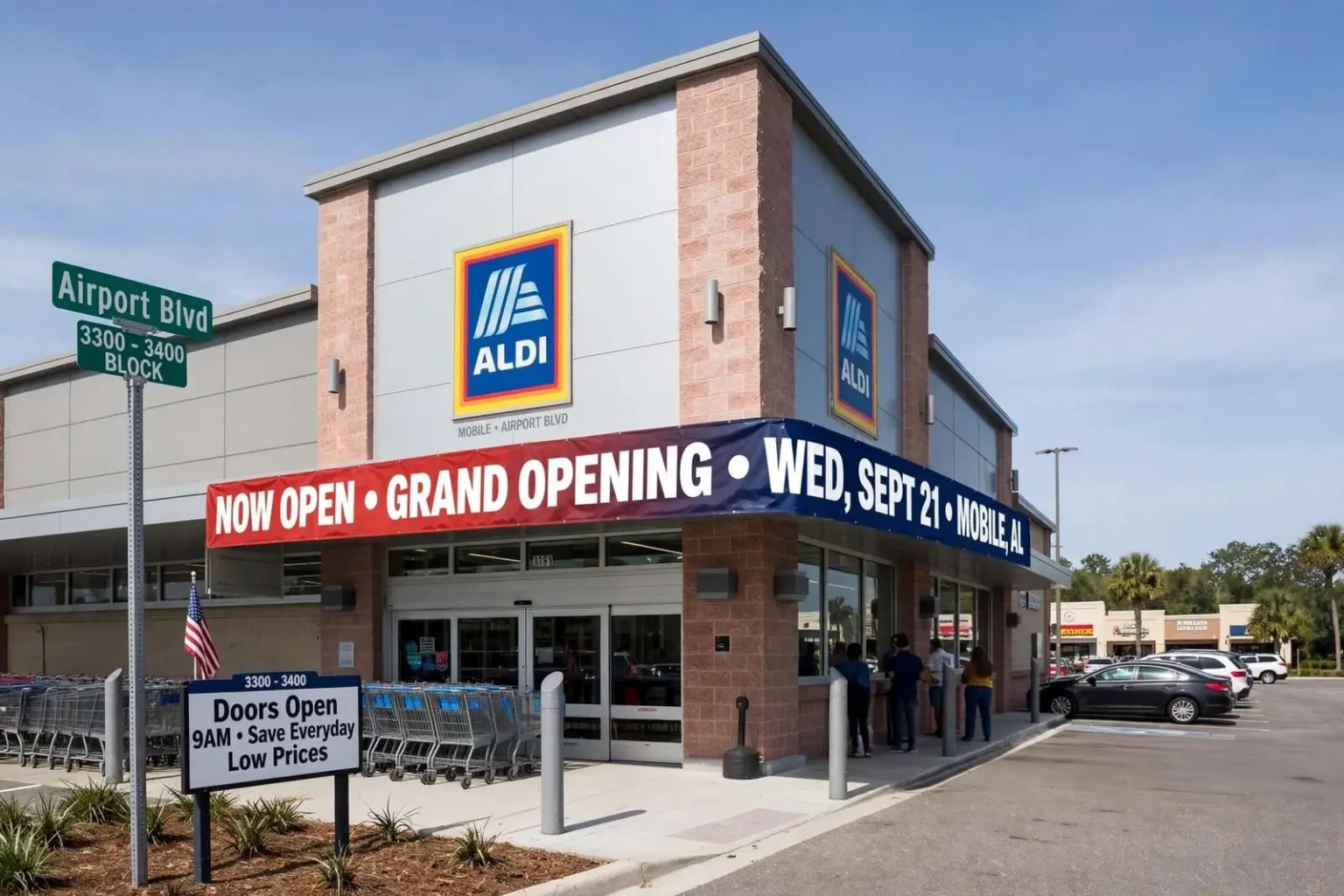
A new Aldi grocery store is scheduled to open on Airport Boulevard in Mobile on Wednesday, Sept. 21, marking the discount grocer’s third location in the city and its latest expansion across the region. The opening caps a busy stretch of growth for the chain in Mobile County, where two other stores debuted earlier in the year and where the German retailer has been methodically building out a footprint designed around its distribution hub just across the bay.
The German-owned chain, known for stripped-down store layouts and heavily discounted private-label products, has been rapidly building out its footprint across south Alabama and the surrounding Gulf Coast over the past two years. Shoppers who visit an Aldi for the first time tend to notice the differences immediately: a smaller floor plan, a limited selection organized with unusual discipline, and shelves stocked largely with the company’s own brands rather than the national labels that dominate conventional supermarkets.
The Airport Boulevard location will join two other Mobile County stores that opened earlier this year, one on Schillinger Road that debuted June 30 and another in Tillmans Corner that opened March 3. Three stores inside a single county within a matter of months reflects the pace of the company’s regional plan, and the placement of the new store along Airport Boulevard puts it in the path of commuters on one of Mobile’s busiest east-west corridors.
Airport Boulevard has long served as one of the city’s commercial spines, lined with retail, restaurants, and service businesses stretching from midtown toward the western suburbs. For the neighborhoods along the corridor, a discount grocer offers a practical addition: full grocery shopping within a short drive for households watching food budgets, in an era when grocery prices have become a recurring concern for families across the Gulf Coast.
The location also fills a retail gap left as older shopping centers along the corridor have cycled through tenants over the years. Groceries are what retailers call an anchor trip — the errand that brings people out several times a week regardless of the economy — and a store that captures that trip tends to lift the smaller businesses around it. That dynamic is part of what corridor businesses and nearby residents will be watching as the opening approaches.
How the Aldi Model Works
Aldi’s shopping model differs from many traditional grocery chains in ways that regulars learn quickly. Customers typically bag their own groceries and pay a quarter deposit to unlock a shopping cart, which is refunded when the cart is returned to a corral. The deposit system is not a gimmick but a cost-saving device: because shoppers return their own carts, the store needs no employees chasing them across the parking lot, and those labor savings flow into lower shelf prices.
The company says the approach, along with a smaller selection of mostly store-brand products, helps keep prices low. Carrying a fraction of the item count of a conventional supermarket streamlines everything from ordering to checkout, and private labels give Aldi control over quality and pricing that name brands do not. The tradeoff — fewer choices, more self-service — has proven popular enough to fuel decades of growth across Europe and, more recently, the United States.
Aldi operates more than 2,000 stores nationwide, a scale that has made it one of the fastest-growing grocery retailers in the country even as traditional chains consolidate. The company’s stores are deliberately compact, typically requiring less land and less construction than a full-sized supermarket, which allows the chain to enter neighborhoods and corridors that larger formats overlook.
The compact footprint has another consequence shoppers notice: speed. With fewer aisles, a shorter item list, and a checkout design that moves carts through quickly, a full grocery run at Aldi tends to take less time than the same errand at a conventional supermarket. For commuters along Airport Boulevard, that efficiency is part of the appeal — groceries on the way home, without a half-hour tour of a hundred-thousand-square-foot store.
The Loxley Hub Behind the Growth
Aldi’s expansion into the Mobile area traces back to a $100 million distribution center it built in Loxley, first announced in July 2020 as part of a broader Gulf Coast growth plan. The Loxley facility is the anchor of everything that followed: stores do not simply appear in a market, they follow the warehouse capacity that can supply them, and the Baldwin County hub gave Aldi the logistics base to open locations across two states’ worth of territory.
Construction on the facility began in February 2021, and the hub was designed to support as many as 100 new Aldi stores across Alabama, Georgia, the Florida Panhandle and Mississippi, with roughly 35 of those locations targeted to be built and running by the end of 2022. The numbers explain the rhythm of store openings local shoppers have watched over the past two years — a steady drumbeat rather than a single splash, paced by the capacity of the Loxley operation.
The Loxley facility gave Aldi its first foothold in Baldwin County, and stores tied to the distribution center have since opened in Daphne, Foley and Pensacola in addition to the new Mobile County locations. The geography forms a deliberate map: Baldwin County’s fast-growing Eastern Shore communities, Foley’s surging south-county population, Pensacola’s Florida market, and Mobile’s west-side neighborhoods, all within a truck route of the hub off Highway 59.
For Loxley and the wider Baldwin County economy, the distribution center represented a different kind of development than the region’s tourism-driven growth. Warehousing and logistics jobs bring year-round employment that does not depend on beach seasons, and the $100 million investment signaled to other companies that the Interstate 10 corridor between Mobile and Pensacola could support major distribution operations. Local officials have pointed to the project as an example of the county’s economy diversifying beyond the coast.
Jobs and the Hiring Push
Ahead of the Airport Boulevard opening, Aldi has been advertising openings for both store and warehouse positions through its hiring portal. Store associates start at $15 an hour, while warehouse workers begin at $19 an hour, according to the company’s listings — wages that sit above the starting pay offered by many retail and warehouse employers in the market and that reflect the chain’s emphasis on leaner crews doing broader jobs.
Each new store adds a modest but steady stream of local employment, and the combined effect of the regional build-out has been meaningful: dozens of stores across four states, each staffed with associates, plus the warehouse workforce in Loxley that keeps them supplied. For job seekers in Mobile, the Airport Boulevard store adds another option in a retail corridor where competition for workers has kept starting wages climbing.
The hiring window ahead of an opening is also the easiest time for applicants to stand out, since a new store staffs from scratch rather than filling occasional turnover. The chain’s model relies on employees who can move between roles — cashier, stocker, floor setup — during a shift, and the job listings emphasize that flexibility. Warehouse hiring in Loxley, meanwhile, continues to support the entire regional network.
A Crowder Grocery Map for Local Shoppers
The new store adds to a growing cluster of Aldi locations serving shoppers across Mobile and Baldwin counties, giving area residents another option for grocery shopping as the chain continues to build out its presence along the central Gulf Coast. For households that live near more than one of the new stores, the practical effect is competition — not just on price, but on convenience, since shorter drives and smaller stores change how often people shop and how much they buy per trip.
Conventional grocers in the market have taken notice of the discount format’s rise. Aldi’s expansion typically nudges competitors to emphasize their own store brands, promotions, and loyalty programs, and shoppers are the immediate beneficiaries of a market where a new player keeps opening locations. The pattern has played out across the South over the past decade, and Mobile’s grocery map is simply catching up to it.
The Airport Boulevard store’s opening week will offer the first test of demand along the corridor. Early crowds are common at Aldi openings, driven by grand-opening promotions and by curiosity about the no-frills format, and the chain’s track record elsewhere in the county suggests the new location will settle into a steady neighborhood trade once the initial rush passes.
For the company, the Mobile County trio — Tillmans Corner, Schillinger Road, and now Airport Boulevard — completes the first phase of a market entry that began with the Loxley announcement two years ago. The distribution center’s long-term capacity of up to 100 stores leaves room for the network to keep growing, and company planners will have watched each opening for signals about where the next locations make sense.
For shoppers, the takeaway is simpler. A grocery option known for low prices now sits on one of Mobile’s main thoroughfares, its third store in the city, stocked from a warehouse an hour away in Baldwin County. From the $100 million hub in Loxley to the cart corral outside the new Airport Boulevard store, the chain’s Gulf Coast build-out has reached the point where discount groceries are no longer a novelty in the market — they are part of the neighborhood retail landscape, with more openings likely to follow as the regional plan continues.