New Book “Life Without Jurisdiction” Revisits 2003 Baldwin County Murder Conviction
A newly published book, “Life Without Jurisdiction,” is drawing fresh attention to the 2005 conviction of Murray “Bubba” Lawrence Jr. in a 2003 Baldwin County murder, raising questions about the evidence behind his life-without-parole sentence.
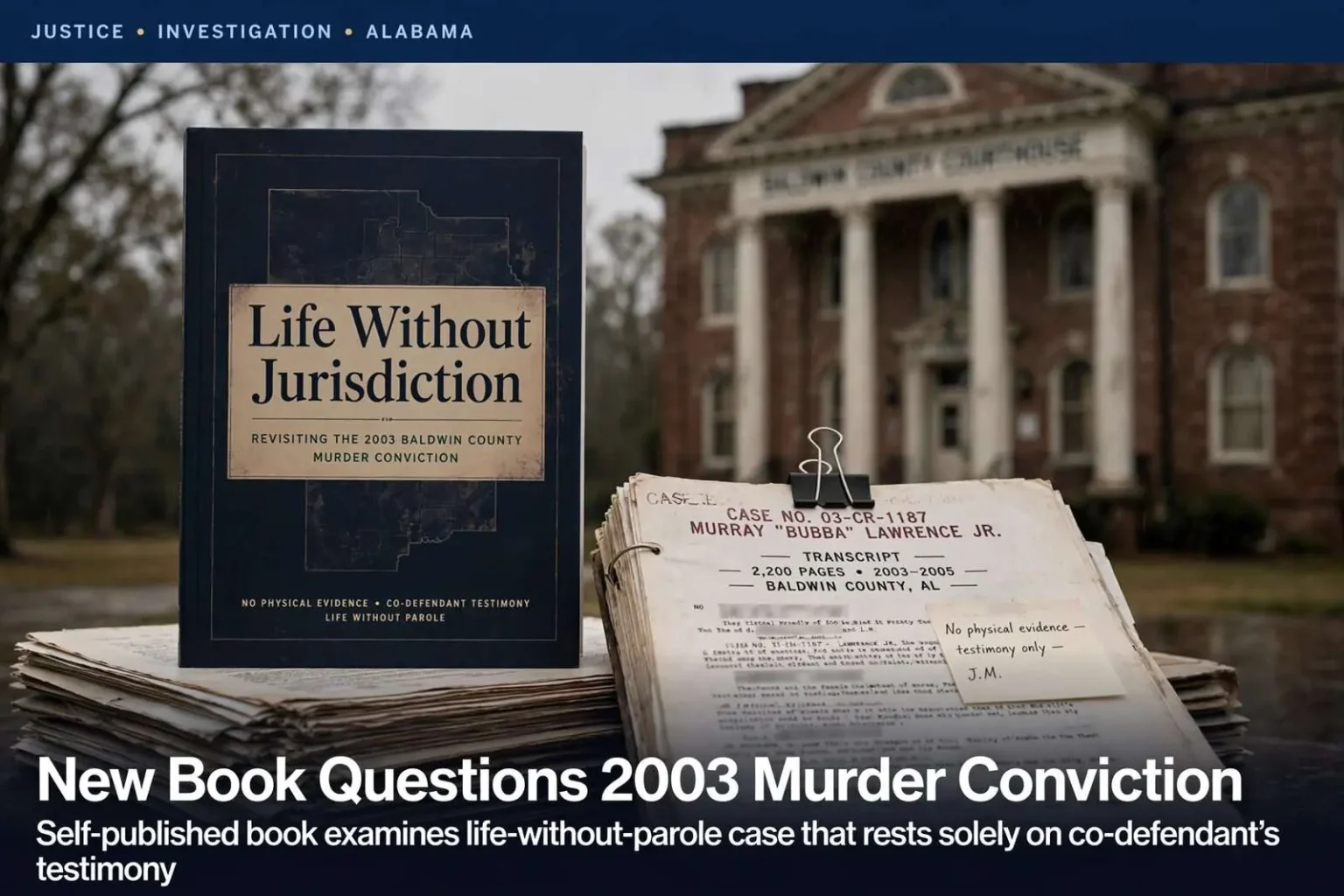
A newly published book is renewing attention on a more than two-decade-old Baldwin County murder case, questioning the evidence that sent a man to prison for life without the possibility of parole.
The book, titled “Life Without Jurisdiction,” examines the case of Murray “Bubba” Lawrence Jr., who was convicted in 2005 in the 2003 murder of Brandon Hastings, a Baldwin County man. Lawrence was sentenced to life without parole.
According to the book, there was no physical evidence connecting Lawrence to the crime, and the conviction rested on testimony from co-defendant Jarius McNeil, who was reportedly the last person known to have been with Hastings before his death.
That evidentiary profile — no physical evidence, a conviction resting on a co-defendant’s testimony — is the hinge on which the book’s argument turns. Defense attorneys and innocence advocates have long noted that accomplice testimony is among the least reliable forms of evidence courts admit, precisely because a co-defendant facing his own charges has the strongest of incentives to cooperate with prosecutors. The book asks readers to weigh what it means when a life-without-parole sentence rests on that foundation alone.
How the book came together
The project traces back to 2016, when Paul ipp, co-author of the book, was introduced to the case by then-Fairhope Mayor Karin Wilson, who encouraged him to look into it.
“She [Wilson] said, ‘You can’t explain this story to people because there are so many ups and downs. We’ve got to write a book,'” ipp recalled. “That’s where the idea came from. My only condition was that we name the people who are responsible for this.”
ipp spent two years reviewing documents and researching the case before committing to the project. He obtained a written transcript of the case from Lawrence’s father — a document running roughly 2,200 pages.
To make sense of the material, ipp reached out to Nancy Koerner, a writer and researcher he had met while living in Belize, and asked her to help condense the transcript into a synopsis. The work was intensive: ipp and Koerner spent about eight hours a day for two to three weeks sifting through the documents.
Once finished, ipp said he used the synopsis as a way to try to attract legal interest in the case, approaching organizations including Alabama Appleseed and the Equal Justice Initiative.
“Some of them do DNA, some of them do extended sentences and other specifics, but there’s nothing for life without [parole cases]. It falls in a crack,” ipp said, describing the difficulty of finding an organization willing to take on the case.
The gap ipp describes is structural. Alabama’s innocence organizations, like their counterparts nationally, organize their dockets around cases where science can settle the question — DNA that was never tested, or testing that has advanced since trial. A case with no physical evidence at all offers nothing to re-test, and a life-without-parole sentence offers no parole date around which advocacy can organize. The case, as ipp put it, falls between the categories the advocacy world was built to address.
A difficult search for legal help
ipp said finding sustained legal representation for the case has been challenging, with several attorneys who worked on it eventually moving to other firms or stepping away from the case entirely.
In 2025, ipp said the team hired an attorney to file a Rule 32 petition — a request asking the court to re-examine Lawrence’s detention and, if it was found unlawful, order his release. That petition, according to ipp, ultimately fell through, leaving the case at a standstill once again.
Rule 32 is Alabama’s post-conviction mechanism, the procedural avenue through which a convicted person can argue that constitutional errors — ineffective assistance of counsel, newly discovered evidence, prosecutorial misconduct — invalidated a judgment that direct appeal could not reach. The petitions are heard in the trial court, are subject to strict filing deadlines, and are routinely denied; they are also, in a case with no physical evidence, essentially the only door left. When the 2025 petition fell through, the legal options narrowed to what they had been before: find a lawyer willing to stay with a difficult case, or change public opinion from the outside.
The attorney churn ipp describes compounds both problems. Post-conviction work is unglamorous, often unpaid or underpaid, and unattractive to firms watching their associates move on — and every departure costs a case its accumulated knowledge, forcing the next attorney to absorb 2,200 pages of transcript from the beginning.
Determined to keep the case in public view, ipp worked alongside Wilson and Koerner for nearly five months to consolidate their research into a 164-page book.
“Life Without Jurisdiction” was self-published in January under the name Alabama Exposure and Accountability LLC, rather than under the authors’ own names.
“We decided to write the book under the blanket of Alabama Exposure and Accountability LLC and not put our names on it as authors because, simply, we did not want to distract from what we were talking about,” ipp said. “We’re not in this for accolades or anything. We’re just looking for justice.”
The anonymity decision is unusual in the genre. Most innocence books carry their authors’ names prominently, because the author’s credibility is part of the sales pitch. The Alabama Exposure and Accountability approach inverts that: the case, the documents and the named individuals within it are meant to stand on their own, with the authors reduced to editors of the record. The title itself makes the argument the authors declined to make in their own voices — that the question is not merely whether a jury got it wrong, but whether the county’s legal machinery had the authority to produce the result it did.
ipp said the book went through 10 rewrites before publication as the team worked to be meticulous about the information included.
Ten rewrites is, in part, liability management. A book that names officials and questions a conviction, self-published by an LLC rather than a traditional press with its own legal review, exposes its creators to defamation claims if it gets a fact wrong. The rewrites reflect the discipline the authors applied to keep every claim tethered to the court record they had spent years reading.
What comes next
ipp said he hopes continued attention on the book will lead to further investigation into the case and, eventually, additional legal avenues that were not detailed in the book itself. He has also floated the idea of a documentary adaptation.
ipp said he previously worked on the 2016 documentary “Gringo: The Dangerous Life of John McAfee,” and hopes a similar format could eventually bring Lawrence’s story to a wider audience.
The documentary path is a familiar one in cases like this. Books reach readers who are already paying attention; films reach everyone else, and a handful of documentary-driven cases have been reopened after their stories reached a national audience. A Baldwin County murder case told through the people still living with it — Lawrence’s father among them, the man who preserved the 2,200-page transcript that made the book possible — is the sort of story the format handles well.
“Life Without Jurisdiction” is available for purchase online through Walmart and Amazon, with additional information available through the Justice for Murray Lawrence Jr. website.
The distribution path mirrors the project’s DIY character. A case that mainstream publishers showed no interest in, and that advocacy organizations passed over for structural reasons, reaches readers only through the authors’ own effort — self-published, self-distributed through the major online retailers, and promoted through a family-run website rather than a publicity tour. That the book exists at all is a product of the same persistence its publication is meant to provoke in others.
What the case means for Baldwin County
The case is a Baldwin County story twice over — in the crime, and in the institutions that processed it. The county’s circuit court, headquartered in Bay Minette with courthouses in Foley and Fairhope, has grown with one of the fastest-growing populations in Alabama, and its criminal dockets have grown with it. A conviction from 2005 sits in a record system that predates much of that growth, preserved on paper in a way that modern digital files might not be — one reason a printed transcript could still anchor a reinvestigation two decades later.
For the Hastings family, the book’s publication reopens a grief the legal system closed in 2005, and any account of the case that dwells on Lawrence’s claims must acknowledge that a man was murdered and a family was told the killer had been convicted. The book’s challenge to the conviction is not a challenge to the loss, and the tension between those two truths is what has kept the case contested for two decades.
Whether the book changes anything will depend on the two things its authors cannot supply themselves: a lawyer who stays, and an audience that demands answers. The first has failed the case repeatedly. The second is, as of January, finally being tested.