New Orleans Artists Anders Osborne, Cha Wa Headline SouthSounds Festival in Mobile
New Orleans artists Anders Osborne, Cha Wa, and George Porter Jr. headline the SouthSounds music festival at O'Daly's Irish Pub in Mobile.
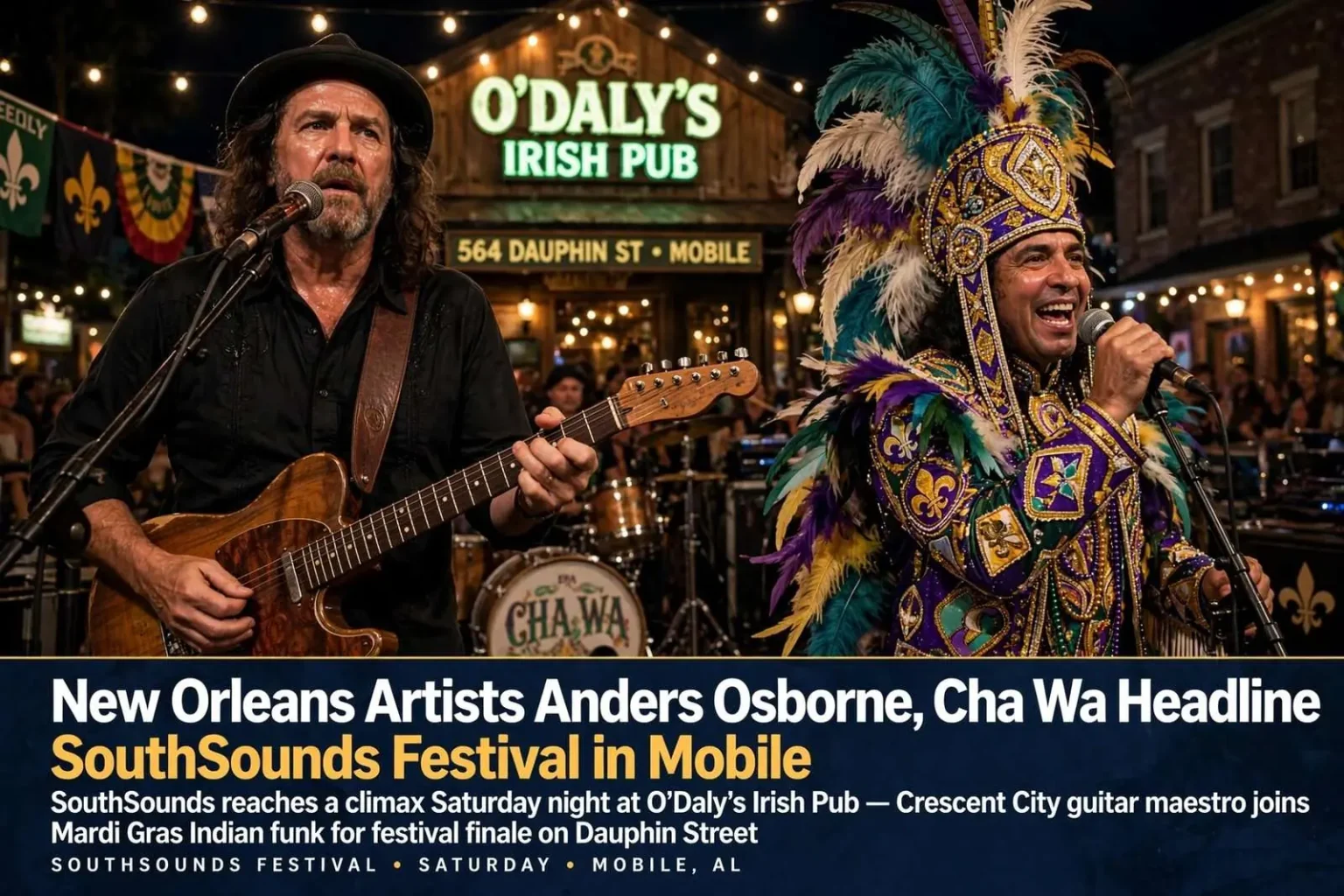
SouthSounds reaches a climax with an invasion of New Orleans artists on Saturday night at O’Daly’s Irish Pub in Mobile. The lineup features Crescent City guitar maestro Anders Osborne, George Porter Jr., Cha Wa, Johnny Sansone, and Yeah, Probably. It is a fitting cap to a festival built on the deep musical ties between Mobile and New Orleans, two Gulf Coast port cities whose exchange of musicians, food and culture runs back generations, and it puts some of the biggest names on the bill on one of downtown Mobile’s most familiar stages.
Osborne returns to Mobile for the first time in nearly a decade, giving audiences a preview of tracks from his upcoming album “Buddha & the Blues.” For fans who have followed his career, the absence makes the homecoming meaningful. Osborne has spent decades building a reputation as one of New Orleans’ most respected guitarists and songwriters, an artist whose blend of blues, rock and soul has made him a fixture of the Crescent City scene and a collaborator and songwriter for a long list of major artists. Nearly ten years between Mobile appearances means Saturday’s crowd will include longtime listeners hearing him locally for the first time in years alongside newer fans discovering his catalog.
The album began with a complex, multilevel vision that Osborne describes as a sonic and visual thing. Rather than a straightforward collection of songs, “Buddha & the Blues” was conceived as an experience that reaches beyond the speakers, an approach that reflects Osborne’s habit of treating each record as a complete artistic statement. Previewing that material at SouthSounds gives the festival audience an early listen to songs still taking shape ahead of their release.
Anders Osborne’s West Coast Vision
For “Buddha & the Blues,” Osborne looked to California and the records he grew up with in the 1970s. The era’s albums — with their layered arrangements, warm production and willingness to move between rock, folk and soul within a single record — left a mark on Osborne that he has now deliberately channeled into new material. The West Coast turn is a departure of sorts for an artist so closely identified with New Orleans, and it gives the album a distinct identity from his earlier work.
He brought in producer Chad Cromwell, whose musical legacy boasts work with Neil Young, Joe Walsh, and many others. Cromwell’s drumming and production resume spans some of rock’s most respected catalogs, and his presence in the producer’s chair signals the classic-rock sensibility Osborne was chasing. An experienced producer with deep roots in that sound was essential to translating a 1970s vision into a modern recording.
The album also features Waddy Wachtel of Fleetwood Mac, bassist Bob Glaub, and Benmont Tench of Tom Petty and the Heartbreakers. The roster reads like a roll call of the session players who defined the sound of 1970s California rock: Wachtel’s guitar work has anchored countless landmark records, Glaub’s bass lines have supported generations of Los Angeles sessions, and Tench’s keyboard playing helped define the Heartbreakers’ sound for decades. Gathering that caliber of musician around Osborne’s songs gave the album the polish and depth its creator was aiming for.
“The background vocals that Windy puts on there are just staggering, and so pristine and so precise,” Osborne said. “It reminds me of the beautiful things Fleetwood Mac used to do.” For an artist citing the 1970s records of his youth as the album’s foundation, the comparison is telling — the layered, pristine harmony vocals that made Fleetwood Mac’s records so distinctive are exactly the texture Osborne wanted listeners to hear in his own new songs.
Cha Wa Brings Mardi Gras Indian Energy
Cha Wa has the potential to be one of the most memorable bands of the weekend. The group takes the traditional festive chants of the New Orleans Mardi Gras Indians and sets them to modern funky grooves and classic New Orleans brass. The result is a sound that is at once deeply rooted in one of New Orleans’ oldest cultural traditions and unmistakably contemporary, built for audiences who want to dance as much as listen.
The Mardi Gras Indian tradition behind Cha Wa’s music is one of New Orleans’ most distinctive cultural institutions. Generations of neighborhood “tribes” have hand-sewn elaborate feathered and beaded suits — often weighing dozens of pounds and taking a full year to complete — and taken them into the streets each Carnival season while singing call-and-response chants passed down through the years. Those chants, once sung a cappella or with tambourines and hand drums, have slowly worked their way into the broader fabric of New Orleans funk and brass-band music, and Cha Wa has become one of the tradition’s most visible modern ambassadors.
Spyboy J’Wan Boudreaux, grandson of Big Chief Monk Boudreaux, leads the charge with his vocal work. His lineage places him at the heart of the tradition he performs: Big Chief Monk Boudreaux is one of the most renowned Mardi Gras Indians of his era, and the spyboy position he once held — the tribe member who walks ahead of the big chief and serves as his scout and lookout — carries deep meaning within the culture. J’Wan Boudreaux’s vocals carry that heritage onto the festival stage for a Mobile audience that may never have seen a Mardi Gras Indian performance in person.
The group has taken the sights, sounds, and culture of the Mardi Gras Indians around the globe, performing songs from the Grammy-nominated album “Spyboy.” International touring has made Cha Wa cultural emissaries as much as entertainers, introducing audiences far from the Gulf Coast to a tradition that began in New Orleans neighborhoods more than a century ago. The album that earned their Grammy nomination put that mission on record, pairing traditional chants with the band’s own funk and brass arrangements.
“Bringing the parade from the street to the stage,” said drummer and founder Joe Gelini. “We’re bringing that energy for people to participate in.” That participation is the point. Mardi Gras Indian performances have always been participatory events — call and response, second-line dancing, crowds drawn into the rhythm — and Cha Wa builds its live show around the same exchange, inviting festival audiences to be part of the procession rather than spectators of it.
The Rest of the Night, and How to Be There
Surrounding Osborne and Cha Wa on the Saturday bill are George Porter Jr., Johnny Sansone and Yeah, Probably. Porter’s name alone carries enormous weight along the Gulf Coast: as bassist for The Meters, he helped invent the New Orleans funk that has influenced everyone from the city’s brass bands to generations of rock and jam bands, and his solo work has kept him on the road continuously for decades. Sansone, a blues harmonica player and songwriter of long standing in the New Orleans scene, brings a rawer, blues-rooted edge to the lineup, while Yeah, Probably rounds out the night with the kind of high-energy set that has made the band a familiar presence at festivals across the region.
SouthSounds takes place at O’Daly’s Irish Pub, 564 Dauphin Street in Mobile. The Dauphin Street address places the festival in the center of downtown Mobile’s entertainment district, the same corridor that hosts the city’s Mardi Gras parades and much of its nightlife. O’Daly’s has long been a stop for touring roots, rock and blues acts, and its rooms offer the kind of close-quarters setting where an artist like Osborne or a band like Cha Wa can play directly to the crowd rather than at it.
Tickets are $15 for a single day or $30 for a weekend pass. For the price of a weekend pass, festivalgoers can move between acts across the full run, and given the caliber of musicians booked for the Saturday finale — a Grammy-nominated band, a New Orleans funk legend, and a guitarist with Osborne’s reputation — organizers have structured the pricing to encourage audiences to stay for the whole event rather than pick a single night.
The New Orleans concentration on the bill is more than booking convenience. SouthSounds has always drawn on the musical corridor that connects Mobile to New Orleans, a stretch of the Gulf Coast where musicians have moved back and forth for more than a century, carrying jazz, blues, brass and swamp pop between the two cities. Saturday’s lineup essentially compresses that history into one evening: a Swedish-born guitarist who became a New Orleans institution, a funk pioneer from The Meters, a bluesman, and a band carrying the Mardi Gras Indian tradition onto modern stages.
For local music fans, the night also represents a rare chance to hear new material in a small room. Osborne’s “Buddha & the Blues” is still ahead of its release, which means songs that will later be heard through the record’s carefully layered studio production will be debuted live, in front of a Mobile audience, well before most of the world hears them. Artists of his standing more often preview new albums in theaters and festival main stages than in an Irish pub on Dauphin Street.
Cha Wa’s set carries a similar weight. The band’s blend of Mardi Gras Indian chants with funk and brass depends heavily on live energy — the call and response, the crowd’s participation, the parade feel Gelini describes — and a packed club is the ideal environment for it. Attendees who have never experienced the tradition should expect to be pulled into it rather than left to watch.
Doors and set times follow the festival’s Saturday schedule, and with a lineup this concentrated at a single venue, early arrival is advisable. Whether it is the first SouthSounds for a newcomer or the latest for a longtime attendee, the Saturday finale at O’Daly’s amounts to a survey of the Gulf Coast’s musical connective tissue: the 1970s California records that shaped Osborne, the New Orleans funk that Porter helped create, the blues that runs through Sansone’s harp, and the century-old street tradition that Cha Wa is carrying onto stages around the world — all of it converging for one night at 564 Dauphin Street.