New Orleans singer-songwriter Andrew Duhon debuts ‘False River’ at Mobile’s Callaghan’s
New Orleans singer-songwriter Andrew Duhon debuts his new album False River at a Sunday album release party at Callaghan's Irish Social Club in Mobile.
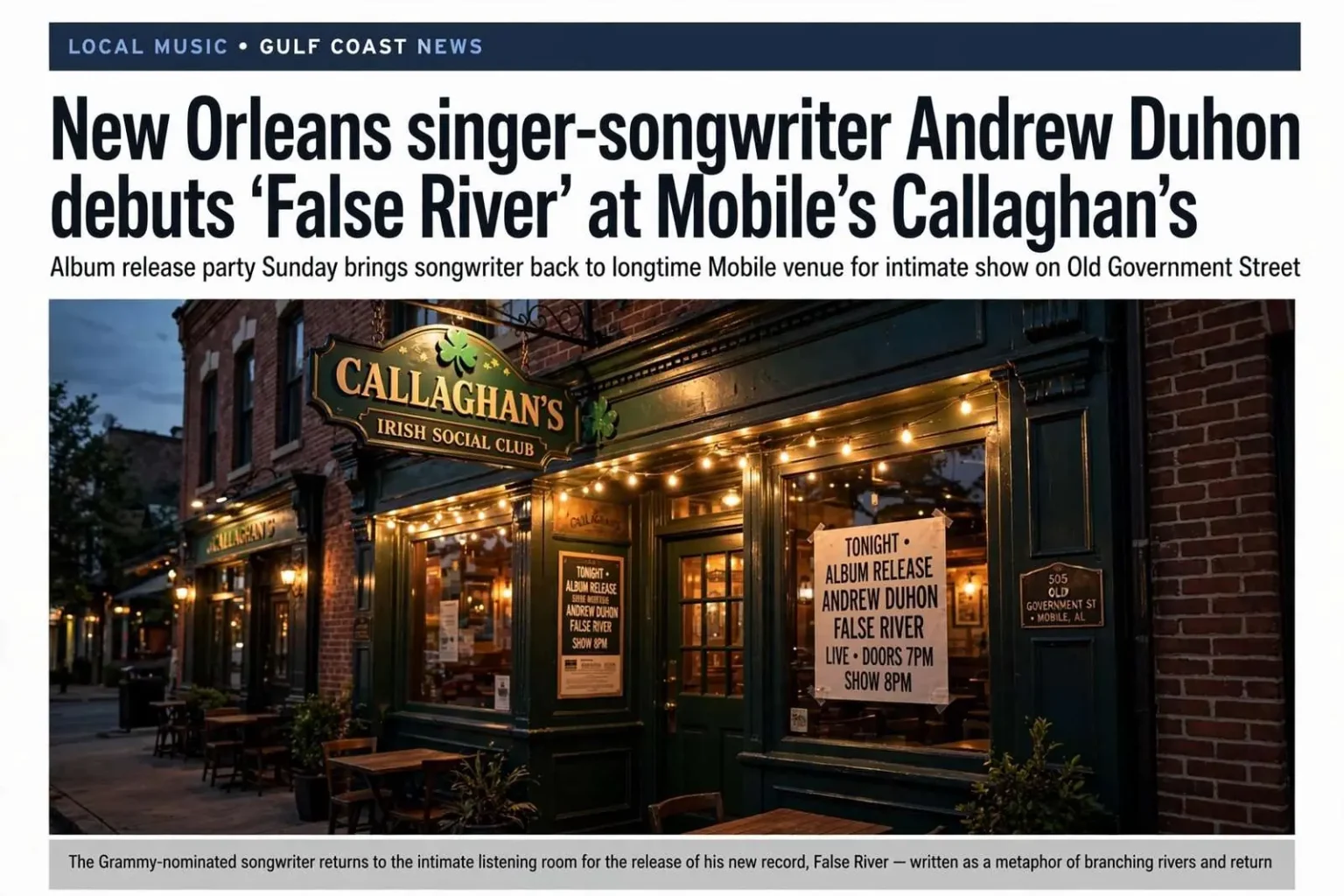
New Orleans singer-songwriter Andrew Duhon will introduce his latest record, False River, during an album release party Sunday at Callaghan’s Irish Social Club in Mobile. The show brings one of the Gulf Coast’s most respected songwriters back to the small Midtown room where he has built some of his most loyal audiences, and it gives Mobile fans the first local chance to hear the new songs performed in the intimate setting where they tend to land hardest.
Duhon has turned the downtown Mobile venue into a regular stop since the 2010 release of his debut, Songs I Wrote Before I Knew You. Even after earning a Grammy nomination for his 2013 album The Moorings, he kept returning to the Azalea City to reconnect with the audience he has built along the Gulf Coast. That consistency has made the relationship unusual in an industry where touring circuits shift constantly; rather than graduating away from the small rooms that nurtured his career, Duhon has kept them on the itinerary, treating them as anchors rather than stepping stones.
A Homecoming on Old Government Street
“Callaghan’s being the only place that I play in Mobile, it feels like a neighborhood bar and family at this point,” Duhon said. “It’s going to feel like coming home and giving friends and fans what we’ve all been looking forward to all this time.” The venue on Old Government Street has long occupied a distinctive place in Mobile’s music landscape, a neighborhood pub that doubles as one of the city’s most reliable listening rooms, where national touring acts and regional songwriters play close enough to the audience that the between-song conversation becomes part of the show.
The show marks his return to Mobile with what he describes as “fresh fuel in the tank” after completing False River. The record extends his reputation for cerebral, literate songwriting — folk rooted in the Big Easy with a tinge of blues. Duhon’s writing has long drawn on the storyteller’s tradition of his adopted city, favoring narrative arcs and carefully observed detail over the simple hook, and early word of the new record suggests he has doubled down on that approach rather than smoothing it out for a wider audience.
An album release show carries a particular weight for a working songwriter. The songs on a new record have typically been shaped over years of writing, road-testing, and studio revision, and the first performances in front of a real audience are the moment the material stops belonging to the artist alone. For a room like Callaghan’s, filled with listeners who have followed Duhon through three records and countless nights on the road, the release party functions less like a promotional stop and more like a family gathering with a new body of work at its center.
Finding the Right Producer
Bringing False River to life took time. Duhon said choosing a producer was as challenging as writing the songs themselves, with hours spent studying the production qualities of albums that inspired him. For an independent artist, that deliberation is not a luxury; a producer shapes the sound of a record for the length of its life, and the wrong fit can flatten songs that worked on paper. Duhon’s method — reverse-engineering the records he admired to understand how they were made — reflects a songwriter who treats the studio as an instrument in its own right rather than a place where performances are simply captured.
A chance conversation at a Nashville bar connected him with producer Eric Masse — known for work with Miranda Lambert and Rayland Baxter — and Masse’s studio. Duhon said the partnership felt like a leap of faith made on an independent artist’s budget. Nashville has become a natural waypoint for Gulf Coast songwriters, a city where the craft tradition runs deep and where a single conversation in the right room can redirect a project, and Duhon’s path to Masse followed that familiar route: talent, timing, and the willingness to commit money and months to a producer whose work he trusted.
The title is a metaphor built on the idea of anastomosis, the way rivers and blood vessels branch and diverge. Duhon said life follows a similar path: an event can send a person down a tangent, while the main current keeps moving and changing. It is the kind of organizing image that suits a writer who has made his name on songs that reward close attention, and it frames the record’s themes of divergence, drift, and return without pinning them to any single story.
“When you’re in a plane and look over a meandering river and see all those elements that have broken off in time, we’re only a blip in the timeline, but Mother Nature is constantly moving,” he said. The image comes naturally to a songwriter whose home region lives by its waterways, where bayous, bayous’ distributaries, and the Mississippi’s shifting course shape both the landscape and the culture built on it. Louisiana’s oxbow lakes are literally abandoned river channels, cutoffs left behind when the current found a shorter path, and the metaphor of the old channel — still water where the current used to run — runs underneath the album’s title and its central idea.
False River itself is a real place, an oxbow lake in Pointe Coupee Parish, Louisiana, formed when the Mississippi River abandoned a loop of its own course centuries ago. A town and community grew along the crescent of the old channel, a settlement living on water that no longer flows. For a record built on the branching paths of a life, the geography is apt: a place named for the river it used to be part of, holding still while the main current moves on.
Show Details
The album release party is set for Sunday at Callaghan’s Irish Social Club, with doors opening in the evening for the intimate room on Old Government Street. Callaghan’s shows tend to fill quickly for acts with a devoted following, and Duhon’s return trips to Mobile have reliably drawn the kind of crowd that knows the songs well enough to sing along, an atmosphere that has made the venue a favored stop for touring songwriters passing between New Orleans and the Florida panhandle.
For Duhon, the Mobile stop is the latest entry in a touring life that has taken him from New Orleans club stages to festival grounds and listening rooms across the country, always circling back to the Gulf Coast corridor where his audience first took shape. The Grammy nomination for The Moorings raised his national profile, but his touring pattern has remained rooted in the same geography, a deliberate choice for a writer whose songs depend on long relationships with rooms and the people who fill them.
Fans who have followed the arc from Songs I Wrote Before I Knew You through The Moorings will hear a writer a decade into his recording career, with the patience and craft that come from that many miles of road. False River arrives as the work of an artist at a settled middle distance — far enough from the debut to have perspective on the tangents and cutoffs of his own path, close enough to the neighborhood bar where it started to bring the record home first.
The economics of an independent release also shape how a record like False River reaches its audience. Without a major label behind it, the album lives or dies on touring, word of mouth, and the loyalty of listeners in cities like Mobile, where a songwriter’s return date circulates by social media and by the simple habit of people who have made the show a tradition. Release parties at venues the size of Callaghan’s are where that economy is built: ticket by ticket, night by night, with the artist present in the room rather than marketed from a distance.
Duhon’s Grammy nomination for The Moorings placed him among the handful of Gulf Coast songwriters recognized at that level, and it changed the texture of his career without changing its direction. National attention tends to pull regional artists toward larger markets, but the Gulf Coast listening-room circuit — stretching from New Orleans through the Mississippi Gulf Coast, Mobile, and Pensacola — has its own gravitational pull, sustained by venues that book original music year-round and audiences that treat songwriter nights as appointments rather than options.
Callaghan’s own place in that circuit is worth noting. The pub has spent years cultivating a reputation as a genuine listening room disguised as a neighborhood bar, booking touring Americana, folk, and blues acts alongside local talent, and its stage has served as a proving ground for songwriters testing new material in front of demanding, attentive crowds. That makes it a fitting site for a record like False River, whose songs are built for rooms where the audience can actually hear the words.
Sunday’s show closes the loop on a project that began with a songwriter studying records in his head and ends with him standing in the room that started it all, presenting the finished work to the friends and fans he says he has been looking forward to seeing all this time. Whatever roads False River travels from here, its first Gulf Coast audience will be the one that has followed Duhon the longest — the family he describes when he talks about a certain bar on Old Government Street.