New Traffic Signal Installed on SR-14 at 17 Springs in Millbrook
ALDOT has installed a new traffic signal on SR-14 at the 17 Springs entrance in Millbrook, with the light set to run in flashing mode before reaching full operation on Aug. 25.
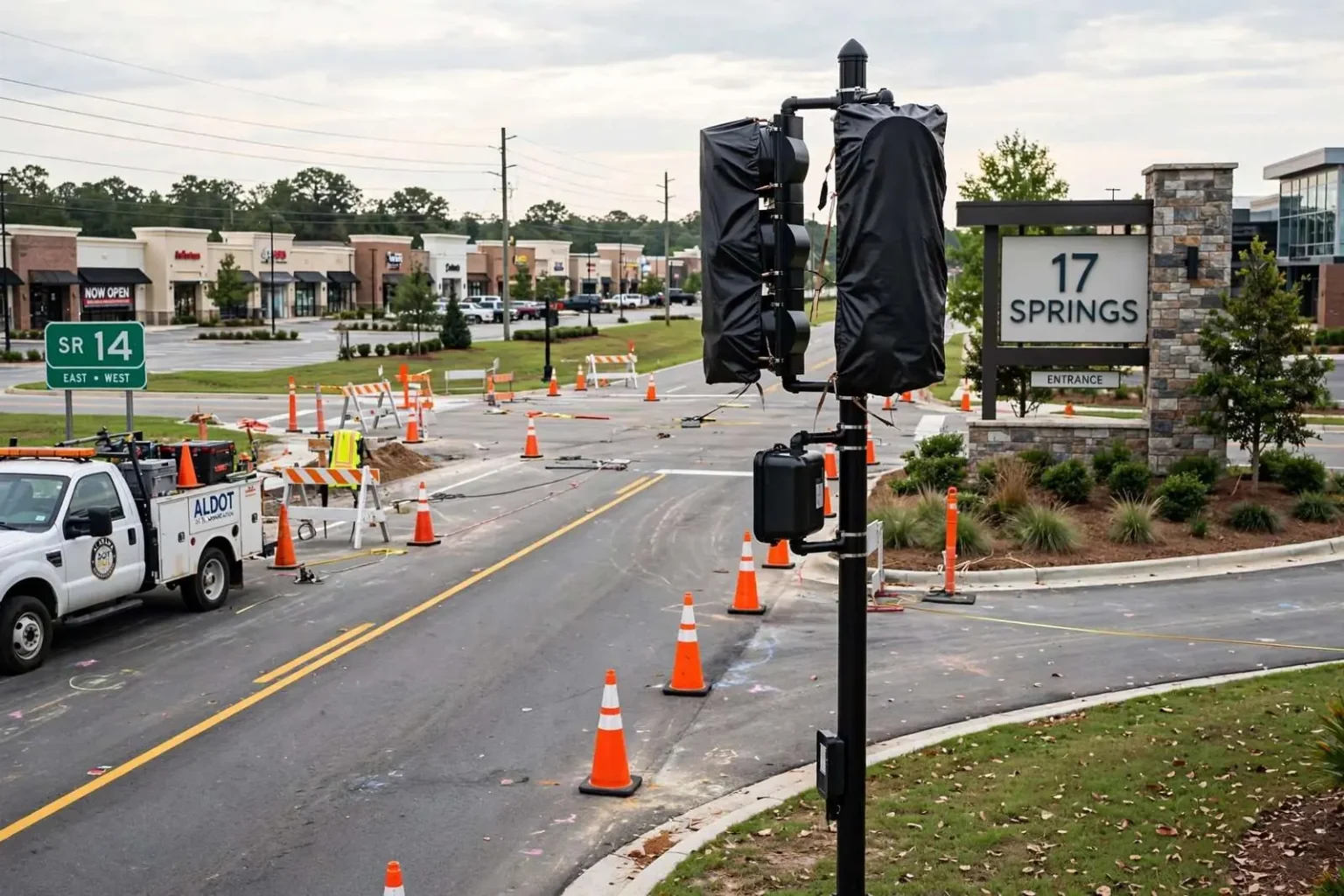
A new traffic signal is now in place on SR-14 at the 17 Springs entrance in Millbrook, part of an ongoing effort by the Alabama Department of Transportation (ALDOT) to improve safety at the intersection. The signal was installed this week, and drivers in the area should expect to see it move through several stages before it becomes fully operational later this month.
The intersection serves as a main gateway to the 17 Springs development, one of the busiest retail destinations in the Millbrook area, and connects directly to SR-14, the primary east-west corridor through the city. Growth along the corridor in recent years has steadily increased the volume of traffic turning in and out of the entrance, and the new signal is intended to bring a more predictable rhythm to a crossing that drivers previously navigated on their own judgment.
Signal not yet active
For now, the newly installed signal heads remain covered, meaning the light is not operational and drivers should continue to treat the intersection as they normally would. Covered signal heads are a standard sight on Alabama roadways in the days after a signal goes up; the covering prevents confusion while the equipment is being wired, tested and calibrated behind the scenes.
ALDOT crews were scheduled to begin placing pavement markings around the intersection Sunday evening, Aug. 16, weather permitting, laying the groundwork for the signal to eventually direct traffic. Those markings — stop bars, turn lanes and lane guides — matter as much as the signal itself, because they tell drivers exactly where to wait and how to position their vehicles once the light is live.
Weather is a recurring variable in projects of this kind, and ALDOT schedules like this one can shift if rain moves into the area. Drivers passing through the intersection during the evening work window should be alert to crews and equipment on or near the roadway after dark.
A phased rollout, following standard safety practice
Rather than switching the signal directly into full operation, ALDOT is following its standard safety practice of easing the light into service. The signal was set to begin flashing mode on Tuesday, Aug. 18, and will remain in that mode for seven days. During flashing mode, drivers typically treat the intersection similarly to a four-way stop, which allows motorists time to adjust to the presence of a new signal before it begins operating with standard red, yellow and green phases.
The practice exists because an abrupt change can be dangerous. Drivers who have traveled a corridor for years without a signal develop habits — and sometimes assumptions — about who goes first. A week of flashing operation gives regular commuters, delivery drivers and school traffic time to learn the new pattern while the intersection still operates on the familiar take-turns basis of a four-way stop.
Under Alabama law, a flashing red signal is treated exactly like a stop sign: drivers must come to a complete stop, yield to vehicles that arrived first or to the driver on the right when in doubt, and proceed only when the way is clear. Motorists who blow through the flashing phase assuming the light is broken put themselves and others at risk during precisely the adjustment period the phase is designed to protect.
ALDOT plans to bring the signal to full operation on Tuesday, Aug. 25, at which point it will function as a normal traffic light, controlling the flow of vehicles through the SR-14 and 17 Springs intersection. From that point forward, drivers should expect the usual signal cycle, including dedicated intervals for left turns if the signal is configured with turn arrows.
What drivers should expect
With crews still working in and around the intersection to finish pavement markings and prepare the signal for full use, ALDOT is asking motorists to plan for potential delays and to watch for workers and equipment in the work zone. Drivers passing through the SR-14 and 17 Springs area in Millbrook over the coming days should stay alert for changing traffic patterns as the project moves through its final phases.
The work zone conditions will change from day to day: one evening may bring lane closures for striping, while the next may involve trucks staging equipment near the signal poles. Drivers can help keep the work safe by slowing down through the intersection, avoiding distractions, and giving crews room to operate. Alabama’s move-over and work zone rules apply to these crews, and rear-end collisions in work zones remain among the most common crash types on state roadways.
Motorists who commute through the intersection at consistent times — the morning and afternoon school runs, the evening retail rush — may notice the biggest adjustment once full operation begins. Peak-hour backups are common at newly signalized intersections in their first weeks, not because the signal is mistimed but because drivers are still learning its cycle. ALDOT typically monitors new signals after activation and can adjust timing based on how traffic actually behaves.
Why the intersection needed a signal
Traffic signals are installed at intersections that meet specific engineering criteria — traffic volumes, crash history, delay measurements and sight lines among them. An entrance serving a major shopping center on a busy state highway is a classic candidate: turning vehicles crossing several lanes of through traffic at speed create the kinds of conflicts that signals are designed to resolve. Between the development traffic and the corridor’s commuter flow, the SR-14 and 17 Springs junction had reached the point where a signal was warranted.
SR-14 is one of the main arteries through Millbrook, carrying local traffic between the city’s residential areas and its commercial centers while also serving as a connector for drivers moving across the northern Montgomery metropolitan area. Millbrook has grown quickly in recent decades, and that growth shows up on its roads; intersections that worked fine for a smaller population come under new pressure as subdivisions and shopping centers multiply along the corridor.
For the businesses at 17 Springs, the signal should make entries and exits easier for customers, particularly during peak shopping hours when turning left out of the development can be difficult. Retailers generally see improved access as a benefit, since shoppers are more likely to visit centers they can enter and exit without long waits in a turn lane or risky crossings.
New signal installations like this one are part of a broader pattern of upgrades ALDOT and local governments have pursued across the River Region as growth spreads north from Montgomery into Elmore County. Each project follows the same playbook seen at 17 Springs: install, mark, flash, then activate — a sequence that looks slow to drivers watching from the road but is built to prevent the confusion and crashes that come with abrupt change.
Drivers with questions about the project or the activation schedule can follow ALDOT’s public updates as the signal moves toward full operation on Aug. 25. Until then, the department’s message is simple: treat the flashing phase like a four-way stop, watch for workers, and expect the light to start doing its regular job by the end of the month.
Tips for driving the flashing phase
For the week of flashing operation, drivers should remember a few basics. A flashing red means stop — a complete stop behind the stop bar — then yield before proceeding, the same rule that applies to a stop sign. When two vehicles arrive at the same time, the driver on the right has the right of way. Drivers turning left must yield to oncoming traffic, and everyone should assume other drivers may be unsure of themselves during the adjustment week.
Motorists approaching from side streets and the 17 Springs entrance should be especially patient. Until the signal goes live, they will face the same alternating flow as everyone else, and gaps in SR-14 traffic may open and close quickly. Waiting an extra cycle is a better outcome than forcing a turn into traffic that is not slowing down.
Drivers should also resist the temptation to use the shoulder or merge lanes to bypass queues during the adjustment period. With crews working near the roadway, blocked shoulders and unexpected equipment can turn an aggressive maneuver into a collision. Patience during the transition week is the price of a safer intersection for years afterward.
What a signal changes for the corridor
Once the signal is fully operational, its effects will reach beyond the immediate intersection. Traffic on SR-14 will move in platoons — groups of vehicles released together at each green — rather than the continuous flow drivers are used to. Businesses and side streets between signals often see easier access as a result, since gaps open in traffic at predictable intervals. Motorists planning trips along the corridor should allow a small buffer of extra time while they learn the new cycle.
Signals also change driver behavior in subtler ways. Speeds tend to drop as drivers anticipate stopping, and intersections with signals generally see fewer severe angle crashes than unsignalized ones, though rear-end collisions can tick up initially as drivers adjust to stopping. Engineers weigh these trade-offs when justifying a signal, and the decision to install one at 17 Springs reflects that the benefits for safety and access outweighed the costs of added delay.
The city’s growth makes such upgrades routine. As Millbrook’s population has climbed, ALDOT and city officials have steadily added turn lanes, signals and other improvements along the city’s main routes. Each upgrade follows public input, traffic studies and construction schedules, and residents who spot problems with a new signal — lights that seem mistimed, arrows that confuse drivers — can report them to ALDOT’s local office so engineers can review the operation.
For now, drivers through Millbrook should keep their attention on the roadway as the project wraps up. Pavement markings will be finished, the covers will come off the signal heads, and by Aug. 25 the intersection at SR-14 and 17 Springs will be running under a full red, yellow and green cycle — the final step in bringing a long-anticipated safety upgrade online.