New Venture Finally Rests on the Gulf Floor After a Rocky Sinking Off Orange Beach
After equipment trouble and a drifting anchor, the 250-foot New Venture is now settled on the Gulf floor south of Orange Beach as Alabama's newest.
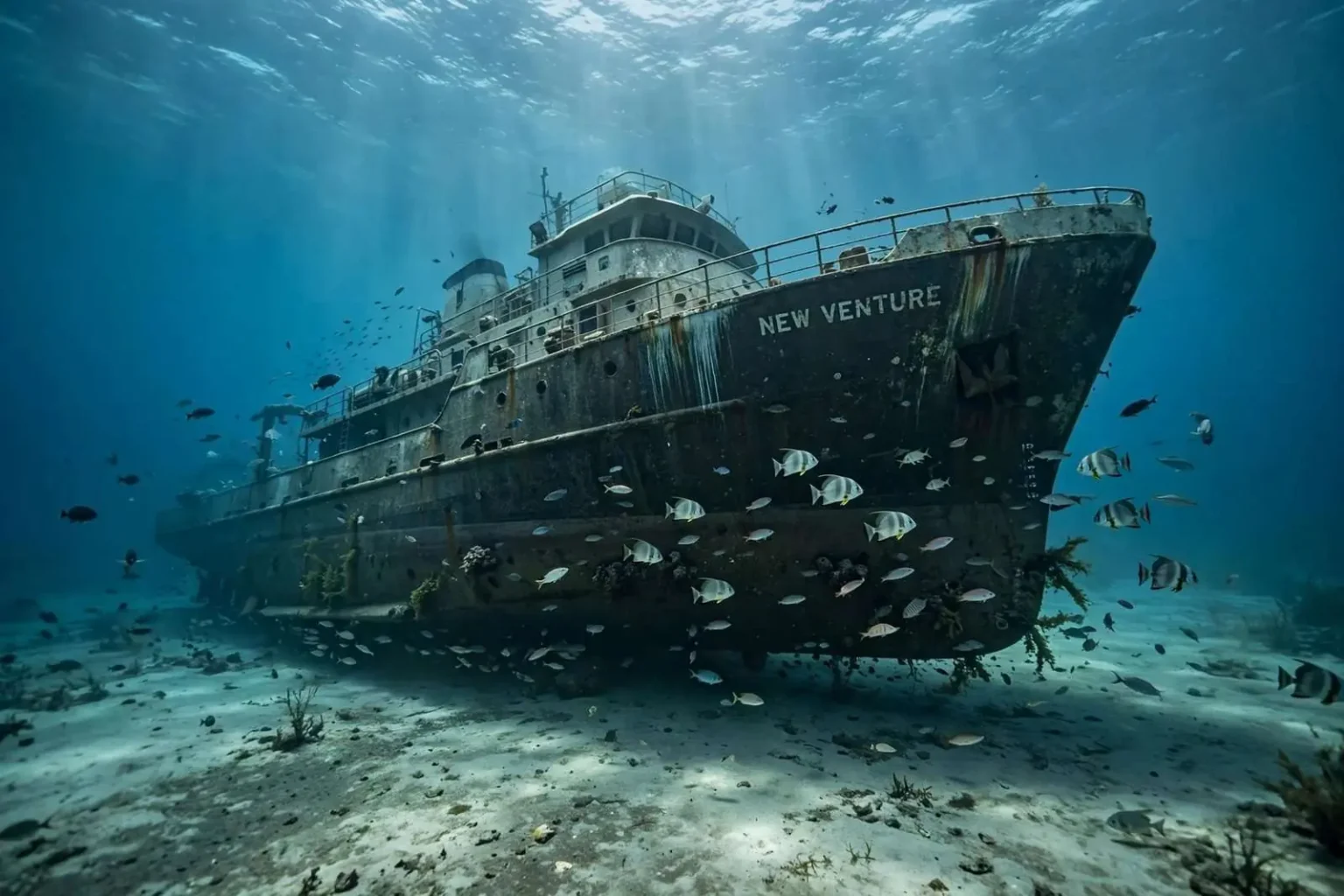
It took two tries, a broken-down pump and a runaway anchor, but Alabama’s newest artificial reef is finally where it belongs: on the bottom of the Gulf of Mexico. “No, but it’s down,” said Craig Newton, a biologist with the Alabama Marine Resources Division, when asked whether the sinking went smoothly. The honest answer captured what those who follow the state’s reef program already know: putting a 250-foot ship on the bottom of the Gulf is heavy marine work, and heavy marine work rarely goes to script.
A rough road to the bottom
The New Venture, a former 250-foot research vessel, now sits on the Gulf floor about 20 miles south of Orange Beach, roughly two miles from where the LuLu, a much larger retired vessel sunk in May 2013, already draws divers and anglers. The LuLu went down on the first attempt. The New Venture did not.
Crews made their first attempt to sink the ship on June 20, but ran into trouble once the vessel was in position. “The biggest problem was the pumps that were taken out there were not in good operating condition and didn’t keep them running,” Newton said. “Then we had to wait until we got another boat out there with some appropriate pumps, with pumps in good condition.” Flooding a ship in a controlled way depends on pumps that run steadily while the water rises; when the pumps falter, the whole operation stalls until replacements can be found and ferried offshore.
While the crew waited for working equipment, the ship drifted off course. “By that time the boat had drug its anchor outside of the reef zone,” Newton said. “Then we had to wait until a tug could make it out there and tow it back to the reef zone and to the reef site. Once we got that done we were able to sink it that day.” A vessel the size of the New Venture cannot simply be nudged back into place; repositioning it required a seagoing tug, and finding one available on short notice added another delay to a day that had already run long.
The holdup mattered for more than scheduling reasons. Reef material must settle within the boundaries of a permitted reef zone, an area mapped and approved in advance, so that the state knows exactly where the structure sits and how it relates to the other wrecks and deployments around it. A ship resting outside the zone would have been an obstruction to navigation and a regulatory headache, which is why crews watch the anchor watch so closely while a vessel waits to go down.
An unplanned descent
Even once the sinking got underway, it didn’t go according to script. The original plan called for the stern of the ship to flood and hit bottom first, followed by the bow. Instead, the opposite happened. “There were too many pipes connecting the forward and aft tanks, so we were unable to isolate where the water was going,” Newton said. “Everything essentially ended up draining toward the bow of the ship, resulting in the bow going down first.”
Reef teams prefer a stern-first sinking for a simple reason: the stern hits the bottom, plants itself like a foot, and the rest of the hull follows it down in a controlled line. A bow-first descent risks the vessel digging its nose into the seabed and pitching forward, or settling at an angle divers and anglers would rather not deal with. In older ships built for other purposes, the internal plumbing rarely cooperates with the engineers’ intentions, and the New Venture was no exception.
Despite the unplanned sequence, the ship settled the way reef managers had hoped. “It still landed upright and is sitting on its keel,” Newton said. “There’s no notable list of the ship sitting on the bottom and the pilothouse is about 57 feet below the surface.” An upright ship on its keel is the best possible outcome of any sinking, planned or otherwise. It presents a predictable profile for divers, creates the kind of vertical relief that attracts reef fish, and holds its position on the bottom without the rolling and shifting that plague vessels that land on their sides.
For the diving public, that pilothouse depth is the number that matters most. The upper structure of the wreck sits within easy recreational range, while the hull extends deeper toward the sand, giving the site a spread of depths that different divers can use in different ways.
More reef work underway
The New Venture sinking is only one piece of a larger reef-building effort by the Alabama Marine Resources Division, the state agency that manages the state’s marine resources and oversees the reef program’s deployments in both state and federal waters. The agency is also in the middle of deploying 600 pyramid-shaped reef structures in seven new reef zones stretching from Dauphin Island to Orange Beach, six to nine miles offshore.
“These are 10-feet tall concrete pyramids. So far we’ve got 100 of those pyramids out now and we should have another 100 of them put out probably Friday or Saturday of this week,” Newton said. “The construction schedule is getting out another 100 of these every other week.” At that pace, the full deployment of 600 pyramids would be complete in a matter of months, converting a long stretch of relatively featureless bottom into seven new zones of structured habitat.
The pyramids are a different kind of reef than a sunken ship. Manufactured from concrete with openings designed to let water move through them, they provide shelter for small fish and hard surfaces for the growth that anchors the food chain, without the navigational hazards and permit complications of a tall wreck. Their modest height keeps them well below the surface even at low tide, so they are invisible from above but easy to find on a depth sounder.
Taken together, the New Venture and the pyramid program represent the two halves of Alabama’s reef strategy: a few large, famous wrecks that draw divers from across the region, and hundreds of smaller structures that raise the productivity of the bottom itself. Both depend on the same slow, unglamorous work — permits, barges, tugs, pumps and patience. The New Venture’s two-day ordeal was a reminder that even a routine deployment can go sideways, and that the measure of success is not a smooth schedule but a ship sitting upright where it is supposed to be.
For now, the newest addition to the fleet is open for business. Charter captains running out of Orange Beach have a fresh set of coordinates to add to their books, divers have a wreck whose pilothouse sits within comfortable range, and the fish have another 250 feet of sheltered structure two miles from the LuLu. It took two tries and a tow back into the zone, but the bottom of the Gulf south of Baldwin County is that much richer for it.
The logistics of the deployment tell their own story about the scale of the program. A sinking operation requires the vessel to be cleaned of fuels and oils, cleared of anything that could contaminate the water, and certified as environmentally safe before it ever leaves the dock. Openings have to be cut or removed so divers can enter safely and so the ship floods in a predictable way, and Coast Guard and state permits spell out where the vessel may rest and what preparations are required. Only then does the towing, positioning and pumping that the public actually sees take place, often far offshore where every equipment failure costs an hour or a day.
Weather and sea state govern everything. A calm forecast at the dock can turn into a hard current at the site, and a barge or tow that handles fine in protected waters becomes difficult work once the shoreline drops out of sight. Crews plan around those variables the way builders plan around rain, and when the sea disagrees with the schedule, the sea wins. That is why reef managers build slack into their calendars and why a deployment that takes two days instead of one draws little surprise from anyone who has worked offshore.
The New Venture’s research-vessel pedigree gives it some advantages as reef material as well. Ships built for science work typically have open deck space, stable hull forms and interior compartments that are easier to swim through than the cramped service spaces of a freighter or a naval hulk. Divers who visited the vessel in its first weeks on the bottom found the structure intact and the interior passages in the condition reef managers want: open enough to explore, with no surprises waiting in the dark.
The arrival of the ship also fills a gap in the geography of the southern reef zone. With the LuLu two miles away, the area now holds two significant wrecks within a short run of each other, giving charter operators the option of a two-wreck dive day and giving anglers a wider choice of structure in the same neighborhood. Reef managers describe that kind of clustering as deliberate: the more productive destinations a zone contains, the more evenly its use is spread, and the more value each new deployment adds to the ones around it.