
Newhouse-owned Alabama newspapers weigh outsourcing Birmingham News printing
Advance Publications is weighing outsourcing The Birmingham News printing in a move that could cut more than 100 jobs at the Newhouse-owned paper.
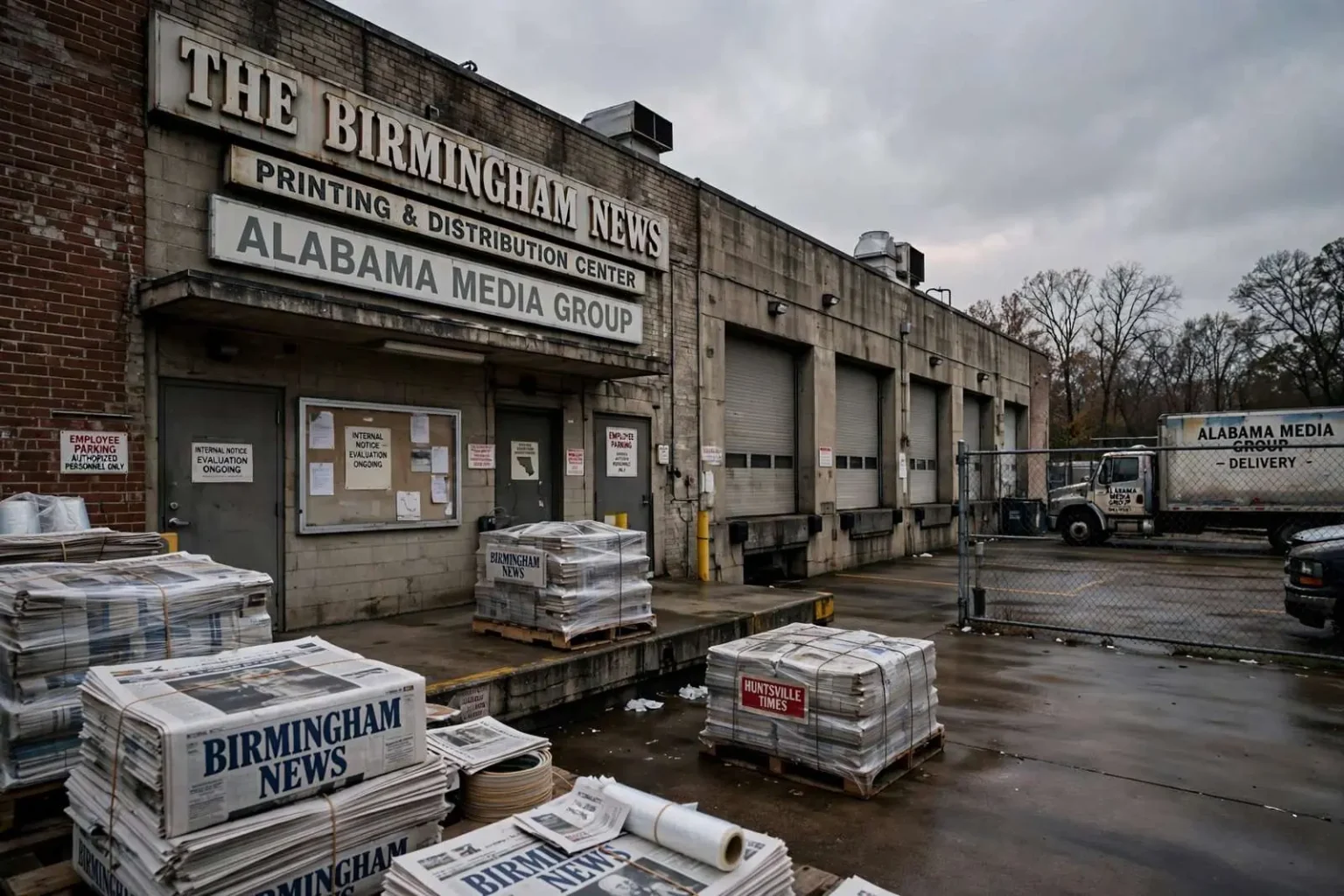
Alabama’s Newhouse-family newspapers are once again redrawing their operations, and the shift is reaching readers in Mobile. An internal company email described to local media indicates Advance Publications is exploring outside printers for The Birmingham News, a change that could eliminate more than 100 positions. A final decision was expected within about eight weeks, with the company pointing to operating, capital and facility savings.
The prospect of a contracting pressroom in Birmingham is not just a Birmingham story. The Birmingham News also handles printing for The Huntsville Times, so any consolidation would touch multiple markets across the state — and it would land on top of a series of moves that have already reshaped how the Newhouse papers in Alabama produce, price and deliver the daily newspaper that reaches tens of thousands of homes from Huntsville to the Gulf Coast.
For the state’s largest news organization, the deliberations mark another step in a long retreat from the heavy infrastructure of print. Each press, each printing plant and each truck route carried real costs that the industry’s economics can no longer support at their old scale, and publishers across the country have made the same calculation Alabama’s papers now appear to be weighing.
What the Company Is Considering
According to the internal email described to local media, Advance Publications has been evaluating whether to move The Birmingham News’ printing to an outside printer rather than continue producing the paper on its own equipment. The potential savings fall into three categories the company itself identified: operating costs, capital spending and facility costs.
Those categories map directly onto what a printing operation requires. Operating costs cover the labor, ink, newsprint and maintenance consumed by every press run. Capital costs cover the presses themselves — machinery that runs into millions of dollars per unit and requires periodic replacement. Facility costs cover the buildings that house the presses, along with the utilities, insurance and upkeep those industrial spaces demand.
More than 100 positions could be eliminated if the outsourcing moves forward, a figure that captures pressroom staff and the support jobs tied to an in-house printing plant. A final decision was expected within about eight weeks of the email, leaving a narrow window for the affected workforce and the communities around the plant.
The Birmingham News’ printing operation is not dedicated to Birmingham alone. The paper also produces the printed edition of The Huntsville Times, meaning any consolidation would ripple into a second market several hours to the north. It is a reminder that newspaper printing has long been a shared industrial operation: one plant, multiple titles, one set of fixed costs spread across as many papers as the presses can carry.
A Longer Pattern of Contraction
The possible outsourcing is the latest chapter in a consolidation that began years earlier. Advance Publications reorganized its Alabama papers around a single Alabama Media Group, merging newsrooms, sharing content across titles and shrinking print schedules. The Mobile Press-Register, The Birmingham News and The Huntsville Times now operate as related editions of one organization rather than as fully independent newspapers, with shared reporters, shared photographers and shared production decisions.
Across the industry, the direction of travel has been consistent. Chains have sold or demolished printing plants, cut home-delivery days and moved increasingly toward digital subscriptions as advertising revenue that once funded large print operations migrated to online platforms. The Newhouse papers’ consideration of outside printing puts Alabama squarely inside that national pattern: the company steers resources toward digital products and away from the physical printing plants that anchored its papers for generations.
For readers, the physical markers of that shift are already familiar. Thinner sections, earlier deadlines, reduced delivery windows and consolidated printing schedules all trace back to the same arithmetic now being applied to the Birmingham pressroom itself.
The Cost Reaching Mobile Subscribers
Separately, Press-Register subscribers in Mobile have begun receiving letters informing them they will now pay city, county and state sales taxes on their subscriptions — charges that had previously been bundled into the overall price of the paper.
The letters mark a change in how the cost of a subscription is presented rather than a change in the news itself, but for subscribers the effect is the same: a higher bill. Inside the city of Mobile, the combined sales tax rate stands at 10 percent, one of the higher combined rates in the state once city, county and state levies stack together. Applied to a home-delivery subscription, that rate adds a visible line to every billing cycle.
It was the second increase for many subscribers in a year. Rack prices for weekday editions rose 50 cents last August, with that earlier hike calculated by ZIP code — meaning the price of picking up a paper at a newsstand varied depending on where the buyer lived and which local taxes and delivery costs applied to that location.
The ZIP-code pricing of the earlier increase reflected the fragmented geography of Alabama’s sales taxes. Municipalities and counties across the state levy their own rates on top of the state’s base tax, and a publisher selling printed papers at hundreds of rack locations has to account for each jurisdiction’s rules. Passing those charges through by location was the administratively simplest way to handle it.
Why the Taxes Are Showing Up Now
Splitting sales tax out of a bundled subscription price follows a broader trend in how digital-era services are billed. When a charge was buried inside a single subscription rate, customers rarely saw it; itemizing it makes the tax explicit on the invoice. The letters to Mobile subscribers accomplish exactly that — converting an invisible cost into a visible one on the same bills that had previously shown a single price.
For a publisher under pressure, the change also raises revenue without raising the headline subscription rate itself. The paper’s list price stays where it is on the letter, while the taxed total climbs. Combined with the rack-price increase of the previous August, subscribers in Mobile have now absorbed two cost increases in roughly a year — one at the newsstand, one on the invoice.
Mobile readers have watched the Press-Register, the state’s oldest paper with roots stretching back to the early 1800s, shrink through the same transitions as its Newhouse siblings. Its newsroom merged into the shared Alabama Media Group operation, its print schedule was reduced, and its production decisions now sit inside the same corporate framework as Birmingham’s and Huntsville’s. The sales tax letters are the newest, most personal expression of that framework — felt not in a pressroom across the state, but on a subscriber’s kitchen table.
What It Means for Readers and Workers
The two developments — possible printing outsourcing in Birmingham and itemized taxes in Mobile — are different faces of the same strategy. One reduces the cost of producing the physical paper; the other increases the revenue collected from the people who buy it. Both flow from the same underlying reality: the printed daily newspaper generates less revenue than it once did, and its publisher is adjusting every part of the operation to match.
For the more than 100 workers whose positions could be eliminated in Birmingham, the eight-week window is the difference between stability and a job search. Printing-plant skills — press operation, mechanical maintenance, logistics — do not transfer easily to other local industries, and a plant closing reverberates through vendors, transport contractors and the suppliers who kept the presses running.
For subscribers in Mobile, the question is simpler and more personal: what a home-delivered paper costs, and whether the value holds as the price climbs. The letters answering that question now include three lines of taxes where there used to be one bundled price.
The Digital Destination
The moves reflect a broader retrenchment by the publisher as it steers resources toward digital products and away from the physical printing plants that anchored its papers for generations. Advance Publications, the Newhouse family’s media company, has executed versions of this transition across its holdings nationwide — most famously in New Orleans, where The Times-Picayune’s print schedule was slashed in favor of a digitally focused newsroom, a decision that made the company a national case study in forced digital migration.
Alabama’s papers followed the same arc on their own timeline. The creation of the shared Alabama Media Group aligned Mobile, Birmingham and Huntsville into one operation with one set of digital products, one website platform and one subscription strategy. Every step since — the merged newsrooms, the reduced print schedules, the pricing changes now arriving in subscribers’ mailboxes — has followed from that consolidation.
The economics behind the shift are not subtle. Print advertising, the revenue that once paid for buildings full of presses, has largely moved to digital platforms that do not employ journalists. Subscription revenue has grown in importance, but digital subscriptions are typically priced lower than print ones, and print subscribers still cost money in newsprint, delivery trucks and fuel. A publisher’s response has been to shrink the print operation toward whatever level the remaining revenue supports — which is precisely the exercise underway in Birmingham.
What Comes Next
Within about eight weeks of the internal email, the company was expected to make a final decision on whether The Birmingham News continues to print in-house or moves to an outside printer. The outcome will determine whether more than 100 employees keep their jobs and whether the building that houses the presses continues to serve its long-standing purpose.
Outsourced printing would not be unprecedented in the industry. Newspapers across the country have moved production to contract printers, to facilities shared with other publishers, or to plants in distant markets, accepting longer truck routes and earlier deadlines in exchange for shedding fixed costs. The physical paper still arrives; the industrial operation behind it simply belongs to someone else.
What would change for readers is mostly invisible, with one significant exception: deadlines. Papers printed farther from their markets must be finalized earlier, which pushes late news, late sports scores and late-breaking photography out of the printed edition. In an era when most readers see updates online within minutes, the practical cost is modest — but it is another narrowing of what the printed paper uniquely offers.
For now, subscribers in Mobile and elsewhere in Alabama are watching the same story unfold from two directions. In Birmingham, the question is whether the presses will keep running at all. In Mobile, the question is what a subscription will cost once every previously bundled charge shows up on the bill. Both questions trace back to the same strategic conclusion the company has already reached: the future of its papers is digital, and every decision about printing plants, pressroom jobs and subscription pricing is now filtered through that endgame.
The generations-long era of Alabama newspapers owning their own printing operations — the plants that turned reporters’ copy into ink on paper for delivery across three metropolitan areas — is not ending with a single announcement. It is ending the way the industry’s transitions always have: in an internal email, an eight-week review, a set of letters to subscribers and a series of quiet line items that add up, eventually, to a different kind of newspaper company than the one the state has known.