News 5 spends the day with the Blue Angels ahead of Pensacola Homecoming
A News 5 meteorologist spent the day with the Blue Angels as the demonstration squadron prepared for its Pensacola Homecoming Air Show.
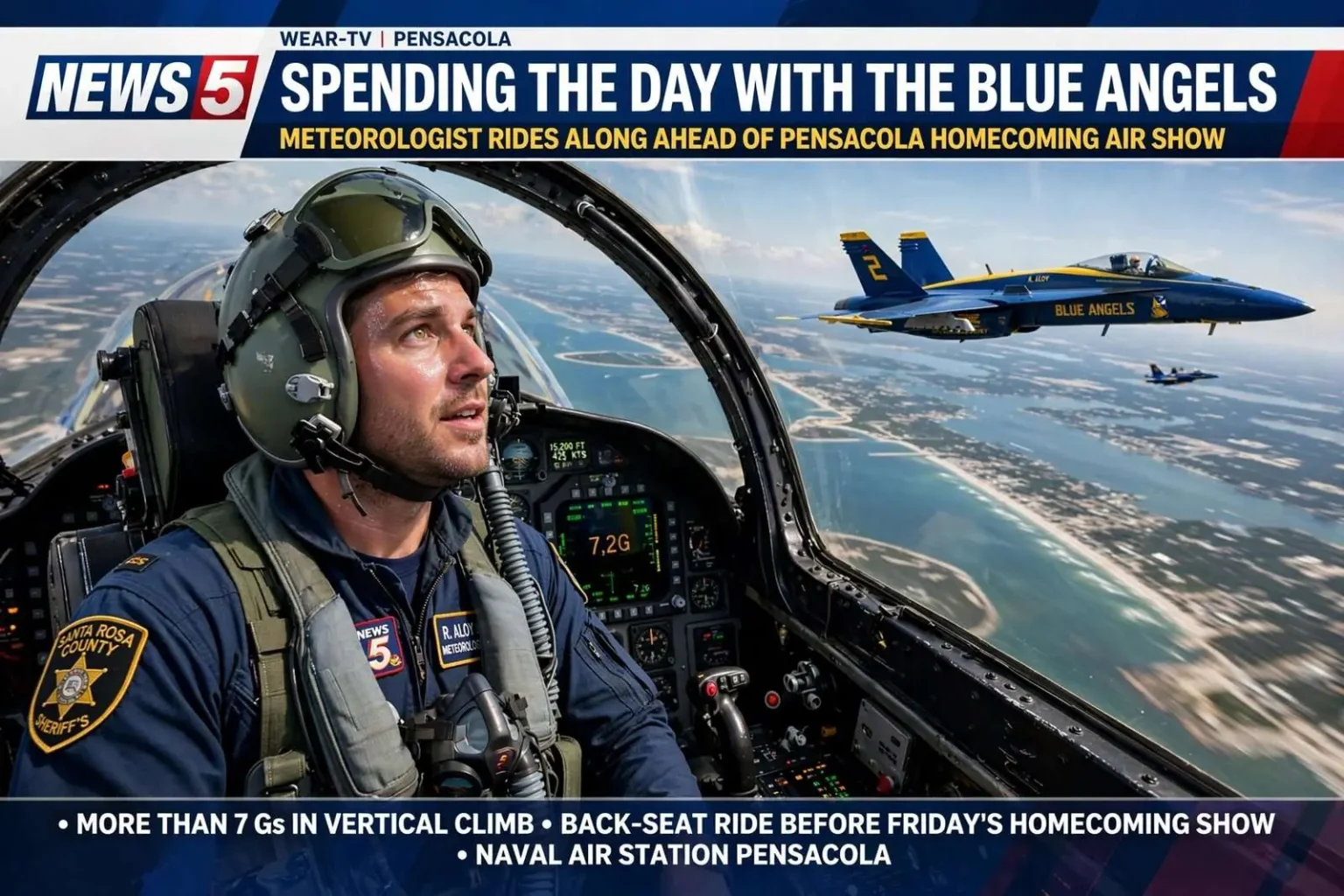
A News 5 meteorologist got a behind-the-scenes look at the Blue Angels this week as the demonstration squadron prepared for its Homecoming Air Show in Pensacola, riding along with the team ahead of the season’s signature event. Rich Aloy, who works for the Santa Rosa County Sheriff’s Office, realized a longtime dream when he strapped in for a flight with the team — a back-seat ride in a Navy F/A-18 that most civilians never experience.
“You just never dream that you’d have this opportunity,” Aloy said as he suited up. The flight came as the Blues put the finishing touches on their routines for the Homecoming Show, the annual season finale held at their home field at Naval Air Station Pensacola, where the squadron has trained and performed since its founding in 1946.
During the flight, the jets pulled more than 7 Gs — seven times the force of gravity pressing on the body — as Aloy rode through the maneuvering that the demonstration pilots perform in front of millions of spectators over a season. For a weather professional who watches the Blues from the ground every year, the ride offered the view from the cockpit: the Gulf Coast unrolling below, the cockpit instruments climbing and the G-force building through each turn.
Seven Gs and a vertical climb
Aloy said the hardest maneuver was a vertical climb. “I got a little queasy, but other than that, it’s just amazing,” he said. The vertical climb is one of the most physically demanding moments in the demonstration, as the aircraft points skyward and acceleration drives the pilot — and any back-seat passenger — deep into the seat while the horizon drops away below the canopy.
Sustained Gs of that magnitude are what disqualify most people from ever riding in a Blue Angels jet. Civilian passengers receive ground training before a flight, including how to perform the anti-G straining maneuver that keeps blood flowing to the brain under load, how to breathe, and what to do when vision starts to narrow. Even so, first-time riders frequently struggle through the peak-G portions of a demonstration flight, which makes Aloy’s verdict — queasy but amazed — a fairly typical after-action report from the back seat.
The ride gave Aloy a new appreciation for what the pilots endure during a show. What spectators see as graceful geometry — the diamond formation’s tight spacing, the pass in review, the opposing passes that close at combined speeds approaching 1,000 mph — is felt in the cockpit as physical force, repeated maneuver after maneuver across a 40-minute performance.
The Homecoming Air Show
The Homecoming Show is the last of the season and was expected to draw big crowds at Pensacola on Friday and Saturday. Each October, the Blue Angels close their air show season at Naval Air Station Pensacola, performing in front of their home crowd — the families, veterans, retirees and aviation fans of the Gulf Coast who watch the squadron practice over the bay nearly every week of the year.
Homecoming is different from the other stops on the circuit. The squadron flies over the base where it trains, in front of an audience that includes its own families and the Navy and Marine Corps personnel who support the team, and the event traditionally features a full lineup of military and civilian performers alongside the Blues’ finale. Parking lines form before dawn, and the crowd that gathers along the show line is among the largest drawn to any event on the Gulf Coast each year.
For NAS Pensacola, the show doubles as an open house and a community celebration — the base’s main annual event open to the public, and the occasion when the region’s long relationship with naval aviation is put on display. The base is home to the Naval Air Technical Training Center and the National Naval Aviation Museum, and generations of Gulf Coast residents trace their own family histories through its gates.
News 5 and the Gulf Coast’s Blue Angels connection
The ride-along continues a long tradition of Gulf Coast media members flying with the team. Local television stations along the Panhandle cover the Blues as a home beat — practices over Pensacola Bay are visible from shore and part of the region’s daily rhythm — and media flights are a standard part of the squadron’s community engagement, sending into the sky the reporters and forecasters who cover the team from the ground all season.
Aloy’s flight also connected two parts of the region’s public-service world. The Santa Rosa County Sheriff’s Office, where he works, patrols the county just north and east of Pensacola — communities that turn out in force for the Homecoming Show every fall — and his flight gave viewers across northwest Florida a back-seat perspective on the event their neighbors fly in every week.
As a meteorologist, Aloy brought a professional’s eye to the weather that governs every air show. Gulf Coast October weather is generally favorable for flying — cooler, drier air behind the season’s first cold fronts — but cloud decks, wind and visibility determine which maneuvers a demonstration team can safely fly on a given day, making the forecast as much a part of the show as the airplanes themselves.
What it takes to fly with the Blues
Civilian rides in Blue Angels jets are rare by design. Passengers fly in the F/A-18D model’s back seat, flown by the squadron’s naval flight officers, and the team limits rides to media members, key influencers and other guests as part of its mission of community outreach. Before anyone straps in, there is ejection seat training, physiological training, a fit check for the flight gear and a briefing on the maneuvers to come — a full day of preparation compressed into the moments before Aloy suited up.
Once airborne, the back-seater experiences the demonstration from the inside: the launch off the runway with the afterburners lit, the G loads through the loops and rolls, the close formation flying where the wingman’s aircraft fills the canopy, and the low passes that make the ground rush by faster than any commercial flight ever will. More than 7 Gs means a 200-pound body weighs well over 1,400 pounds at the peak — and the anti-G maneuver riders learn on the ground is the difference between riding it out and passing out.
That is the appreciation Aloy carried home. The pilots do it all while flying formation within feet of each other, executing a scripted sequence at speeds of up to 700 mph, without the queasiness that a first-time passenger feels. The ride gave Aloy a new appreciation for what the pilots endure during a show — and gave his viewers a reason to watch this year’s Homecoming performance with new eyes.
The season ends at home
With Pensacola’s Homecoming Show, the Blue Angels close another season that has taken them to cities across the country — performances before crowds that number in the millions over the course of a year, each show a recruiting showcase for naval aviation and a signature event for the communities that host them.
Friday and Saturday’s expected crowds will be the largest the team draws all season. For the Gulf Coast, the Homecoming Show is a homecoming in the truest sense: the squadron’s own families watching from the flight line, the region’s schools emptying out for the day, and the beaches and bayfront filling with spectators watching for the diamond formation over the water.
Aloy’s flight will be long over by the time the team takes off for its finale, but his back-seat report — more than 7 Gs, a vertical climb, a little queasy and entirely amazing — stands as the best preview of what the pilots and their aircraft will deliver over Pensacola as the 2021 air show season comes to its close.
The rides matter to the mission
The Blue Angels exist for outreach — the squadron’s official mission is to enhance recruiting and represent the pride and professionalism of the Navy and Marine Corps, and every civilian flight serves that purpose. A back-seater who returns to earth talking about the experience reaches an audience that no advertisement can buy, and Gulf Coast media rides have introduced the team to generations of viewers who might never otherwise set foot on a flight line.
For Aloy, the flight also bridged his two professional worlds: the forecasting he does for News 5 and the emergency-response work of the Santa Rosa County Sheriff’s Office, both of which depend on understanding the Gulf’s weather from the ground. From 15,000 feet over the Florida Panhandle, he saw the same skies he forecasts for from a very different angle.
A finale worth the crowd
The crowds expected Friday and Saturday at Pensacola will cap the season the way the Blues’ home crowd expects: the full demonstration flown over the field where the team rehearses, the crescendo of the sneak passes and the bomb burst, and the pass in review that closes every performance. Spectators should arrive early, expect security screening at the base gates, bring sun protection and prepare for a full day on the flight line — the format that has made Pensacola’s show a rite of fall on the Gulf Coast.
For the team, ending at home means the season’s last performances are flown over familiar water in front of familiar faces. For Rich Aloy, it meant watching the finale having just come down from the back seat — with a new appreciation for more than 7 Gs, a memory of a vertical climb that made him queasy, and the story of a dream realized in the cockpit of a Blue Angels jet.