
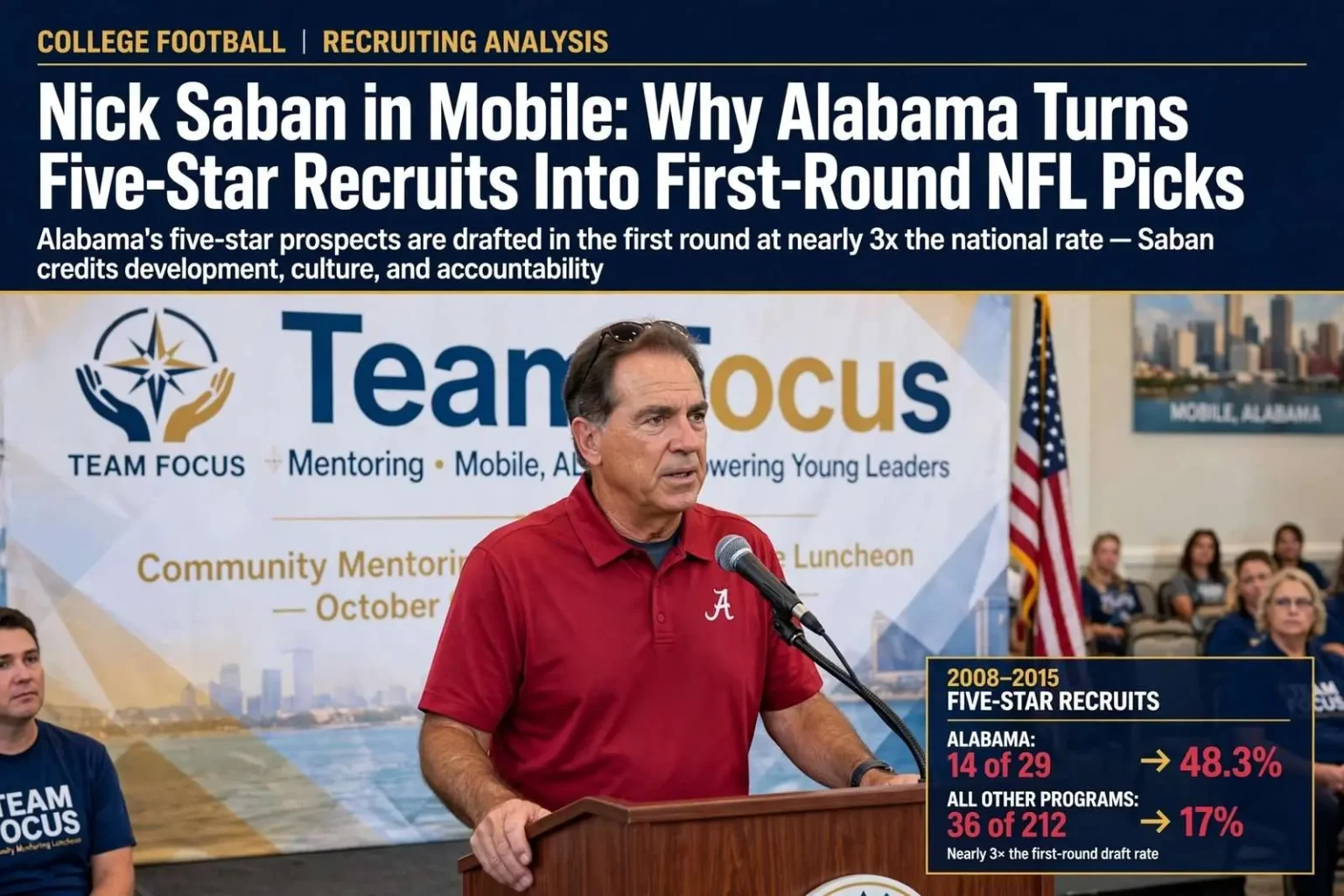
Alabama’s recruiting pitch rests on a striking statistic: from the 2008 through 2015 classes, five-star prospects who signed with the Crimson Tide reached the first round of the NFL Draft at nearly three times the rate of five-stars who went anywhere else. The figure has become a staple of Alabama’s recruiting conversations, delivered by assistants on the trail and echoed by coaches around the SEC: if a prospect is choosing among the sport’s elite programs, the one in Tuscaloosa has turned elite rankings into professional outcomes at a rate no rival can match.
The numbers come from an examination of the 247Sports composite rankings across eight recruiting cycles — 241 players rated five-star nationally in that span. Fifty of them, or 20.7 percent, went on to become first-round picks. The composite, which averages the ratings of the major national recruiting services, is the closest thing college football has to a consensus talent ranking, which makes the tracking of its five-star tier the cleanest available test of whether elite rankings translate to professional careers.
But Alabama alone signed 29 of those blue-chippers, and 14 of them heard their names called in the first round, a success rate of 48.3 percent. The other 212 five-stars who signed elsewhere hit first-round potential at just 17 percent (36 of 212). In other words, a five-star who signed with Alabama was nearly three times as likely to become a first-round pick as a five-star who signed with any other program in the country — a gap too large to attribute to the ranking itself.
The sample includes some of the biggest names of the era, and the pattern held across position groups. Five-stars are overwhelmingly drafted from the premium positions — pass rushers, tackles, skill players — where early entry and athletic testing drive evaluation, and Alabama’s marquee signees at those spots delivered. For recruits and their families weighing the decision, the breakdown offered a concrete answer to the question every elite prospect eventually asks: where does a five-star actually become a first-rounder?
Five members of the 2016 class reach round one
Five members of the 2016 class were already first-round selections in last month’s draft — Ohio State’s Nick Bosa, Houston’s Ed Oliver, Alabama’s Jonah Williams, Michigan’s Rashan Gary and Clemson’s Dexter Lawrence. The draft class demonstrated that the five-star pipeline runs through programs across the country, not just through Tuscaloosa. But it also showed the range of outcomes within the tier: five early first-rounders from a single cycle, each of whom validated a top ranking years before his draft night.
For Alabama, Jonah Williams’ selection continued the program’s streak of producing early-round offensive linemen, a position group where development is often cited as the difference between a recruit’s rating and his professional ceiling. Offensive linemen arrive on campus with similar tools and leave with dramatically different pro prospects, and Alabama’s record at the position — developing touted high school blockers into high draft picks — has become one of the quiet arguments in its recruiting pitch.
Saban: ‘We do a really good job of developing players’
Nick Saban, appearing in Mobile to support the youth mentoring organization Team Focus, was asked directly why his program converts elite talent at such a high rate. The event brought the Alabama coach back to the Gulf Coast, where his recruiting footprint has long been deep, and gave local fans and youth a close-up look at a coach more often seen on Saturdays. His answer, in front of an audience built around mentoring young people, focused less on talent acquisition than on what happens after signing day.
“I think what it indicates is that we do a really good job of developing players,” Saban said. “We recruit a lot of good players and we have a lot of good players. But I think the key to the drill is how do we get those guys to play as well as possible for their benefit, for our benefit and for their future.” The framing — that development serves the player first — is the message Saban has carried into living rooms for years, and the draft statistics give it an evidentiary backbone that most recruiters lack.
Saban said the program takes a holistic view, building value through personal development, academic support and career preparation while surrounding players with what he called a culture of accountability. The structure is deliberate: strength and conditioning programs engineered to prepare bodies for professional evaluation, academic tracking that keeps players eligible and on schedule, and life-skills programming that treats the NFL as one stage of a career rather than the whole of it.
“We’re very proud that we’ve had 32 players drafted in the last three years, 22 in the last two years and 10 this year,” he added. “We want every guy in our program to get drafted as high as possible, but getting drafted is really just a starting point.” The draft totals, compiled across three consecutive classes, made Alabama the sport’s most prolific producer of professional talent during that stretch — a run that required not just signing five-stars but developing three- and four-star players into professionals as well.
What the numbers mean for recruits
For recruits weighing whether rankings guarantee professional futures, the honest answer is that they do not — and the data proves both directions at once. More than 80 percent of five-stars from the 2008-2015 cycles never became first-round picks, a reminder that elite ratings are a starting point rather than a prophecy. But Alabama’s 48.3 percent conversion rate shows that environment matters: the same rating, placed in the same program, produced dramatically different professional outcomes than the national average.
Recruiting analysts attribute the gap to a combination of factors that are hard to replicate. Alabama’s practice environments put five-stars against elite competition every day, its defensive and offensive schemes mirror professional systems, and its staff’s NFL connections shape how players are used and evaluated. Add the visibility of College Football Playoff television audiences and the program’s steady presence in national championship games, and five-stars in Tuscaloosa are evaluated by pro scouts constantly, in the most demanding settings available.
The counterargument, advanced by rival coaches, is that Alabama simply selects the surest five-stars — the ones most likely to succeed anywhere. But the composite data undercuts that claim: other elite programs signed plenty of the same tier of prospect, and their conversion rates remained far lower. Whatever weight one gives to selection versus development, the raw gap is why the statistic keeps appearing in Alabama’s recruiting materials — and why programs around the country have rebuilt their player-development operations in response.
Team Focus, the mentoring organization Saban appeared in Mobile to support, works with young people in the Gulf Coast region, connecting them with mentors and leadership programming. The coach’s appearance underscored the connection he draws between his program’s development philosophy and the mentoring message: talent is common, in his telling, and what separates outcomes is structure, accountability and people who invest in a young person’s future.
For South Alabama’s football families — a region that produces its share of Division I prospects — Saban’s Mobile appearance and the statistics behind his pitch carried a local relevance. High school players in Mobile and Baldwin counties sign with programs across the Southeast every February, and the five-star data has become part of the calculus their families weigh. The message from Tuscaloosa, backed by nearly a decade of draft results, is that development — not just the star rating — is what turns a recruit into a professional.
As the 2016 draft class showed, five-star talent will always find its way to the league — from Columbus, Houston, Ann Arbor and Clemson alike. But for eight straight recruiting cycles, the fastest route from the composite’s top tier to the first round ran through Tuscaloosa, and Alabama’s own numbers make the program’s case better than any recruiter could.
The 32 players drafted across three years deserve their own note, because the figure captures something the five-star data alone does not. No program signs 32 five-stars in three cycles; Alabama’s hauls, however celebrated, are a fraction of that number. The remaining draftees arrived as three- and four-star prospects — players the composite rated as good but not generational — and became professionals through the same development structure Saban described. That is the fuller proof of the program’s pitch: Alabama does not merely collect elite rankings, it raises the professional ceiling of players across its entire roster.
The 10 draftees in this year’s class alone would have ranked among the strongest single-draft outputs in the sport, and the two-year total of 22 set a pace that rivals have struggled to approach. Sustained draft production of that kind feeds on itself: high picks sign lucrative contracts, return to campus as visible examples, and become the most persuasive recruiting material a staff could ask for. Each April’s draft, in a real sense, becomes the following February’s recruiting class.
The pattern also reflects how professional evaluation has changed, in ways that favor Alabama’s model. NFL teams now lean heavily on college performance against elite competition, measured in detailed practice and game data, rather than on scouting combine workouts alone. Players who spend three years practicing against first-round-caliber teammates arrive in the league already tested at professional speed. For a five-star, that means the fastest way to prove pro readiness is a college environment where every rep is contested by future pros.
Saban’s Team Focus appearance also fit a broader pattern in how the Alabama staff markets its culture. Development, in the program’s telling, is not a slogan but a system — position coaches with professional experience, a strength staff that prepares players for the draft’s physical benchmarks, and an accountability structure that players describe as demanding from the first workout. Prospects hear the same message from former players on the trail, which gives it credibility that no brochure can match.
And for every five-star who converts, the program’s example shapes the decisions of the players ranked just beneath. A four-star watching 14 of Alabama’s 29 five-star signees become first-round picks draws the obvious inference: if the program develops top-of-the-tier talent at that rate, the same structure is available to him. The statistic aimed at five-stars, in practice, recruits the whole roster.