Nine Months After Ladder Fall Left Him in a Coma, Alabama Man Shows Progress in Florida Rehab
John Peacock, who suffered a traumatic brain injury in a November ladder fall, is showing progress four weeks into a rehabilitation program at Brooks Rehabilitation Hospital in Jacksonville, his family says.
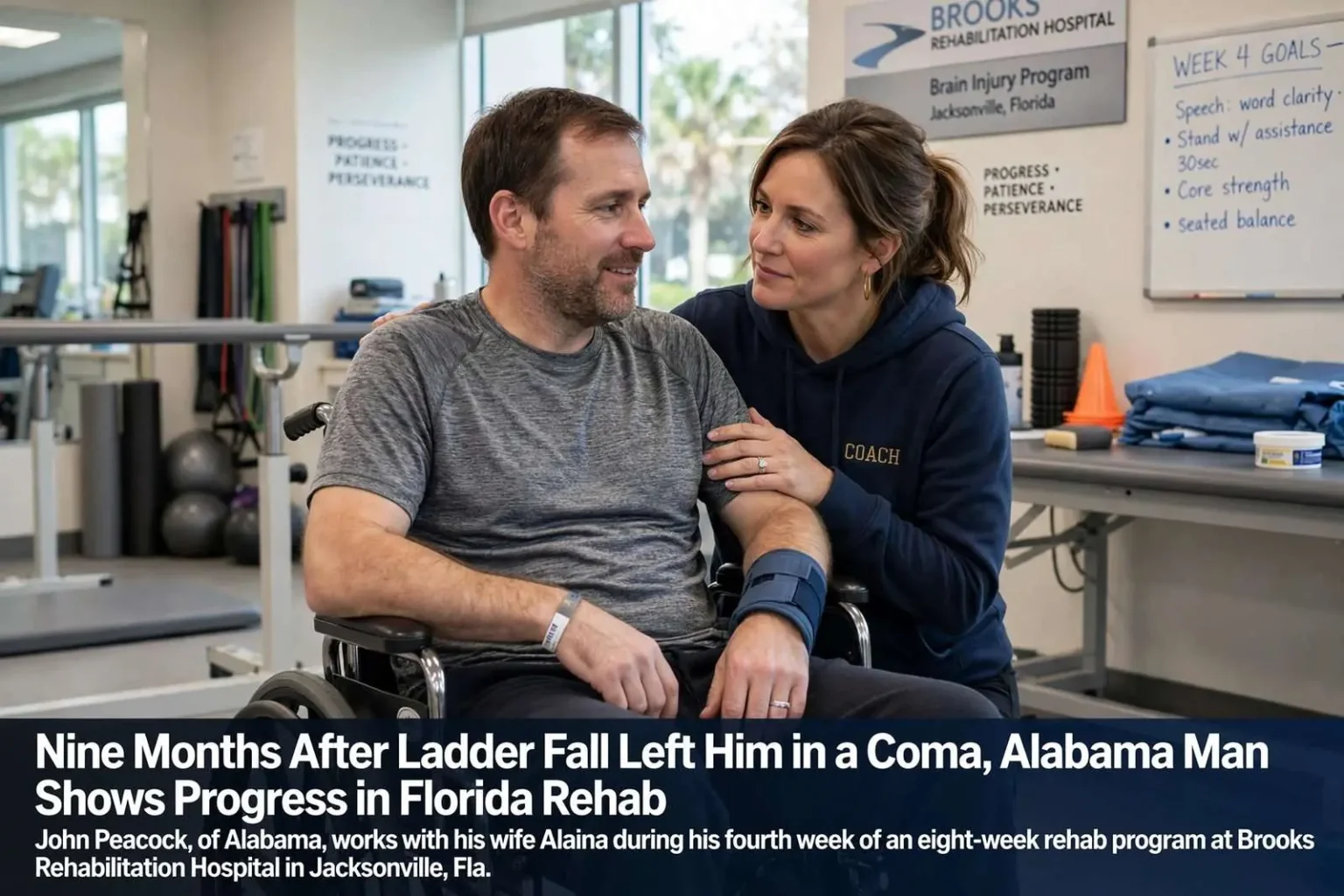
Nine months after suffering a traumatic brain injury in a fall from a ladder, Alabama resident John Peacock is four weeks into an eight-week individualized rehabilitation program at Brooks Rehabilitation Hospital in Jacksonville, Florida, and his family says he is making real progress.
Peacock fell in November and spent nearly a month in a coma before being transferred to Brooks Rehabilitation Hospital, where he began showing signs of movement, according to his wife, Alaina Peacock.
The arc of his care traces the path severe brain injury typically follows. The first weeks after such a fall are spent in acute care, where the immediate work is survival — managing swelling, pressure and the complications that follow prolonged unconsciousness. A coma lasting nearly a month is a measure of how serious the injury was. Only after a patient stabilizes and begins to surface does the focus shift to rehabilitation, the long, painstaking process of rebuilding speech, movement and cognition a hospital ICU cannot begin.
Brooks Rehabilitation Hospital, where Peacock is now in his fourth week, is one of the Southeast’s dedicated facilities for that work, drawing patients from across the region for its brain injury programs. Families routinely travel hundreds of miles to place a loved one there — which is how an Alabama family came to spend the spring and summer of his recovery in Jacksonville.
The road to keeping him in continued care has not been easy. Alaina said insurance companies pushed the family to have John leave Brooks, and she spent weeks fighting to keep his treatment on track.
That fight is familiar to almost every family in a comparable position. Insurance coverage for post-acute rehabilitation is structured around assessments of functional progress, and carriers routinely press for discharge once a patient’s measured gains slow, even when clinicians believe more therapy would produce more. For the family, the dispute arrives at the worst possible moment — while they are learning to navigate a new world of therapy schedules, medical terminology and paperwork — and it has to be fought with appeals, documentation and persistence at precisely the time their emotional reserves are lowest.
After an evaluation in May, doctors determined John was not yet physically ready for the facility’s day program, so he was brought back for an individualized program aimed at getting him there.
“He didn’t get into the day program, which we’re still working really hard to get him ready for it, but brought him back for his own individualized program to get him ready for it,” Alaina said.
The distinction between the two tracks is central to how Brooks works. The day program is the step at which a patient attends therapy intensively while living more independently; the individualized inpatient program is the more supported stage before it. Being held at the earlier stage was not a setback so much as an honest assessment — the therapists judged that he needed more groundwork before the day program’s demands would serve him, and the family accepted that judgment as the plan.
A coach leaves the court for a hospital
Alaina, the former head women’s basketball coach at Alma Bryant High School, stepped away from coaching to be by her husband’s side throughout his recovery.
The school she left sits in the Irvington area of southwest Mobile County, and her departure removed a familiar figure from its sidelines. High school coaching in a single community is a years-long investment in young athletes and their families, and stepping away from it mid-recovery meant surrendering a program she had built — a decision families in her position make not because they want to, but because rehabilitation demands an advocate present every day.
She said progress that once seemed out of reach has become visible in recent weeks. “He is able to produce words now, whereas four weeks ago, he absolutely couldn’t,” she said.
The reappearance of words is one of the milestones families of brain injury patients watch for most closely, because speech is where cognition, memory and the physical apparatus of speaking intersect. Producing words again does not mean conversation has returned; it means the machinery is coming back online, and that the months of therapy aimed at that machinery are doing something measurable.
Alaina said she has also learned how to support John outside of his formal therapy sessions. “They taught me how to have a conversation with him, and so that was the first week he was here and that was huge,” she said.
The training she describes is a deliberate part of modern brain injury rehabilitation. Therapists coach family members in pacing, prompting and patience — how to give a patient time to find a word, how to structure questions so they can be answered, how to read frustration without reacting to it. The effect is to turn every interaction at the bedside into an extension of therapy, which is why families who learn it often describe the lesson as transformative.
A family split across two states
The recovery has separated the family. While Alaina remains in Florida with John, the couple’s two sons have returned to school — their younger son, Easton, a first-grader staying with family in North Alabama, and their older son, J.C., beginning his senior year of high school in Irvington.
“It’s definitely heartbreaking because our oldest is a senior, so we have missed the beginning of his senior year,” Alaina said. Still, she said the family is doing what has to be done. “Everyone is where everyone has to be right now,” she said.
The arrangement the Peacocks describe is the ordinary logistics of catastrophic injury, and it is worth spelling out because it is so often invisible. One parent lives near the rehabilitation hospital for months. The children stay with relatives — in this case in North Alabama, hours from their home in Mobile County — and attend school from there. The senior year, with its football games, applications and last first days, proceeds without one of the parents who expected to watch it. None of this appears in any medical chart, yet it is the part of the injury that the family carries longest.
John has four weeks remaining in his current rehab program. After that, the family hopes to return home briefly before coming back to Brooks for additional rehabilitation.
The plan maps the road ahead for severe brain injury recovery, which rarely ends with one discharge. Patients typically move through multiple program phases over a year or more — inpatient rehabilitation, then day programs, then outpatient therapy — with gaps at home between them. Each return to Jacksonville for more rehabilitation reflects the understanding that progress, once underway, should be kept moving while it is moving, rather than pausing for the calendar’s convenience.
A GoFundMe page has been set up to help support the Peacock family.
The fundraiser addresses the practical arithmetic the family faces. Months of lodging near a Jacksonville hospital, income interrupted by a coach’s departure from her post and the costs of maintaining a household across two states add up in ways insurance does not touch. Community fundraising has become the standard mechanism for such gaps, and pages like the Peacocks’ typically carry the story of an injury in the family’s own words — in this case, a ladder fall in November, a month in a coma, and a recovery that is, week by week, giving words back.
The Peacocks’ account is also a picture of what brain injury rehabilitation looks like from the family’s side of the glass, a view that is easy to miss when coverage stays on medical milestones.
The first part of that picture is advocacy. Alaina’s weeks of fighting to keep John at Brooks — against insurers pushing discharge — are the labor that determines whether a promising rehabilitation actually continues. Families in her position become, without training, experts in coverage rules, assessment criteria and appeal deadlines, because the alternative is accepting a discharge date they believe is premature.
The second part is participation. The conversation training Brooks gave her in the program’s first week turned her from a visitor into part of the therapy itself, which is the model modern rehabilitation facilities prefer: progress made in therapy sessions holds better when the environment around the patient — above all the family — reinforces it.
The third part is endurance, measured not in therapies but in calendars. Nine months after the fall, the injury still dictates where every member of the family lives. A first-grader in North Alabama, a senior at his home school without his mother at the season’s start, a coach away from her team, a father four weeks into an eight-week program: the schedule of one man’s recovery has been redistributed across an entire family, and everyone, in Alaina’s words, is where they have to be.
For families across Alabama facing similar injuries, the specifics of the Peacock case carry practical information. Severe brain injuries are most commonly caused by falls, vehicle crashes and violence, and ladder falls in particular are among the most frequent serious injuries at home. The path that followed — acute care, a coma measured in weeks, transfer to a specialized rehabilitation hospital, disputes with insurers over continued care, staged programs building toward a day program — is the standard sequence, and knowing it exists helps families ask the right questions early: what comes after acute care, what programs does a rehabilitation hospital offer, and what does it take to stay in them.
Brooks Rehabilitation Hospital’s role in that sequence is why an Alabama family is in Jacksonville at all. Specialized brain injury programs of its kind are limited in number across the Southeast, and families routinely travel to reach them, accepting the separation and expense the Peacocks describe as the cost of care calibrated to the injury. John has four weeks left in the current program; the family’s hope, stated plainly, is a brief return home and then another round at Brooks — the next stage of a recovery that, four weeks ago, could not produce words and now can.