No charges to be filed in Five Mile Swamp Fire that burned 2,000 acres
No charges will be filed in the Five Mile Swamp Fire that burned more than 2,000 acres and destroyed a dozen homes in Santa Rosa County.
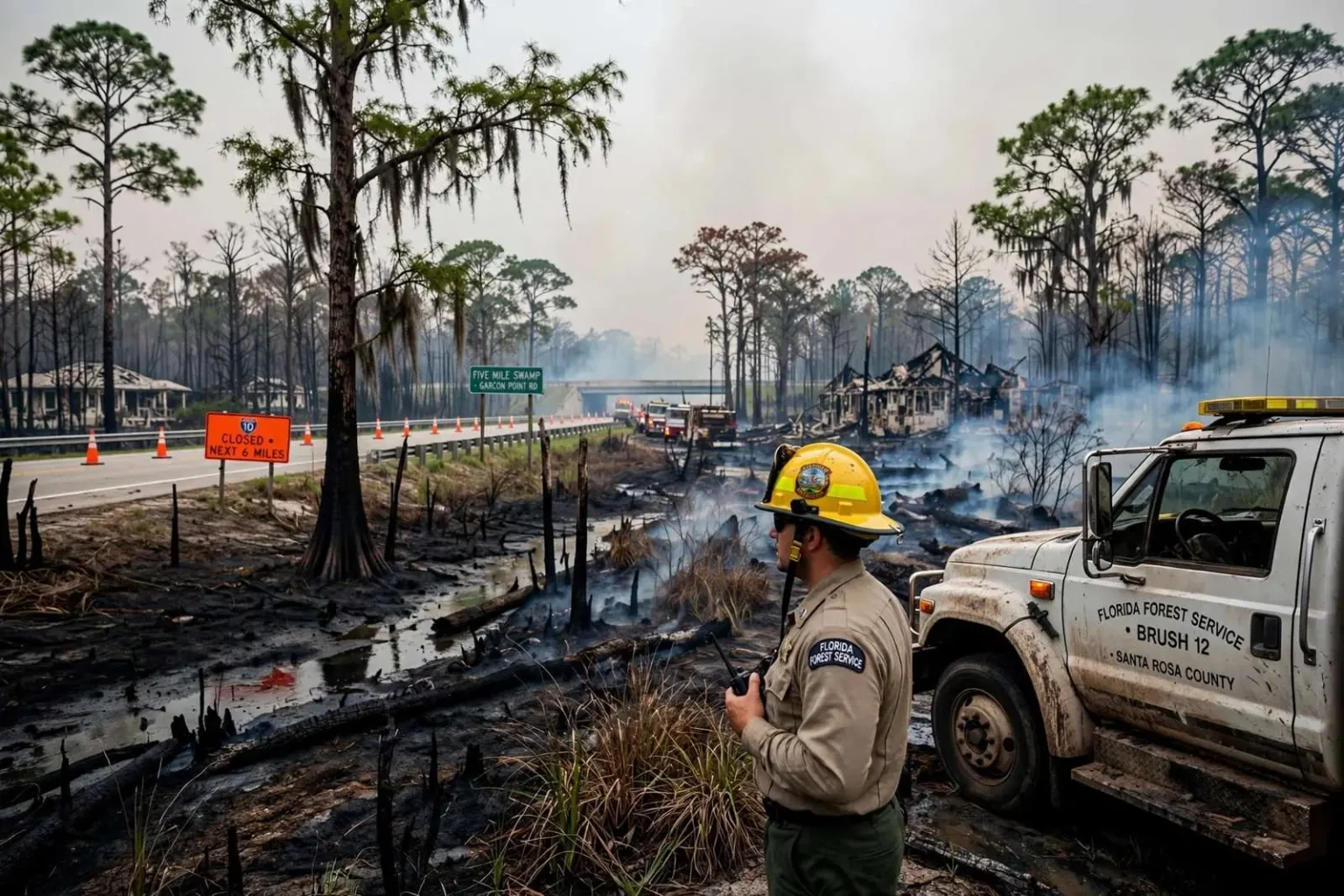
No one will face charges after an authorized prescribed burn escaped control in May and grew into the Five Mile Swamp Fire. For more than a week, the fire destroyed more than a dozen homes and burned over 2,000 acres of land. It closed several miles of Interstate 10 in Santa Rosa County and forced residents to evacuate in the Garcon Point area. Two Florida Forest Service employees checked on the burn more than an hour before it escaped. Joe Zwierzchowski with the Florida Forest Service confirmed that neither the Office of Agricultural Law Enforcement nor the State Attorney’s Office will pursue charges.
The determination brought a legal close to one of the most disruptive wildfires the Pensacola area has seen in years, but it left behind the harder questions that follow every escaped prescribed burn: how a fire authorized by the state’s own land management agency could outrun its boundaries, and what changes when it does. For the families who lost homes in the Garcon Point area and the neighborhoods along the fire’s path, the decision not to file charges closed one chapter without resolving the losses themselves.
How the Five Mile Swamp Fire Grew
The fire began as a prescribed burn — a fire set deliberately and under permit to clear vegetation and reduce the fuel that feeds uncontrolled wildfires — before escaping its designated boundaries in early May. Once free, it moved through the swampy, brush-choked terrain between Pace and the Garcon Point peninsula, an area northwest of Pensacola in Santa Rosa County where subdivisions sit close to wildland that burns readily in dry spring conditions.
Over the days that followed, the fire consumed more than 2,000 acres, a footprint that grew rapidly in wind and low humidity. Flames reached structures along the fire’s edges, and by the time the burn was fully contained, more than a dozen homes had been destroyed. Fire crews from the Florida Forest Service and volunteer departments across Santa Rosa County spent more than a week on the lines, working through the same swampy ground that made the area desirable to some residents and difficult for engines to reach.
Closed Lanes of Interstate 10
Among the most visible effects of the fire was the closure of several miles of Interstate 10 in Santa Rosa County. I-10 is the primary east-west artery for the Florida Panhandle, carrying commuter, tourist and freight traffic between Pensacola and the rest of the state, and closing a stretch of it within sight of the burning swamp cut a main road through the region. Smoke drifting across the roadway reduces visibility to a few feet in the worst conditions, and embers carried on the wind can ignite the grassy medians and roadside vegetation that line the interstate.
Drivers who relied on the corridor had to detour onto U.S. 90 and the county roads that parallel the interstate, adding time to trips between Pace, Milton and Pensacola. For emergency services, the closure added complexity to a week that already included evacuations, structure protection and sustained firefighting. The lanes reopened only after crews were confident the fire would not jump the highway again.
Evacuations in the Garcon Point Area
The evacuations centered on the Garcon Point area, the peninsula of unincorporated Santa Rosa County that sits between Escambia Bay and Blackwater Bay, connected to the mainland by the Garcon Point Bridge and to Milton by rural roads that offer few alternatives when a fire closes them. Residents there live amid the kind of wildland-urban interface where a fast-moving fire can reach a neighborhood before an evacuation order fully spreads, and the week the Five Mile Swamp Fire burned saw families loading vehicles and leaving with little notice.
Shelters and staging areas opened as the fire grew, and the Red Cross joined county emergency management in supporting displaced households. For the families whose homes were among the dozen-plus destroyed, the evacuation proved permanent for the season — there was no house to return to once the fire passed through.
The geography of the fire zone made the fight harder. The swamp and marsh ground that gives the Five Mile Swamp area its name is laced with water channels, dense undergrowth and soft soils that fire engines cannot cross, meaning crews often had to fight the flames from the edges rather than from inside the burn itself. Aerial support and brush trucks handled what ground units could not reach, and the same conditions that slowed the fire’s spread in places allowed it to smolder for days in the interior, flaring up whenever wind found the hot spots.
Why No Charges Were Filed
The decision not to pursue charges followed an investigation into the circumstances of the escape. Two Florida Forest Service employees had checked on the burn more than an hour before it escaped its lines, a detail that mattered to the review. Zwierzchowski, speaking for the agency, confirmed that neither the Office of Agricultural Law Enforcement — the law enforcement arm that investigates fire and agricultural crimes in Florida — nor the State Attorney’s Office would pursue charges.
Florida’s prescribed burning program is among the most active in the country, and the state’s statutes give landowners and agencies broad authority to burn under permit as long as the burn is conducted with the required equipment, staffing and adherence to the plan. The law recognizes what fire ecologists have long argued: the longleaf pine and wiregrass ecosystems of the Panhandle evolved with frequent fire, and without controlled burns the fuel accumulates until the inevitable wildfire burns hotter and moves faster than it otherwise would. An escaped burn, under the statute, is treated differently from an act of negligence or arson, and the investigation in this case concluded that the personnel involved followed the requirements in place.
The agency’s own record during the fire also shaped the outcome. Florida Forest Service crews were among the first on the scene and remained on the fire for the full week it burned, protecting structures and building containment lines even as the fire that escaped their permit consumed homes nearby. Investigators reviewing the file had to weigh not only the conduct before the escape but the response afterward, and both pointed to a burn that was managed according to plan until conditions overwhelmed it.
The Prescribed Burn Debate
Still, the outcome left the community weighing the trade-off at the heart of prescribed fire. The burns are set precisely to prevent the kind of destructive wildfire that the Five Mile Swamp Fire became, and Florida’s program conducts hundreds of thousands of acres of controlled burning every year, most of it without incident. When an authorized burn escapes and destroys homes, though, the residents who bear the loss often ask whether the checks that preceded the burn were sufficient — whether the weather forecast, the staffing and the timing were right.
In this case, the review pointed to the pre-escape checks: two employees of the Florida Forest Service had visited the burn and evaluated it more than an hour before it broke loose, documentation that supported the conclusion that the burn was being monitored as required. Weather in the Panhandle in early May can shift quickly, with sea breezes, gusting winds and dry fronts capable of pushing a smoldering fire past its boundaries in minutes, and investigators weighing the file evidently found no basis for criminal or civil enforcement.
For Santa Rosa County, the fire’s lessons are already visible in the landscape. The areas that burned will regrow through the seasons, and the fuel loads that fed the fire have been reduced, at enormous cost, across the footprint the flames covered. Local fire officials have used the episode to renew the case for defensible space — cleared buffers between homes and surrounding wildland — and for residents in the Garcon Point area and the communities near the fire’s path to maintain evacuation plans and sign up for county emergency alerts.
The destruction of more than a dozen homes and 2,000 acres of land will be part of the region’s memory for years, alongside the week that Interstate 10 closed and the images of smoke rising over Garcon Point. The decision that no charges will be filed ends the legal inquiry, but the fire’s larger legacy is the argument it settled and reopened at once: prescribed burning remains the region’s primary tool for preventing catastrophic wildfire, and the Five Mile Swamp Fire showed both what happens when that tool slips and why agencies keep using it.
Recovery for the families who lost homes continued long after the last smoke cleared, through insurance claims, assistance programs and the slow work of rebuilding in a rural corner of one of Florida’s fastest-growing counties. The fire department crews, forest service personnel and volunteers who fought the burn for more than a week were credited with keeping the loss from growing further, holding the fire’s edges through the days when wind and drought pushed it toward more neighborhoods.