
No Holiday Light Show at Hank Aaron Stadium This Year as Dispute Continues
The Christmas Nights in Lights drive-through show is skipping Mobile this year after the Hank Aaron Stadium contract dispute, moving to Orlando.
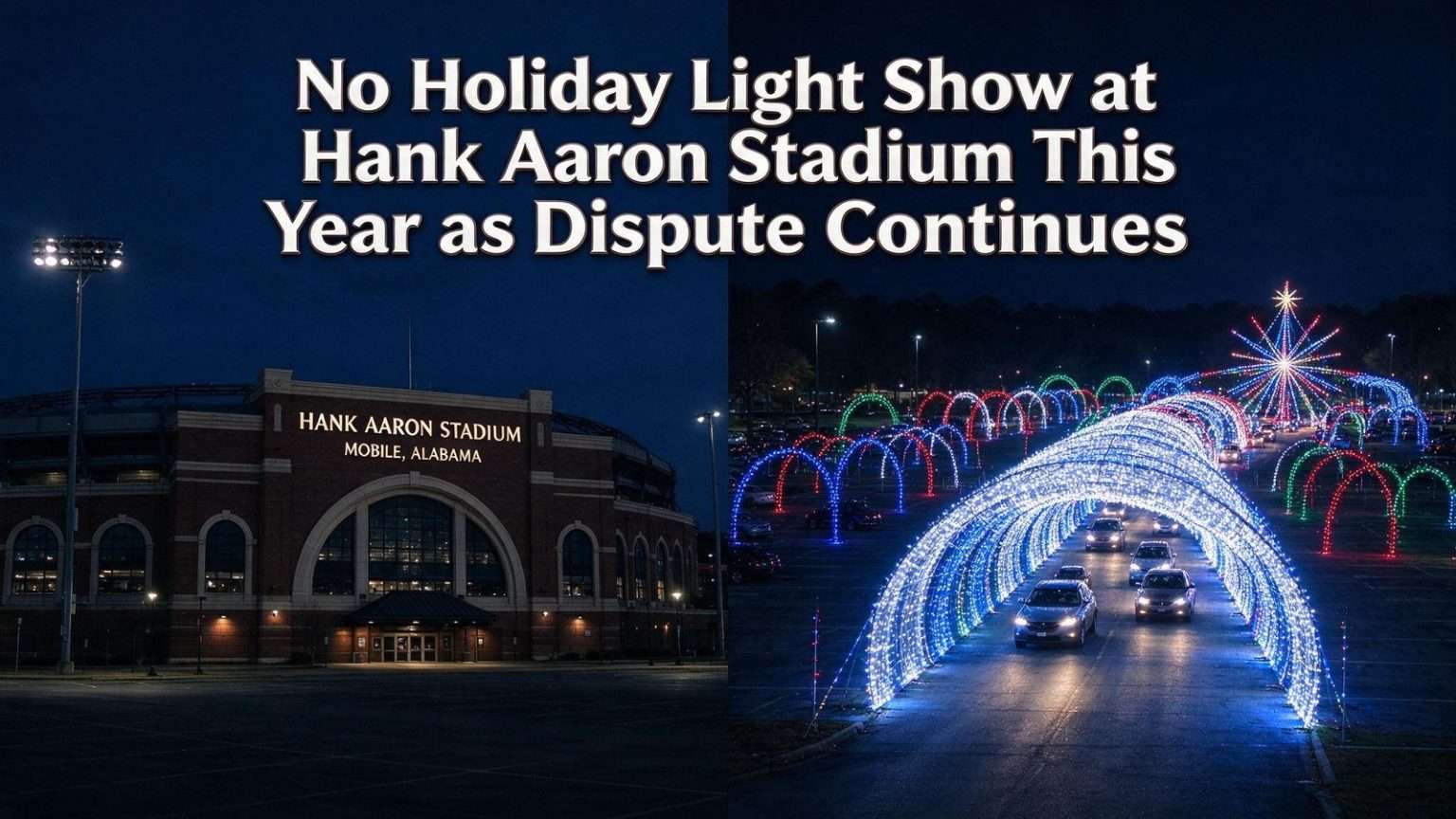
Drivers traveling along Interstate 65 through Mobile will notice something missing from the city’s holiday landscape this season: the drive-through light show that glowed from the parking lots of Hank Aaron Stadium for four straight years is gone. Christmas Nights in Lights, the music-synced holiday display that wound through the stadium grounds each December, will not operate in Mobile this year, and the reason traces back to a contract dispute that has clouded the property’s future for most of the year.
For many families in the Port City, the show had become a December tradition. Attendees bundled into their cars at the stadium off Cottage Hill Road, tuned their radios to a designated frequency, and rolled slowly past tunnel after tunnel of synchronized lights as holiday music played through the speakers. The format made it accessible to families with small children, older relatives, and anyone who preferred to enjoy the spectacle from the warmth of a vehicle rather than standing in a long outdoor line. On peak nights, streams of headlights crept along the course well past closing time, and the glow from the displays was visible to commuters on the interstate nearby.
The show arrived in Mobile after Mobile Sports and Entertainment Group took over management of the stadium property in 2019. The company, which has specialized in operating attractions and events, quickly made the underused ballpark a hub for family entertainment, and the holiday light show became its signature seasonal event. Four consecutive December runs built a loyal following, with regulars planning their calendars around it and many making repeat visits within a single season.
A Dispute That Changed Everything
The light show’s disappearance follows a decision earlier this year in which the city announced that its 26-year contract with the stadium’s property owners was null and void. That declaration threw the long-term future of Hank Aaron Stadium into uncertainty and set off a period of instability for everyone who depended on the venue, from sports tenants to event operators. With the legal status of the property in question, the companies and organizations that had scheduled activities there were left to scramble.
Ari Rosenbaum, president and managing partner of Mobile Sports and Entertainment Group, said the dispute left his team searching for alternatives on short notice. The company needed somewhere to stage its holiday attractions, and the timing of the contract fight collided directly with the calendar. A light show of this scale cannot simply appear overnight: displays have to be built and tested, power and traffic plans have to be arranged, and a venue has to offer enough land to lay out a driving course with room for queues and support vehicles.
Unable to lock down a suitable location in Mobile in time for the season, the company made the difficult call to move the show out of town. Christmas Nights in Lights will operate this year at Dezerland, a sprawling entertainment complex in Orlando located near Universal Studios. The move places the attraction in one of the country’s most competitive tourism markets, thousands of visitors from Mobile and the surrounding Gulf Coast region included, but it also means local families who made the stadium show an annual ritual will have to go without it or travel hundreds of miles to see it.
A Painful Departure for a Mobile Company
What makes the relocation sting locally is that Mobile Sports and Entertainment Group remains a Mobile business. The company is still headquartered in the city, maintains an office there, and operates a large warehouse that it uses to maintain and build its light displays. The equipment now lighting up a parking lot in Orlando was fabricated, stored, and serviced in Mobile. Rosenbaum described leaving the city as a painful but necessary step to keep the company operating, a choice between sustaining the business and holding out for a local resolution that never arrived in time.
The Stadium at a Crossroads
Hank Aaron Stadium opened in the late 1990s as the home of Mobile’s minor league baseball franchise and was renamed in 2015 to honor the Mobile-born Hall of Famer whose career remains one of the proudest chapters in the city’s sporting history. For years it hosted professional baseball along with concerts, community gatherings, and seasonal events. As attendance trends shifted across minor league sports in recent years, the venue increasingly depended on alternative uses, such as the light show, to keep the property active and generating revenue outside the baseball calendar.
That dependence is part of why the contract dispute carries consequences well beyond a single holiday season. When the city declared the 26-year agreement with the property owners null and void, it did not just unsettle one tenant. It put every arrangement at the stadium under a question mark: who controls the property, what uses are permitted, and what investments make sense when the legal foundation of the lease is contested. For an events company weighing whether to mount a seasonal attraction that requires months of preparation and significant upfront spending, that uncertainty is effectively disqualifying.
The situation has also drawn attention from residents who see the stadium as part of Mobile’s civic identity. The ballpark bears the name of one of the most celebrated athletes the city has produced, and its location along a heavily traveled corridor made the light show a kind of advertisement for the city itself, visible nightly to thousands of commuters. Its darkened parking lots this December are, for some, a visible symbol of how much is at stake in resolving the property dispute.
What the Light Show Meant to Families
The loss is felt most personally by the families who made the show part of their holidays. Regulars describe loading grandchildren into the car, buying hot chocolate, and creeping through the light tunnels while children pressed against the windows. The drive-through format meant that the experience worked for nearly every age and ability: no walking required, no cold bleacher seats, and a loop that could be repeated for those who were not ready for it to end. For a city that prides itself on its deep holiday traditions, from its historic downtown celebrations to neighborhood displays across the area, the stadium show had quickly become one of the newer entries in that lineup.
One of those regulars, Darnisha Matthews, made the show an annual outing with her grandchildren. She said she hopes the attraction finds its way home soon, both for the kids and for the view she misses on her morning commute past the darkened stadium. That sentiment, the sense that something belonging to the city’s December landscape has been temporarily taken out of circulation, is common among attendees who never gave much thought to the lease arrangements underneath the lights.
Hopes for a Return Next Year
The company has made clear that Orlando is intended as a detour, not a destination. Mobile Sports and Entertainment Group says it wants to bring Christmas Nights in Lights back to Mobile next year and is actively searching for the right site. That search is not limited to the stadium; any sufficiently large property with good road access could host the show, though the stadium’s central location and interstate visibility made it an especially strong fit. The outcome likely depends on how the dispute over the property resolves and whether the company can secure usable terms for a future season.
For now, Mobile residents have a choice between waiting out the dispute and making the trip to Orlando to see their hometown show operate in someone else’s parking lot. City officials and the company alike have reasons to want a resolution: a working stadium with active tenants benefits the city, and a Mobile-based company clearly prefers to operate at home. If those interests eventually align, the lights could return to I-65 next December. Until then, the darker stretch of parking lot where the tunnels used to glow stands as a reminder of how quickly a beloved tradition can vanish when the paperwork underneath it falls apart.
What Comes Next for the Venue
The immediate question hanging over the stadium is what use the property can legally support while the contract fight plays out. A venue of that size does not sit idle cheaply, and every month without an anchor event makes the eventual path back to regular programming harder. Event operators, sponsors, and food vendors who once built their own calendars around dates at the ballpark have likewise had to look elsewhere, a ripple effect that reaches well beyond the company that ran the light show.
The episode is also a case study in how dependent seasonal traditions are on stable arrangements behind the scenes. A holiday attraction looks simple from the driver’s seat: lights, music, a winding course, a friendly volunteer at the ticket window. Underneath, it is a stack of leases, insurance policies, electrical work, and city permissions, and if any single layer fails, the whole experience disappears overnight. That is essentially what happened this year in Mobile.
Residents hoping to see the show return next year can follow the city’s handling of the stadium dispute, since a resolution there is the most direct route back. The company’s warehouse full of displays sits ready in Mobile, and the same routes that carried families to the ballpark are still there waiting. Whether next December brings the tunnels of lights back to I-65 depends on decisions being weighed right now between the city and the property’s owners.


