North Baldwin Utilities Urges Caution as Novelis Boom Drives Digging Surge
North Baldwin Utilities is urging patience and reminding residents to call Alabama 811 before digging as Novelis-driven growth and fiber broadband expansion increase the risk of underground utility line breaks.
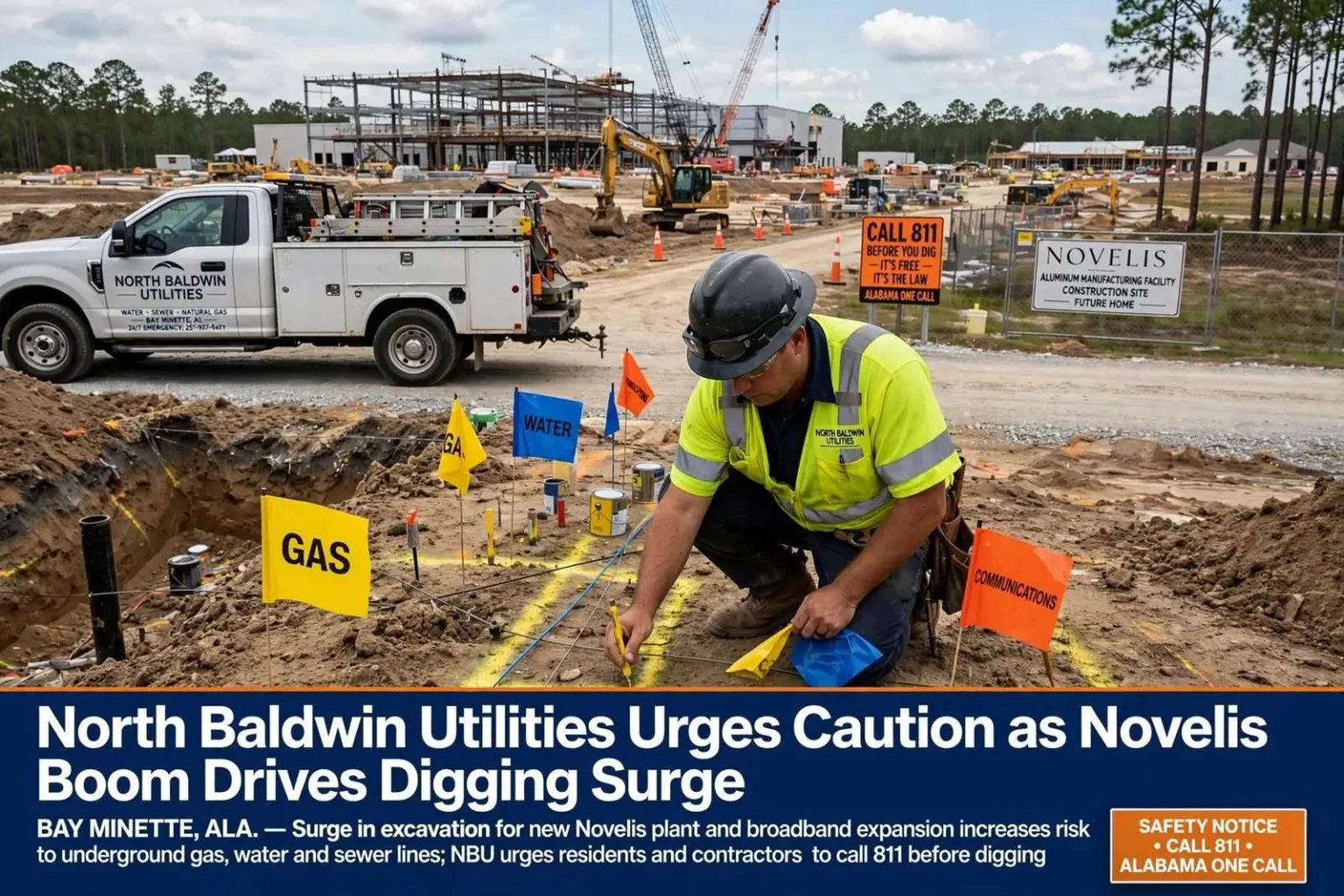
BAY MINETTE, Ala. — North Baldwin Utilities (NBU) is seeing a rise in underground utility line breaks across its service area as Baldwin County works through a period of historic growth and infrastructure expansion. Much of that growth is tied to the construction of the new Novelis aluminum manufacturing facility in Bay Minette, a multi-billion-dollar investment expected to create approximately 1,000 jobs.
The Novelis project, one of the largest single industrial investments in Baldwin County history, has accelerated residential, commercial and infrastructure development throughout North Baldwin County, with new neighborhoods, retail spaces, restaurants and hotels underway to support the incoming workforce and population growth. Every one of those projects requires digging — foundations, water and sewer taps, drainage, and service lines — and every hour of excavation is an hour of risk to the buried infrastructure beneath it.
NBU provides water, sewer and natural gas service to Bay Minette and surrounding communities in the northern half of the county, operating a network of mains and lines that was laid out over decades for a far smaller customer base. The utility’s crews are now working in an environment where a single road corridor can carry a dozen simultaneous construction projects, each one an opportunity for a backhoe or directional drill to cross a line it should not.
A Broadband Build-Out Adds to the Activity
At the same time, multiple telecommunications providers are expanding high-speed fiber broadband networks across the area, including Mediacom Communications, Point Broadband and Brightspeed. Those projects are expected to bring faster and more reliable internet service to homes, schools, healthcare facilities and businesses, improving access to services like telemedicine, online education and digital commerce.
In addition to that private broadband expansion, the Alabama Fiber Network (AFN) is strengthening broadband backbone infrastructure across the state. The middle-mile system supports local providers and is intended to position communities like Bay Minette for long-term economic growth, connecting regional networks to the long-haul fiber routes that carry the bulk of internet traffic between major metros.
Fiber construction is uniquely demanding on buried utilities. Unlike a building foundation, fiber routes run for miles in shallow trenches and plowed conduit, crossing water mains, gas lines and sewer laterals again and again. Directional boring — the method most contractors use to avoid open cuts — carries its own hazard, because a drill head that drifts off depth can puncture a pressurized gas line or a water main without any visible disturbance at the surface until the damage is done.
More Digging Means More Risk to Buried Lines
The combination of housing construction, commercial development and fiber installation means far more excavation activity than North Baldwin County has typically seen, and NBU says that comes with a higher risk of accidental damage to underground utilities. Many of the recent service interruptions, the utility says, have been caused by third-party telecommunications contractors performing fiber installation work. Those contractors are not affiliated with NBU or other local underground utility providers.
NBU has been making that point directly to its customers as the pace of work has picked up. Growth is exciting, and expanded broadband access is welcome, the utility says, but the volume of digging across the service area means every locate request, every hand-dig and every call to 811 matters more than it ever has. The utility is urging residents, contractors and do-it-yourselfers alike to treat the buried network with the caution a boom of this size demands.
Alabama’s one-call system, known to most residents simply as 811, exists precisely for this situation. State law requires anyone planning excavation to notify the Alabama One Call center before digging so that member utilities can mark their lines for free. Once a ticket is filed, utilities have a set window to respond with paint and flags showing where buried gas, water, sewer, electric and communications lines run. Digging without a locate request is not just risky; it exposes the person digging to liability for repair costs and service losses.
The stakes rise sharply when natural gas is involved. NBU distributes gas alongside water and sewer service, and a struck gas main can force evacuations of entire blocks while crews shut down and repair the line. Water main breaks carry their own consequences — pressure losses that can trigger boil-water notices, muddy service for thousands of customers, and road closures while repairs are made. Sewer line strikes can push wastewater into neighborhoods and waterways, creating environmental problems that outlast the repair itself.
What the Novelis Boom Means for North Baldwin
The Novelis facility on the outskirts of Bay Minette represents a scale of manufacturing new to Baldwin County. The plant will produce rolled aluminum sheet for the automotive and beverage-can markets, and its construction site alone has drawn thousands of workers at peak periods. Around it, developers have been assembling subdivisions, hotels and retail space on land that was pasture or pine not long ago, and the county and municipalities have been widening roads and extending utilities to keep pace.
Economic developers describe the effect as a multiplier: the thousand direct jobs at the plant support additional hiring at suppliers, service businesses and schools, and each new rooftop adds demand for water, sewer, gas and broadband. That is the growth North Baldwin leaders have spent years courting, and few in the area would trade it back. But the same activity that fills tax coffers also fills the ground with new pipe, conduit and cable — all of it buried, much of it crossing older infrastructure that predates anyone’s current construction maps.
The utility says the burden of care falls on everyone who puts a shovel in the ground. Professional contractors are required to file locate requests and respect the marks, but the same rules apply to homeowners planting trees, installing fences or building decks. NBU’s guidance to the public is consistent: call 811 before every dig, wait the required time for lines to be marked, dig carefully near the marks, and report any suspected line damage immediately — including nicks, scrapes and pulled connections that may not cause an obvious outage right away.
Looking Ahead
The period of heaviest risk is likely to last as long as the build-out itself. Fiber crews will be active in the area for years as providers chase the same customers, and construction around the Novelis corridor will continue through the plant’s opening and beyond. As neighborhoods mature and contractors move to the next site, the frequency of strikes should ease, but the underground network NBU and its fellow providers are building today will be in the ground for generations.
For now, NBU says its message is simple. The growth reshaping North Baldwin County is good for the region, and the broadband expansion it accompanies will serve the community long after the construction trucks leave. The utility asks only that the people doing the digging — professionals and homeowners alike — make the phone call that costs nothing before the backhoe starts, because the cheapest line repair is the one that never has to be made.
How a Locate Call Works
For residents unfamiliar with the process, the mechanics are simple. A call to 811 — or an online request through Alabama One Call — starts a ticket that is routed to every member utility with facilities in the dig area. Utilities respond within the statutory window, marking their lines with a color code: red for electric, yellow for gas, blue for water, green for sewer, orange for communications. The service is free to the person digging, and the marks are valid for a limited number of working days, so large projects may need the request refreshed as work proceeds.
Utility officials stress that the marks are only the beginning of safe practice. Hand digging is required within a tolerance zone on either side of a marked line, and power equipment should never be used to punch through the final few feet. Roots, rocks and old abandoned lines can shift a trench path in ways a machine operator cannot see, which is why damage prevention programs across the industry emphasize patience in the tolerance zone as much as they emphasize the locate request itself.
When damage does occur, the response clock starts immediately. NBU asks that anyone who strikes or even scuffs one of its lines stop work, clear the area if gas is suspected, and call the utility’s emergency line right away. Small kinks in service lines can fail hours or days later under pressure, so an honest report at the moment of contact is far safer — and usually far cheaper — than a failure discovered after crews have left the site.
The growth reshaping North Baldwin County shows no sign of slowing, and NBU says it welcomes the development, the jobs and the connectivity coming with it. The utility’s request to the public is not to slow the boom, but to build safely through it: one locate request, one careful trench and one reported near-miss at a time, so the water, gas and sewer systems that will carry the growing community for the next half-century come through the construction era intact.