
Nudes in November Returns to Blue Velvet Studio for Third Year During LoDa ArtWalk
Blue Velvet Studio's third annual Nudes in November figure-art show opened during LoDa ArtWalk Nov. 11, 2011, with work from 16 Mobile-area artists.
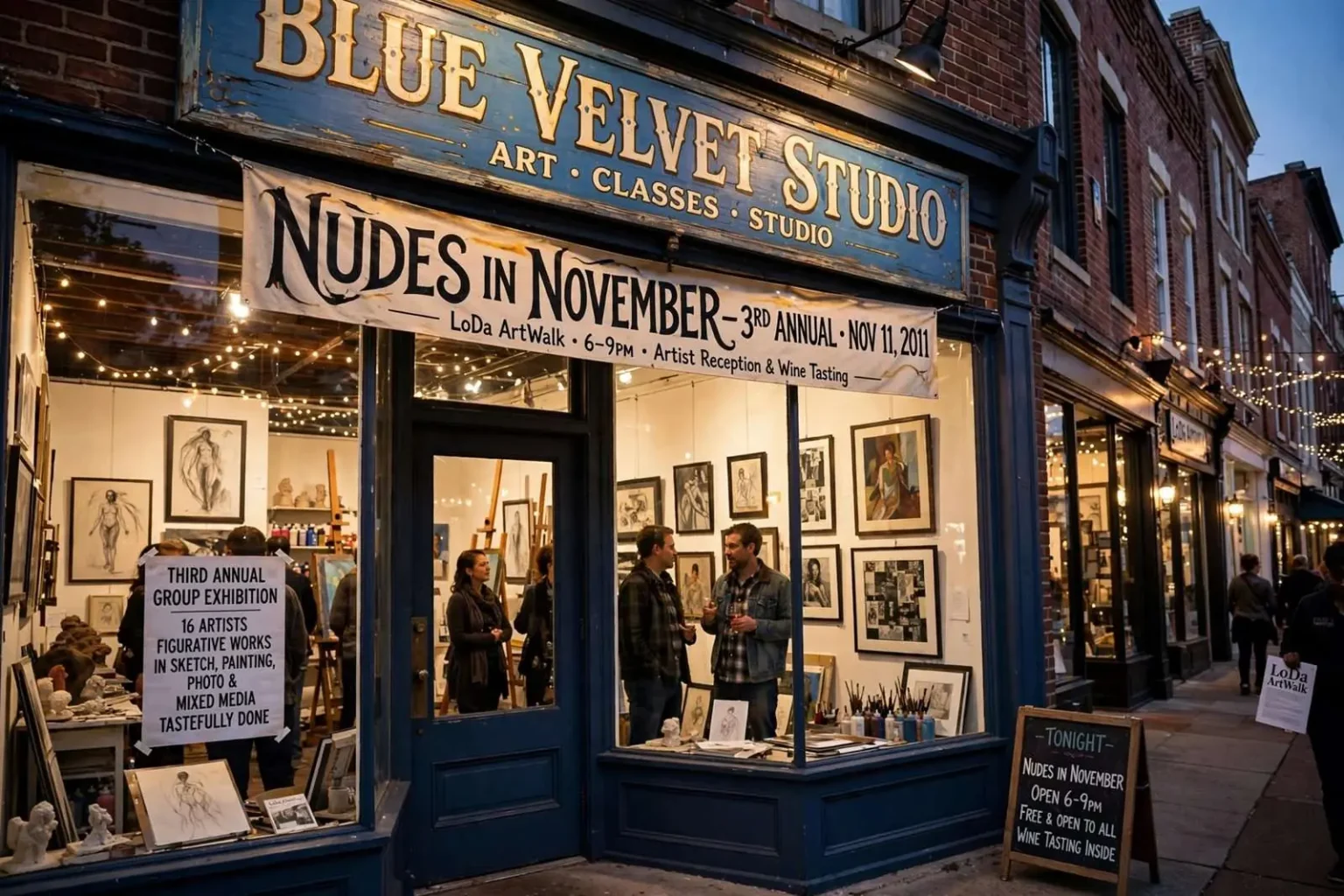
Blue Velvet Studio hosted its third annual “Nudes in November” exhibition on Friday, November 11, 2011, from 6 to 9 p.m., timing the opening to the LoDa ArtWalk crowd with an artist reception, refreshments and a wine tasting inside the Dauphin Street studio. The one-night launch drew the steady foot traffic that ArtWalk nights bring to downtown Mobile, and it gave visitors a reason to step off the sidewalks and into one of the district’s most active working studios.
The group show gathered interpretations of the human form across sketches, paintings, photography and mixed media — presented, as organizers put it, tastefully done. The figure has been a central subject of Western art for centuries, and the exhibition treated it that way: as a discipline and a subject with deep traditions, not a novelty. Visitors moving through the studio encountered the range of ways local artists approach the body, from quick gestural drawings to carefully finished canvases and photographic work.
Sixteen artists took part, including A.J. Tompkins, Amanda Youngblood, Carlo Coyne, Casey Howell, David Trimmier, Grant Benoit, Jacqueline Dunsworth, Jeff Byrd, Karen Cassidy, Lucy Gafford, Satomi Kamei, Sharon Welton, Susan Howell, Susan Peele and Tara Spies. The roster read like a cross-section of Mobile’s working art community at the time, mixing veteran names with younger artists showing in the district’s monthly walk for the first time.
A Studio That Doubles as a Classroom
Blue Velvet Studio had become one of downtown Mobile’s busiest artist hubs by its third year running the figure-show tradition, which drew on the studio’s regular life-drawing practice. Weekly sessions with live models gave artists throughout the area a place to work from the figure without needing to rent space or organize their own groups — an infrastructure that few smaller cities can claim and that Mobile’s art community had built for itself.
The 2011 edition followed strong turnout for the inaugural exhibit and gave several younger Mobile artists their first ArtWalk-night exposure. For emerging painters and photographers, that kind of debut matters: ArtWalk crowds bring collectors, gallery owners and fellow artists past the work, and a single well-received show can open doors that months of quiet studio time cannot.
The studio’s mentorship model paired working artists with students in weekly drawing sessions, keeping a pipeline running between established names and newcomers. That structure shaped the exhibition itself, which read in places like a family tree of local figurative work — teachers and students, mentors and mentees, all hanging on the same walls.
LoDa ArtWalk and the Dauphin Street Scene
By 2011, the LoDa ArtWalk had grown into downtown Mobile’s signature monthly event, drawing thousands of visitors into the Lower Dauphin entertainment district on the second Friday of each month. Galleries, studios, shops and restaurants extend their hours, and the sidewalks fill with a crowd that ranges from serious collectors to families out for the evening.
For a working studio like Blue Velvet, the walk is both a stage and a test. The crowd moves quickly, so the work has to hold attention in seconds; the audience is broad, so the presentation has to communicate across levels of art experience. “Nudes in November” met that challenge by grounding itself in craft — drawings that show the hand, paintings that show the study, photography that shows the eye.
The exhibition opened during one of the year’s most crowded ArtWalks and remained up for viewing at the studio afterward, continuing a November tradition that quickly became a fixture of Mobile’s fall gallery calendar. For the artists involved, the third annual show marked the point where an experiment had become an expectation — the kind of recurring event a city’s art scene is measured by.
The Figure as Subject and Discipline
Figurative work occupies a specific place in an artist’s development. Drawing from a live model demands observation, economy and honest assessment of one’s own weaknesses in a way that still life or landscape does not, and art schools have treated the figure as core training for generations. A studio that keeps regular life-drawing sessions running is, in effect, maintaining a continuing education program for the entire local art community.
The works on view in “Nudes in November” reflected that training across four media. Sketches captured the short-pose energy of a drawing session; paintings showed what artists do when they slow down and develop; photography brought its own tradition of the figure to the walls; and mixed media pieces pushed the subject in directions that traditional media don’t reach. The variety was the point — sixteen artists, one subject, sixteen different answers.
The “tastefully done” framing that organizers used was also a practical one. An ArtWalk crowd includes families and casual visitors, and an exhibition that wants to reach that audience has to present the figure with the same seriousness and restraint a museum would. The show’s reputation across its first two years suggested it had found that balance.
The Artists Behind the Show
The participant list traced the shape of Mobile’s art scene in 2011. Names on the roster had appeared across the district’s galleries and group shows in recent years — some as regulars at cooperative spaces, others as featured artists in solo exhibitions, and a few as the younger figures the studio’s mentorship model was built to lift.
Multi-artist exhibitions work because of that mix. A established name draws a following; a first-timer benefits from the traffic. When the two hang together in a well-run show, the result raises the floor for everyone involved, and it gives collectors an efficient way to survey what a city’s artists are actually doing.
Blue Velvet’s role in convening that roster three years running was itself a statement about the studio’s standing. Organizing a group exhibition means recruiting artists, jurying or at least selecting work, coordinating the reception, and staffing the space — the work of a gallery, done by working artists in a studio that also hosts weekly sessions and classes.
Mobile’s Gallery Tradition and the Figure Show
Mobile’s art community has long organized itself around spaces like Blue Velvet — artist-run, community-facing, and sustained by the monthly rhythm of the ArtWalk. The city’s galleries historically cluster in the Lower Dauphin and Cathedral Square districts, where walkable blocks let visitors move from show to show in a single evening and artists can count on a recurring audience without a large marketing budget.
Figure exhibitions occupy a recurring place in that calendar. Studios across the region have mounted similar shows, often timed to November, when the ArtWalk’s cool-weather crowds are among the largest of the year. The subject’s long tradition gives such shows a built-in legitimacy, while the local roster keeps them fresh from year to year.
The 2011 edition’s place as the third annual confirmed the format had found its audience. Attendance at the inaugural exhibit had been strong enough to justify a repeat, the repeat had performed well enough to justify a third, and the third had grown into a sixteen-artist show with a wine tasting and a reception timed to the district’s biggest night.
After the Opening
Visitors who missed the ArtWalk-night opening still had the chance to see the show, which remained up for viewing at the studio afterward. That extended run matters to working artists: openings produce excitement, but sales and connections often happen in the quieter weeks that follow, when visitors can actually spend time with individual pieces.
The exhibition’s afterlife also served the studio’s teaching mission. Students in the weekly drawing sessions could see finished work built from the same practice they were learning, closing the distance between the exercise and the result — a concrete answer to the question every student asks about whether the hours at the easel go anywhere.
By the time the show came down, “Nudes in November” had secured its slot in Mobile’s fall gallery calendar — a tradition born in a Dauphin Street studio, sustained by a rotating cast of local artists, and visible to the entire city one ArtWalk night each November.
What ArtWalk Nights Mean to a Studio
For the artists who work behind Dauphin Street’s storefronts, the second Friday of the month structures everything. Work is finished for the walk, walls are arranged for it, and the week before it runs on a deadline that no studio critique ever imposes. A show like “Nudes in November” represents weeks of that preparation compressed into a three-hour opening window on a November evening.
The economics of a working studio make the walk essential. Admission is free, the crowd arrives on its own, and the cost of participating amounts to time and materials — a model that lets small spaces compete for attention with established commercial galleries. The wine tasting and refreshments at Blue Velvet’s reception were part of that hospitality, signaling that visitors were welcome to stay and talk rather than glance and move on.
Studios also benefit from what the walk does for the district as a whole. Each monthly event trains the city in the habit of coming downtown for art, and habits like that compound: a visitor who discovers one studio on one walk tends to return, bringing friends, and the district’s reputation grows one Second Friday at a time.
Building a Scene, One Annual Show at a Time
Recurring exhibitions are how an art scene builds memory. A one-night show is an event; an annual show is a fixture that artists plan for and audiences anticipate. By its third year, “Nudes in November” had crossed that line, and the studio could count on artists asking to be included rather than being persuaded to participate.
That stability also raises the quality bar. Artists who expect a show to recur save their strongest figure work for it, and audiences learn to expect a serious exhibition rather than a casual display. The sixteen-artist roster of 2011, mixing the studio’s established names with its younger students, showed the effects: the work had deepened as the tradition had.
For Mobile, shows of this kind do something larger than fill a single evening. They keep working artists visible, they give students a public goal, and they demonstrate — to residents, to visitors, and to the artists themselves — that the city sustains an art community worth the name. The third annual “Nudes in November” was one more year of proof.


