
Officer Injured, Fleeing Suspect Killed When Backup Patrol Vehicle Struck Both in Prichard Chase
A fleeing suspect was killed and a Prichard officer injured when a backup patrol vehicle struck both during a pursuit from Highway 45.
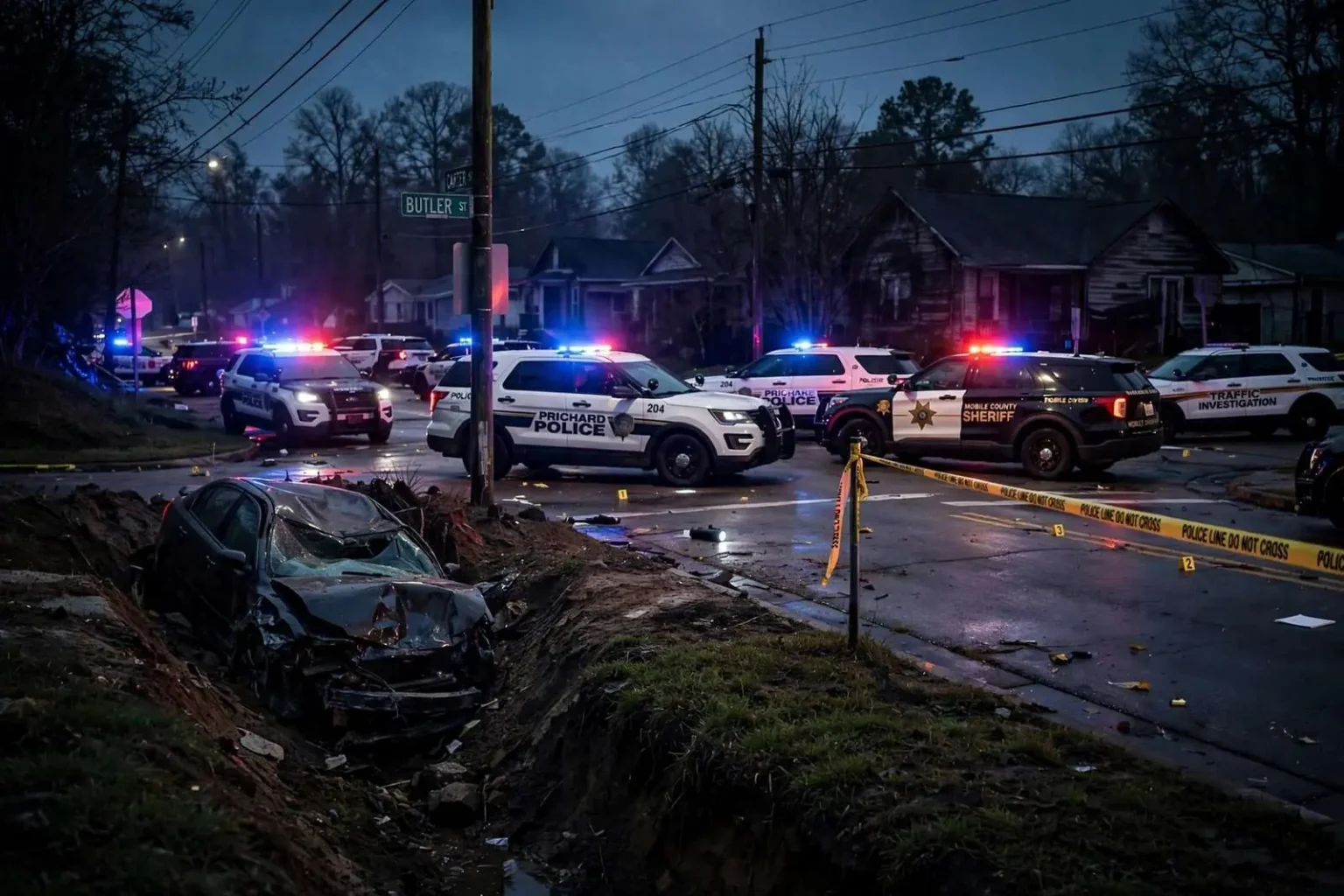
PRICHARD, Ala. — A Prichard police officer was seriously injured and a fleeing suspect was killed early Tuesday when a backup officer’s patrol vehicle struck both men as they struggled in the street, authorities said. The collision turned a routine traffic stop into a fatal incident and triggered a multi-agency review that stretched on for months before closing without charges.
The chase began around 1:30 a.m. when Officer Simeon Beeson tried to pull over James Buford for a traffic violation on Highway 45 near Interstate 65. Buford refused to stop and a pursuit followed into Mobile, crossing municipal lines as patrol units trailed the fleeing vehicle north along the Highway 45 corridor.
The pursuit ended when Buford’s vehicle hit a ditch at the intersection of Butler Street and Carter Avenue in Mobile. Disabled at the crash site, Buford bailed out and ran north on Butler Street, with Beeson chasing on foot through a residential stretch of the neighborhood in the early-morning dark.
As the officer caught up and the two struggled in the roadway, backup Officer Jay Wilson’s vehicle struck both of them. Police said it was dark, and Wilson did not see the men in the road. Buford was pronounced dead at the scene. Beeson was taken to University Hospital for treatment of his injuries, which authorities described as serious.
How the investigation unfolded
Prichard police, the Mobile County Sheriff’s Office and MPD’s Traffic Division jointly investigated the incident, with MPD handling the traffic-fatality investigation. The arrangement followed a pattern common across Mobile County, where smaller municipal departments bring in outside agencies whenever an officer’s actions result in a death, both to provide additional expertise and to avoid the appearance of an agency examining itself.
Officials cautioned that because an officer was involved and a life was lost, they wanted to conduct a thorough review before drawing conclusions. Investigators reconstructed the pursuit from dispatch records, patrol vehicle data and scene evidence, work that unfolded over an extended period while the injured officer recovered from his wounds.
The sheriff’s office ultimately concluded its investigation into Officer Wilson, determining that no criminal charges would be filed against him. The finding addressed the criminal question only; officials noted that the circumstances — a nighttime foot chase, a struggling officer and driver in the roadway, and a backup unit arriving behind them — fell within the kind of rapidly evolving situation that reviews of officer-involved deaths are designed to examine.
Prichard police extended sympathy to both families and asked the decedent’s family for patience as investigators worked to bring the case to closure. The department acknowledged from the outset that the incident involved a grieving family on both sides of the encounter — the family of the officer who was struck, and the family of the man who died.
The corridor where the pursuit began
Highway 45 near Interstate 65 is one of Prichard’s busiest traffic arteries, a multi-lane route that carries commuters between the city and Mobile and feeds a cluster of businesses and neighborhoods along its length. Traffic stops along the corridor are routine police work, and pursuits that begin there can move quickly into Mobile’s jurisdiction, as this one did.
Pursuit policy is a standing concern for departments everywhere. Officers weigh the seriousness of the offense against the risk a chase poses to the public, and departments review every pursuit that ends in injury or death. The initial cause here was a traffic violation — the kind of stop that happens daily — but the outcome has prompted the familiar questions that follow any pursuit that ends tragically.
University Hospital’s role
University Hospital, where Beeson was treated, serves as the region’s major trauma center and the destination for the most seriously injured patients across southwest Alabama. Its role in the case underscored the severity of the officer’s injuries; patients transported there after such incidents typically arrive with injuries that smaller facilities are not equipped to manage.
For Prichard’s police department, the case marks one of the most serious incidents in its recent memory: an officer hospitalized within minutes of a routine stop, a suspect dead in the street and a review process that required three agencies to sort out what happened. The department’s public statements throughout emphasized transparency and sympathy while the investigation ran its course.
What happens when no charges are filed
The decision not to file charges closes the criminal phase of the case, but it rarely ends the institutional review. Departments typically conduct their own administrative examination of pursuits and officer-involved deaths, evaluating whether policies were followed and whether procedures should change. Those internal reviews operate separately from criminal charges and can lead to policy adjustments, retraining or disciplinary findings of their own.
Prosecutors and sheriff’s investigators weigh the same evidence through different lenses. A criminal standard asks whether an officer’s conduct crossed legal lines; an administrative one asks whether the incident reveals gaps in training, equipment or procedure that should be fixed. In this case, the nighttime conditions and the compressed sequence of events — ditch, foot chase, struggle, impact — formed the factual core that both reviews had to reckon with.
The finding also reflects the reality of backup responses. Officers arriving at a scene in seconds make decisions with incomplete information, and investigators consider what the responding officer could reasonably have seen and known at the moment of the collision rather than with hindsight.
The neighborhood left with the aftermath
For residents along Butler Street, the incident arrived in the middle of the night in the most abrupt way possible — a crashed vehicle in a ditch, a foot chase through the darkness and a collision that left one man dead in the roadway. Neighbors awoke to police tape and investigators, and the intersection spent the morning as a scene rather than a street.
Communities that host officer-involved deaths often wait months for answers, and the extended timeline here followed that pattern. The joint investigation’s length reflected the number of agencies involved, the severity of the outcome and the care officials said they wanted to take before announcing conclusions about a case involving a death.
Both departments’ final public messages centered on the two families. The officer’s recovery and the decedent’s family’s grief will outlast the news cycle, and Prichard police framed their closing statements around those two households — acknowledging the sympathy extended to both and the patience requested of a family that waited through a long investigation for its conclusion.
Police work across municipal lines
The case illustrates how seamlessly police work crosses municipal boundaries in Mobile County. A Prichard officer’s traffic stop became a Mobile crime scene within minutes, and the investigation that followed drew on the sheriff’s office and MPD’s specialized traffic division — a division that handles crash reconstruction across the county regardless of where the pavement sits.
Multi-agency investigations of officer-involved deaths have become the accepted practice in the county’s smaller departments, which rarely have the in-house reconstruction resources that such cases demand. The model gives prosecutors a file built largely by agencies with no stake in the involved department, a structure intended to support public confidence in the outcome.
With the criminal review closed, the case’s remaining questions are administrative and personal: what Prichard’s department takes from the pursuit into its own policies, and how two families carry the outcome of a chain of events that began with a traffic violation on Highway 45 in the earliest hours of a Tuesday morning.
Prichard and the demands on a small department
Prichard, one of Mobile County’s older cities, has long faced the budgetary and staffing pressures typical of small urban departments: a limited roster covering a full slate of calls, aging equipment and the constant demand of patrol work across a compact but densely populated city. Incidents that would strain any department — pursuits, officer injuries, multi-agency investigations — test those limits in ways that last well beyond the news cycle.
When one of its own officers is hospitalized, the department’s daily work continues around the absence. Colleagues cover shifts, and the injury of a fellow officer weighs on a force that numbers only a fraction of the region’s largest agencies. The department’s handling of the case — from the night of the crash through the final announcement — has been closely watched by the city’s residents, whose relationship with policing in Prichard reflects both strong support for officers and the scrutiny that follows any death in police custody or pursuit.
The collaboration with the Mobile County Sheriff’s Office drew on the county’s established practice of assisting municipal departments in major cases. Sheriff’s investigators handle officer-involved incidents for departments across the county, bringing dedicated personnel and a separation from the involved agency that smaller cities cannot provide on their own.
For the two families at the center of the case, the investigation’s end does not close their chapters. The officer faces continued recovery, and the decedent’s family carries a loss that no finding of law can address. What the months of review produced is an official record — reconstructed from a dark street in Mobile, a ditch at Butler and Carter, and the seconds in which a chase became a tragedy — and a determination that no crime occurred in the collision that ended it.
