Okaloosa County reopens public beaches as other counties weigh plans
Okaloosa County voted to reopen public beaches for limited hours May 1 as Escambia and other counties weigh their own reopening plans.
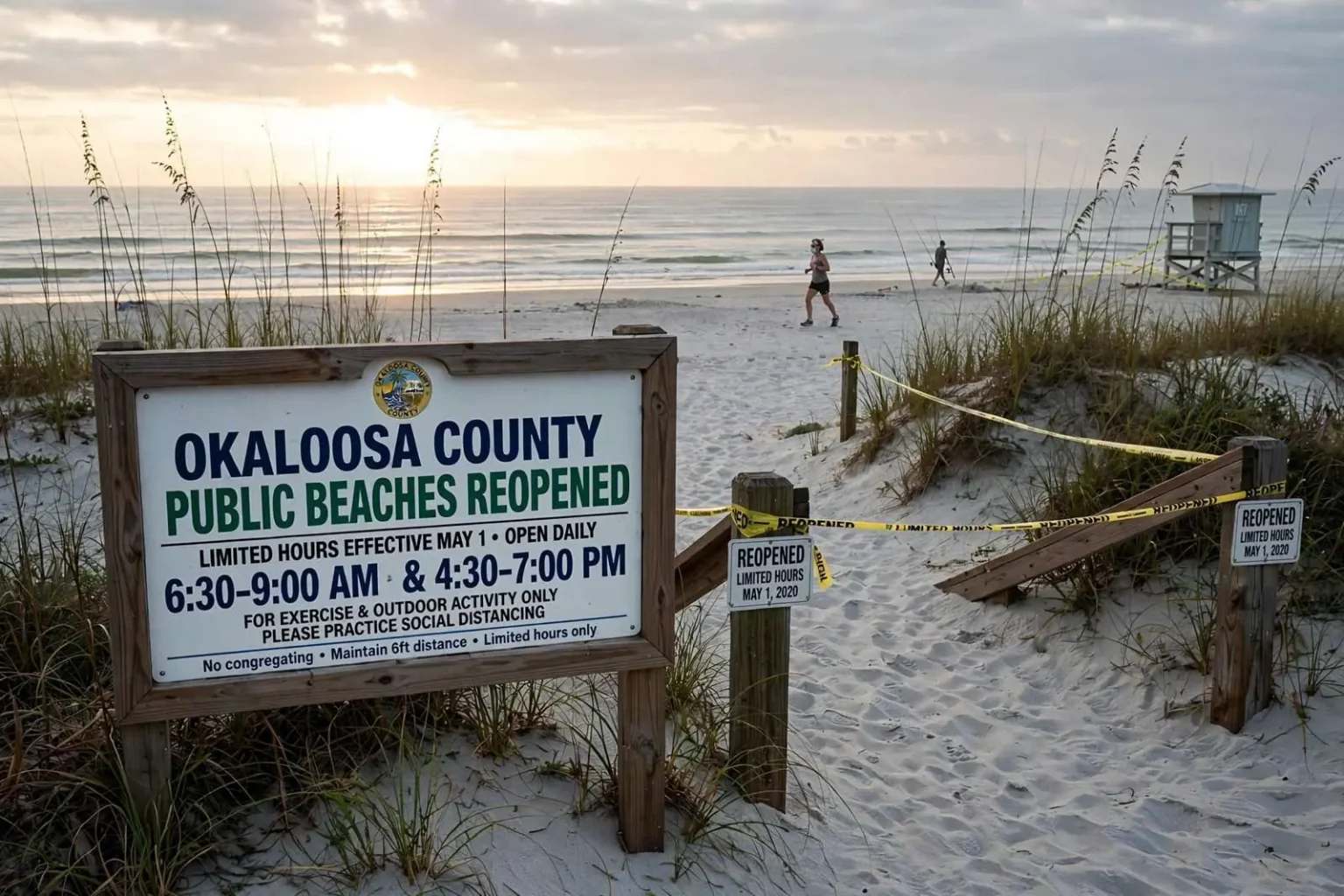
Okaloosa County commissioners voted Tuesday to reopen public beaches for limited hours starting May 1, even as neighboring counties in the Florida Panhandle continued to weigh their own plans for restoring beach access during the coronavirus closures. Under the decision, Okaloosa County public beaches will be open every day from 6:30 to 9 a.m. and again from 4:30 to 7 p.m. — windows designed to let residents exercise and enjoy the shoreline while avoiding the midday crowds that make social distancing difficult.
The vote put Okaloosa, home to Destin and Fort Walton Beach, ahead of much of the surrounding region. Along the Panhandle, each county has been charting its own course on closures, a patchwork that has frustrated residents who can watch the surf from one county while standing legally barred from it in another. Other local counties plan to decide on their own beach access within the coming week, and the Okaloosa decision gave those boards a concrete model: restricted hours rather than a simple open-or-shut choice.
Beaches across Northwest Florida had been shut down since March as part of the broad emergency measures aimed at slowing the spread of the virus. The closures hit especially hard in a region where the shoreline is both the economic engine and the defining feature of daily life. Tourism officials, business owners and residents have spent weeks pressing local governments to find a path back, arguing that the outdoors — wide, windy, and open-air — presents far less risk than the indoor settings where transmission is understood to be greatest.
Escambia’s slower timetable
Not everyone to the west was moving as quickly. In Escambia County, home to Pensacola Beach, commissioners scheduled a special meeting for April 28 to consider reopening public beaches, and the delay drew sharp criticism from one of their own. “I really think that’s just unacceptable,” Escambia County Commissioner Doug Underhill said, referring to the decision to wait until April 28 for the special meeting. Underhill was the only commissioner to vote to reopen beaches at an earlier meeting in early April, a position that made him the most visible proponent of faster action on the board.
“There are working-class citizens in my district that are suffering greatly because the government has overreached on all these closures, and it’s time now and it’s clearer that it’s safe for us to go ahead and start doing some incremental opening with just managing some of the social distancing,” Underhill said. His argument reflected a tension playing out in coastal counties across the South: officials balancing public health guidance against the financial and psychological toll of prolonged closures on communities whose livelihoods and lifestyles are built around the water.
Escambia’s situation carries particular weight because of Pensacola Beach and Perdido Key, two of the region’s most visited stretches of sand. The island economy there runs on a season that begins in earnest in May, and every week of closure compounds losses for restaurants, rental companies, hotels and the workers who staff them. County leaders also have to weigh the messages sent to visitors: reopening too slowly risks a lost season, while reopening too broadly risks a surge that forces a second shutdown.
Pressure from the public
The debate is not confined to commission chambers. A protest is planned for the morning of the special meeting in Escambia County as residents demand the beaches be reopened, a sign of how strongly the issue resonates beyond the boardrooms where the decisions are made. Similar demonstrations have been gathering across the country in April as stay-at-home orders stretch on, and on the Gulf Coast the beach — an open, natural space where families have always gone to cool off — has become a potent symbol of what residents feel has been taken from them.
For many residents, the frustration is less about the virus itself than about what they see as inconsistent rules. Boaters have still been able to reach the water in some areas, private beach access points have remained open while public ones closed, and neighboring counties have adopted different timetables. The result is a patchwork that residents find difficult to defend. As one Okaloosa resident put it after the county’s vote: “I think they oughta be open with limitations” — a sentiment that captured the middle ground most Panhandle residents seem to occupy between total closure and unrestricted access.
The limited-hours model adopted in Okaloosa is an attempt to occupy exactly that middle ground. By opening in the early morning and evening, the county gives beachgoers the chance to swim, walk, surf and fish while keeping the number of people on the sand at any moment well below a normal spring day. Deputies and lifeguards can monitor compliance more easily during constrained hours, and any sign of crowding can prompt an immediate adjustment before problems develop.
What limited hours look like on the sand
The morning window from 6:30 to 9 a.m. serves the region’s devoted exercisers — runners, walkers and swimmers who have long treated the beach as their gym — along with fishermen taking advantage of dawn activity in the surf. The evening window from 4:30 to 7 p.m. captures families after work and school, and in late spring offers cooler temperatures and spectacular light as the sun drops over the water. Both windows fall outside the peak heat of the day, which reduces the lure of all-day gatherings and makes it easier for visitors to treat a beach trip as an outing with a defined end.
Enforcement remains the open question for every county that reopens. Sheriff’s offices across the Panhandle have said they prefer education first — warnings and reminders before citations — and the limited hours make that approach more practical. Signs at public access points lay out the hours, and officials have urged residents to maintain distance between groups, keep towels and umbrellas spaced apart, and leave the beach if it begins to fill.
Commerce on the sand remains constrained even where access returns. Chair and umbrella rentals, a fixture of the region’s beach economy, have been limited or suspended during the first phase of reopenings, and many counties are restricting activities to exercise rather than leisure gathering. The distinctions matter to the businesses that depend on tourism, which is why officials have described the current openings as a first step rather than a restoration of normal operations.
What comes next for the Panhandle
With Okaloosa’s vote in place, attention turns to the counties that have not yet acted. Escambia’s April 28 special meeting will decide whether Pensacola Beach and Perdido Key follow the limited-hours model, and Santa Rosa and Walton counties face similar decisions in the coming week. Each board is reading the same guidance and the same pressure, but the calculus differs from county to county depending on the size of the resident population, the weight of the tourism economy and the local trajectory of the virus.
The stakes extend into the summer season that the entire region depends on. Memorial Day weekend, traditionally the opening bell for the Panhandle’s tourism year, is now less than a month away. A coordinated reopening that keeps infection numbers stable would allow the region to salvage some of the season; a fragmented approach that produces a spike could force renewed closures just as the industry reaches its most important weeks. That is the tension every commissioner in the region is managing, and the Okaloosa model — restricted hours, monitored compliance, incremental expansion — has become the reference point.
For now, residents of Okaloosa County can return to the sand under the new schedule beginning May 1, with the county joining a small but growing list of Gulf Coast governments choosing managed reopening over continued closure. Whether the experiment holds will depend on the behavior of the crowds and the course of the outbreak. What is already clear is that the pressure to reopen will not fade: with working-class families missing income and residents missing the shoreline that defines their home, the region’s leaders have been put on notice that the beaches — in some form — are coming back.
As the Panhandle’s county commissions convene through the coming week, the sequence set by Okaloosa may prove to be the template: limited hours first, broader access as conditions allow, and constant adjustment based on what the sand actually looks like each morning. It is a cautious way to reopen a coastline, and for many of the residents who have spent April staring at closed parking lots, it is a very long-awaited start.
The differences between counties also reflect different populations to manage. Okaloosa and its neighbors host hundreds of thousands of seasonal visitors in a normal May, and each board must judge how many people will actually arrive if access is restored, and from how far away. A beach that draws mostly local residents walking from nearby neighborhoods presents a different risk calculation than a resort beach drawing interstate travelers. Those practical distinctions, as much as any philosophical disagreement, explain why the Panhandles reopening timetable is likely to remain a county-by-county question for weeks to come.