One Dead After Crash Shuts Down Walker Springs Road in Clarke County
A Saturday afternoon crash shut down a portion of Walker Springs Road in Clarke County, Alabama, and officials confirmed one person died in the wreck.
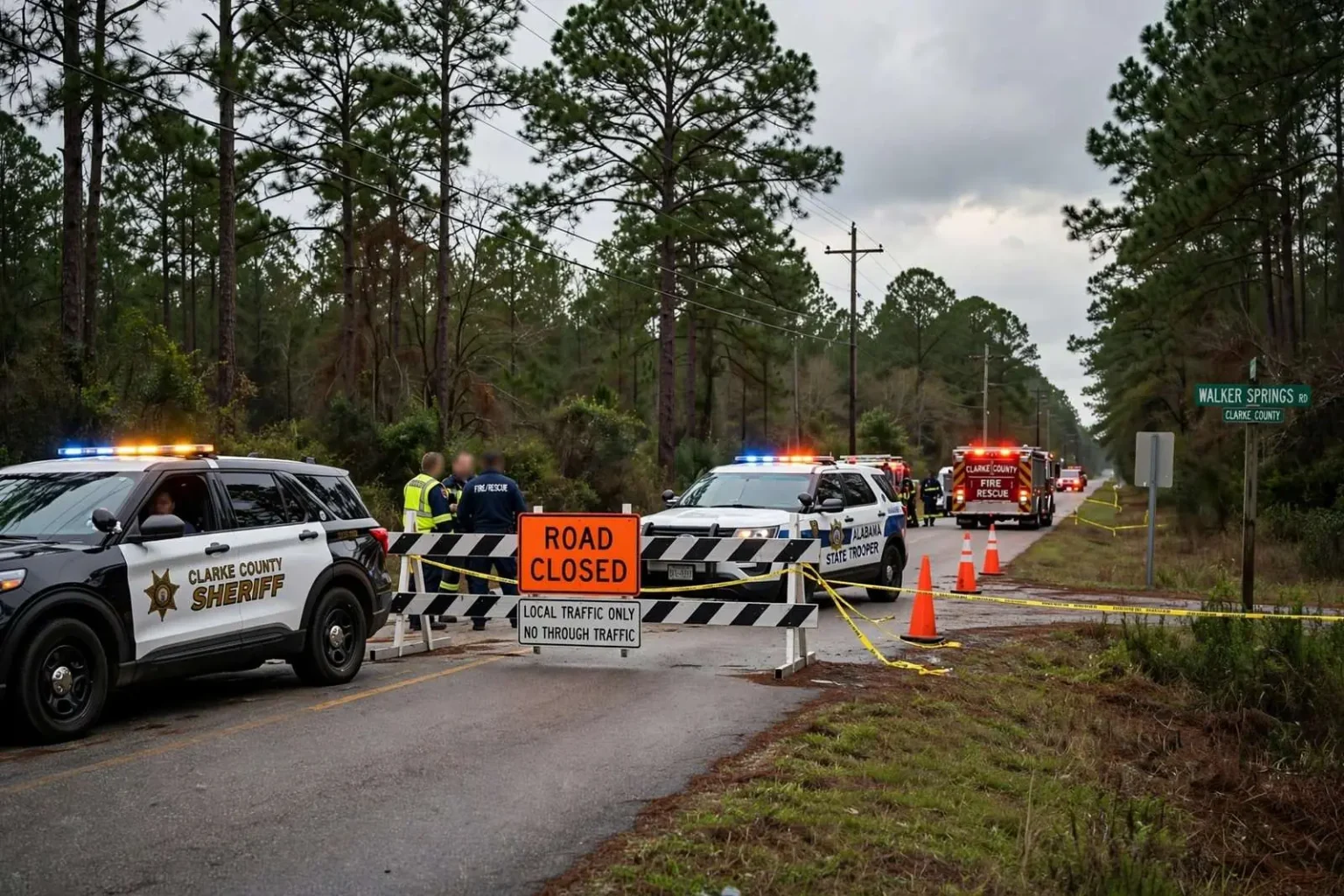
JACKSON, Ala. — A Saturday afternoon crash shut down a portion of Walker Springs Road in Clarke County, and officials later confirmed that one person died as a result of the wreck. The collision occurred after 3 p.m., and the road was closed while emergency crews worked the scene. Authorities said few details were immediately available but described the crash as serious.
Walker Springs Road is one of the primary routes connecting the town of Jackson to the rural Walker Springs community and points deeper into Clarke County, including the road’s namesake community along the Tombigbee River basin in the county’s southwestern section. Because it carries a steady mix of commuter, school and commercial traffic between Jackson and neighboring parts of the county, any closure of the roadway forces drivers onto long detours through secondary county roads. Residents reported the closure stretched for several hours while investigators documented the scene.
Closing a Rural Corridor
In rural Alabama counties like Clarke, a shutdown of a main artery such as Walker Springs Road has an outsized effect. There is no parallel four-lane route nearby, so traffic is pushed onto narrow two-lane farm roads with limited shoulders and poor sight lines. Emergency responders themselves face the same constraint: when the main road is blocked by a crash scene, ambulances and fire apparatus from surrounding volunteer departments must route around the closure, adding minutes to response times in an area where minutes matter.
Saturday afternoon crashes on rural Alabama highways are a persistent safety concern for state and local officials. The Alabama Department of Transportation and the Alabama Law Enforcement Agency routinely urge drivers on rural two-lane roads to watch for slow-moving farm equipment, deer crossing at dusk, and oncoming traffic in curves and hills where passing is unsafe. Clarke County’s road network, like much of southwest Alabama’s, includes long straight stretches that can encourage speeding, punctuated by sharp curves near creek crossings and church driveways.
Clarke County, with its county seat in Grove Hill and its largest city in Jackson, is home to roughly 22,000 people spread across more than 1,200 square miles of pine forest, river bottoms and small communities. Law enforcement coverage is split between the Clarke County Sheriff’s Office, municipal police departments in Jackson, Grove Hill and Thomasville, and state troopers from the Alabama Law Enforcement Agency’s highway patrol division, which covers fatal crashes in the county. Serious injury and fatal wrecks in the county frequently involve the region’s network of state highways and county roads rather than an interstate, since no interstate crosses the county.
What Happens After a Fatal Crash
When a crash involves a fatality in Alabama, the investigation typically passes to the state troopers, who work with the county coroner’s office to document the scene, recover the vehicle and determine the cause. The coroner is responsible for identifying the deceased and notifying next of kin before any name is released publicly, which is one reason officials can go hours or even days after a wreck with only limited information available. Investigators also examine roadway conditions, vehicle damage and witness accounts before producing a final reconstruction.
Road closures like the one on Walker Springs Road serve two purposes: they protect the crash scene for investigators and give tow and recovery crews room to clear heavy wreckage. On rural routes, where a damaged vehicle can end up in a ditch or down an embankment, recovery can require winch trucks and extended closure times. Local residents are generally advised through the sheriff’s office and social media channels to avoid the area until it reopens.
Jackson is the largest city in Clarke County and the anchor of the county’s western side, sitting near the Tombigbee River with a long history in the paper and timber industry. Jackson’s road connections matter not only to city residents but to people in the smaller communities around it — Walker Springs, Suggsville, Whatley and Gainestown among them — who use those routes for work, school and medical appointments. A fatal crash on one of those corridors is felt across the community, both because of the loss of life and because of the practical disruption that follows.
Rural Road Safety in Southwest Alabama
Safety advocates point out that rural crashes in Alabama are disproportionately deadly relative to the miles driven, a pattern attributed to higher travel speeds, longer emergency response times, lower seat belt usage rates and the sheer distance to trauma care. In southwest Alabama, the closest major trauma centers are in Mobile, which can be an hour or more away by ambulance from parts of Clarke County. That distance is why local fire departments and rescue squads invest heavily in first-response training and why helicopter medical transport is often requested for serious rural crashes.
The Walker Springs Road crash also illustrates the routine coordination required between agencies after a serious wreck. The sheriff’s office typically assists with traffic control, municipal fire departments handle fire suppression and extrication, ambulance services transport the injured, and the coroner’s office manages the deceased. Each of those agencies draws from a small pool of volunteers and staff in a rural county, and multi-hour scenes place real strain on those resources, particularly on weekends.
Officials have not said what led to the vehicle leaving the roadway or whether other vehicles were involved, and more information is expected once investigators complete their work. In similar cases, findings such as speed, visibility, roadway surface conditions and restraint use are documented in the eventual crash report, which becomes part of the public record once the investigation closes.
A Community’s Response
Fatal crashes in small Alabama communities tend to reverberate beyond the families directly involved. Churches, schools and civic groups in Clarke County communities routinely organize meal trains, funeral support and fundraising when a neighbor dies suddenly, and area ministers often provide chaplaincy support to first responders at difficult scenes. Local officials regularly remind drivers that a single moment of inattention on a two-lane road can change dozens of lives — the victim’s family, the responders who work the scene and the drivers who happen upon it.
For drivers who regularly use Walker Springs Road, the crash is a reminder of the route’s limitations. The road serves school traffic for area schools, timber trucks heading to the region’s mills, and residents commuting to jobs in Jackson, Grove Hill and Thomasville. County officials periodically evaluate pavement conditions, shoulders and signage on such routes, but funding for rural road improvements in Alabama is limited, and most rural two-lane roads retain their original alignments.
Anyone with information about the Saturday afternoon crash is typically encouraged to contact the Clarke County Sheriff’s Office or the Alabama Law Enforcement Agency, as witness statements collected early often prove decisive in fatal crash investigations. Details about the victim and the circumstances of the wreck had not been made public as of Saturday evening, and officials said additional information would be released once next-of-kin notifications were complete.
The closure of Walker Springs Road was lifted once the scene was cleared, and traffic in the area returned to normal. As is standard practice, the investigation remains active until the final report is filed, and authorities caution that preliminary accounts of a crash can change as evidence is reviewed.
The broader pattern of serious crashes along Clarke County’s rural corridors has been a recurring subject of discussion among county officials and community leaders. Roads like Walker Springs Road, U.S. Highway 43, Alabama Highway 69 and the county’s grid of numbered roads carry traffic between the county’s three main population centers while passing through heavily wooded areas where deer, farm equipment and occasional flooding can create sudden hazards. County highway department crews grade shoulders, clear brush from curves and replace signage as budgets allow, but fundamental upgrades — wider shoulders, centerline rumble strips, passing lanes — remain rare on routes with modest traffic counts.
Emergency management officials in the region also note that weekend afternoons are among the most demanding periods for rural first responders. Volunteer fire departments in communities like Walker Springs depend on members who may be at work, at church or away from the area when pagers sound, and a serious crash scene can require 10 or more responders between fire suppression, traffic control and patient care. Mutual aid agreements between neighboring departments in Clarke, Monroe and Wilcox counties help fill those gaps, but they add travel time that responders work hard to offset with quick first-response care from whoever arrives first.
Motorists in the area can take practical steps that safety officials say measurably reduce rural crash risk: slowing to posted speeds or below in curves and during rain, keeping headlights on at all times, moving fully over for stopped emergency vehicles, and avoiding distractions such as phones. In crashes like the one on Walker Springs Road, investigators will look at each of those factors, along with mechanical condition and roadway evidence, before reaching conclusions about what happened.