One in Three South Mobile County Residents Say They’d Leave After BP Oil Spill, Poll Finds
A South Alabama poll finds nearly a third of southern Mobile County residents would move away after the BP oil spill, fearing lasting damage.
Nearly a third of residents in southern Mobile County say they would move away from the area if they could, according to a new poll measuring the lasting effects of the 2010 BP oil spill on communities along the Gulf Coast. The survey, conducted by the University of South Alabama’s polling group, found that 32 percent of respondents said they would relocate to another community if given the option.
The finding underscores how deeply the spill has shaken residents’ confidence in the region months after the Deepwater Horizon well was capped. For a coastal area whose population has historically been tied to the water through fishing, boat building and tourism, the willingness of one in three residents to consider leaving stands out as one of the starkest measures of the disaster’s human toll, alongside the more familiar tallies of closed fishing grounds and lost tourism revenue.
Doubts About Long-Term Damage and Seafood Safety
The poll also found widespread belief that the spill caused lasting harm to the Gulf ecosystem. Seventy-one percent of respondents said they believe the oil spill caused permanent ecological damage to the Gulf of Mexico, a figure that shows how far skepticism about official reassurances had spread in the communities closest to the affected waters.
Confidence in the region’s seafood supply was shakier still, with 38 percent of those surveyed disagreeing that seafood from spill-affected areas is safe to eat, despite repeated assurances from state and federal officials that Gulf seafood has been tested and cleared for consumption. That gap between official messaging and public belief has been one of the spill’s most durable effects, because seafood sales depend as much on consumer perception as on laboratory results, and perception is slow to recover once it erodes.
The Press-Register first reported the poll results. Pollsters conducted the telephone survey of 412 residents living south of Interstate 10, excluding Theodore, between Sept. 9 and Sept. 27. The survey carries a margin of sampling error of plus or minus five percentage points, meaning the true figures for the population could shift somewhat in either direction, though the broad patterns are difficult to dismiss.
Communities on the Front Line
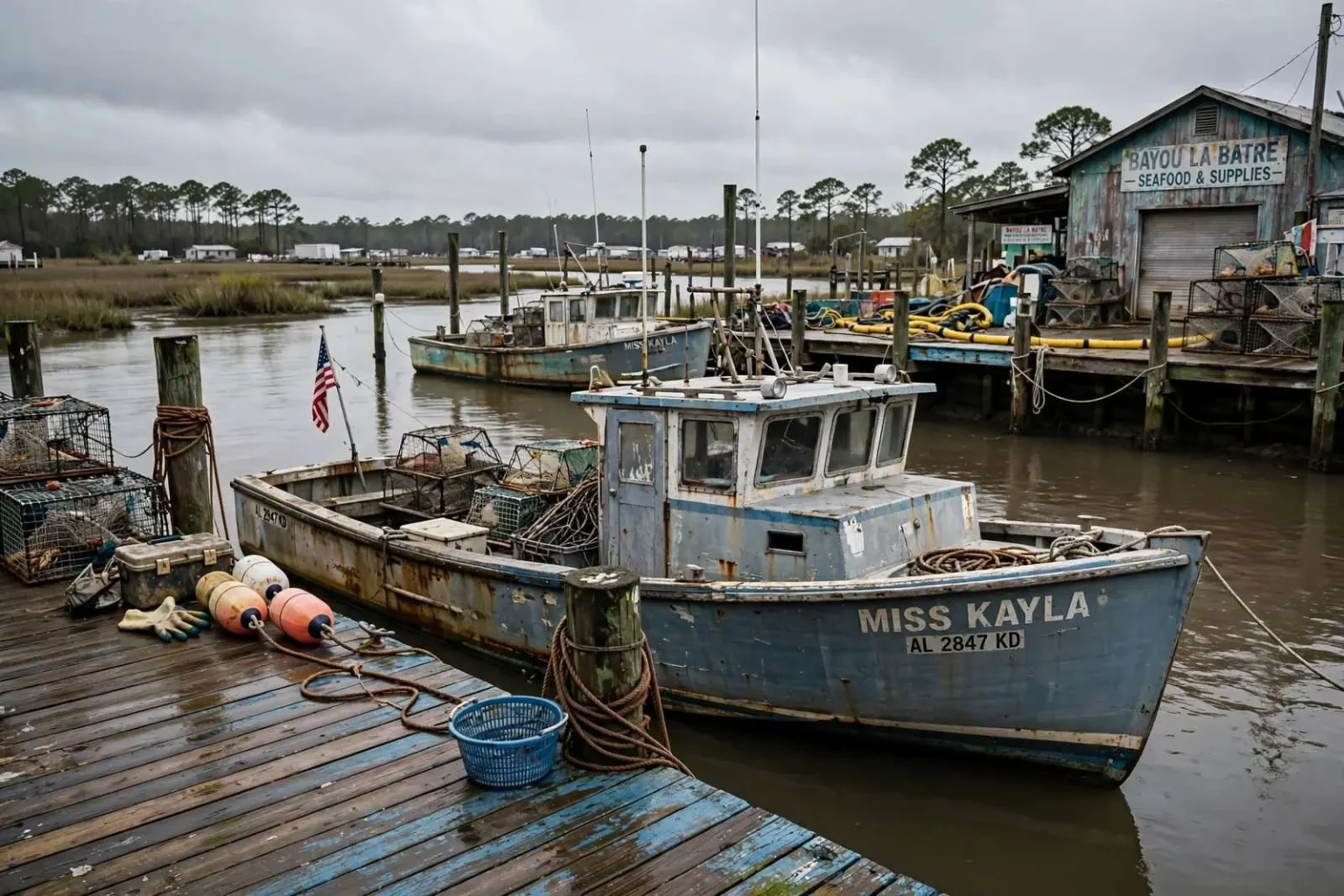
The geography of the survey matters. Southern Mobile County includes some of the hardest-hit communities on the entire Gulf Coast: Bayou La Batre, a working waterfront town long known as a center of commercial shrimp harvesting and boat building; Coden, a fishing community just to its west along the bayou country; and Dauphin Island, the barrier island town whose economy rises and falls with fishing seasons and beach traffic.
Bayou La Batre in particular had spent decades building a fleet and processing industry that made it one of the most important seafood ports in Alabama, a history that earned it a place in national coverage when the spill closed Gulf waters. When fishing grounds shut down earlier in 2010, deckhands, processing workers and boat owners all lost income at once, and many families in the area had no obvious alternative employment to fall back on during the closure.
Tourism communities felt a parallel squeeze. Beach town economies from Dauphin Island down the coast depend on visitors who book months in advance, and the long stretch of uncertainty over where the oil would come ashore did damage even in places the oil itself never reached. Cancellations and empty rentals translated directly into lost wages for workers in restaurants, charter boats, bait shops and rental offices.
Against that backdrop, the poll’s numbers read less like abstract pessimism than like a realistic assessment of what residents had watched happen to their livelihoods. The 32 percent who said they would relocate were disproportionately likely to be people whose work depends directly on the water, and whose skills do not transfer easily to jobs inland. For a shrimper or a deckhand, moving means leaving not just a place but an entire trade built over generations.
A Coastal Economy Still Recovering
Southern Mobile County communities such as Bayou La Batre, Coden and Dauphin Island rely heavily on commercial fishing, shrimping and tourism, industries that were hit hard when the Deepwater Horizon spill shut down large stretches of Gulf waters to fishing earlier in 2010. Even with the well capped and many fishing grounds reopened, the survey suggests many residents remain unconvinced the coast has fully recovered, both ecologically and economically.
Reopening waters is a regulatory act; rebuilding confidence is not. Federal and state testing programs cleared Gulf seafood batch by batch as areas reopened, but the poll’s finding that nearly four in ten residents doubt seafood safety shows how slowly perception follows the data. For the region’s processing houses and dockside markets, whose customers include wholesalers, restaurants and tourists as well as local families, that lingering doubt carries a continuing price in reduced orders and softer prices.
The ecological questions are similarly unresolved in the public mind. Scientists have continued to study where the oil went, how the marshes and oyster reefs along the coast are recovering, and what the spill may have done to generations of fish, shrimp and crab stocks, and definitive answers have come slowly. The 71 percent of respondents who treat the damage as permanent reflect a community that watched oil wash ashore, saw fishing seasons close one after another, and heard official predictions shift repeatedly along the way.
Compensation programs and claims processes have moved money into coastal communities, but payments cannot by themselves answer the questions residents are asking about the future of their industry and their towns. A claim check covers a season’s losses; it does not restore a fishery or reassure a buyer two years from now. The poll suggests many residents see the spill not as a finished event but as an ongoing condition they are still living with.
The University of South Alabama’s polling work fills an important role in that picture. National surveys of Gulf Coast attitudes have often lumped the region together, while a poll aimed specifically at residents south of Interstate 10 captures the population that lives closest to the water and depends on it most directly. That focus helps explain why the numbers are so much darker than the picture presented in statewide summaries.
What the Numbers Mean Going Forward
The results add to a growing body of research examining how the spill reshaped attitudes in Gulf Coast communities. Researchers across the region have documented elevated stress, financial uncertainty and consideration of relocation among coastal residents, and the USA poll adds locally specific data from one of the areas nearest to the spill response, where the sight of cleanup crews and closed waters was a daily experience rather than a news report.
For local officials, the numbers point to the work ahead. Keeping residents in communities such as Bayou La Batre and Dauphin Island depends on restoring both the industries and the confidence behind them: sustained seafood testing that the public understands and trusts, honest and consistent reporting on ecosystem recovery, and economic development that gives fishing families alternatives during lean seasons without ending the working waterfront culture that defines the area.
The poll also serves as a baseline. As recovery programs mature and further studies of the Gulf’s condition are published, later surveys can measure whether the doubts captured this fall — about the ecosystem, about the seafood, about the region’s future — soften over time or harden into lasting outmigration. Each percentage point in that measurement represents families deciding whether the coast can still support the life they have built around it.
The stakes are not evenly distributed. Younger families with more portable skills have more options to leave, while older residents with homes and decades in the seafood trade have fewer, and the community loses something either way — either the people or the continuity that holds the industry together. Schools, churches and civic institutions in Bayou La Batre and Coden all feel those departures, and the working waterfront that remains depends on crews and families staying close enough to the docks to crew the boats when seasons reopen.
For now, the survey stands as a snapshot of a coast still measuring its losses. A third of south Mobile County residents ready to leave, seven in ten convinced the damage is permanent, and nearly four in ten doubting the seafood on local plates together sketch a community whose faith in the water that defines it has not yet been restored. How long that lasts will depend less on the next official statement than on what residents see on the docks, in the water and at the market in the seasons to come. Until then, the poll’s numbers remain the most honest and most local accounting the community has of where it stands.