Billboards Go Up Along Alabama Highways Opposing Lowndes County Data Center
Protect Lowndes County has placed billboards along I-85, I-65 and U.S. Highway 80 opposing Project Red Clay, a proposed 1,500-megawatt hyperscale data center on more than 800 acres near the Selma-to-Montgomery trail.
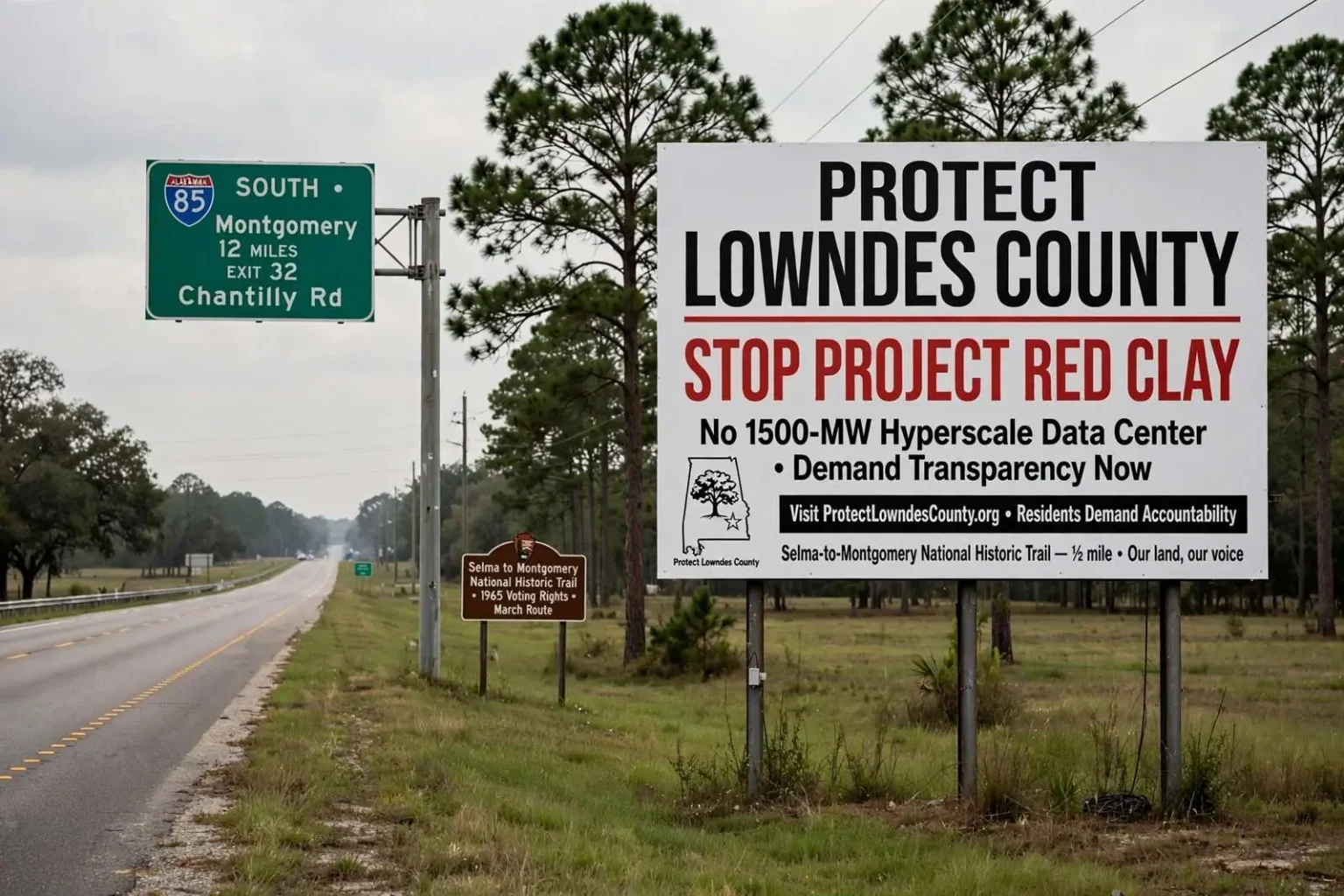
LOWNDES COUNTY — Billboards opposing a proposed hyperscale data center in Lowndes County are now up along major Alabama highways, marking an escalation in organized resistance to the development known as Project Red Clay.
Protect Lowndes County, a grassroots residents group, announced that it has placed billboards at three locations: along I-85 southbound near the Chantilly exit in Montgomery, along I-65 northbound leaving Lowndes County near the Fairview exit, and on U.S. Highway 80 entering Lowndes County. The billboards direct motorists to ProtectLowndesCounty.org, where the organization is urging residents to oppose Project Red Clay and calling for greater public disclosure surrounding the proposed development.
What Is Project Red Clay?
Project Red Clay is a proposed hyperscale data center development being pursued by Houston and Seattle-based Cloverleaf Infrastructure. The company has assembled more than 800 acres in northeastern Lowndes County for the project, which industry trackers have listed as a planned 1,500-megawatt facility spanning nearly 3 million square feet.
Cloverleaf is developing the site for an eventual owner or operator that has not been publicly identified. A formal tax-abatement request had not been filed as of previous reporting, though county officials have discussed whether the project could qualify for an abatement lasting up to 30 years.
Civil Rights History Adds a Layer
The opposition campaign carries historical weight given the project’s proximity to the Selma-to-Montgomery National Historic Trail. The proposed site sits roughly half a mile from a field where civil rights marchers camped during the 1965 voting rights march, a detail that has added emotional resonance to the debate.
“The Selma to Montgomery March passed through this land. People bled for the right to be heard here,” the group said. “Now an out-of-state developer wants to drop a hyperscale data center on top of it, and the folks who actually live here were the last to find out.”
The Transparency Demands
Protect Lowndes County describes itself as a residents group seeking more transparency before county officials take action on the project. The organization is circulating a petition calling on the Lowndes County Commission to identify all entities and tenants involved, disclose water, energy and economic impact information, and make all project documents publicly available.
Supporters argue that citizens cannot meaningfully weigh in on a project of this scale without that information, particularly given the potential for decades-long tax agreements.
What a Hyperscale Data Center Means
A 1,500-megawatt development would rank among the largest data center projects in the country. Such facilities require extraordinary amounts of electricity and water for cooling, and they typically seek lengthy tax abatements to offset construction costs. For a rural county, the promise of jobs and an expanded tax base must be weighed against the demands on local infrastructure and the question of who benefits once the development is operational.
Cloverleaf Infrastructure is a relatively new entity formed to assemble and prepare large sites for hyperscale tenants. Its business model relies on securing land and permits before a final operator is named — which is why residents say they feel kept in the dark about who will ultimately occupy the campus.
Why the Location Matters
Lowndes County sits in Alabama’s Black Belt, a region defined by its rich soil, deep rural character and central role in the civil rights movement. It was along the rural roads here that voting rights marchers walked in 1965, and the county remains a symbol of both the struggle for civil rights and the enduring challenges of rural Alabama.
The county’s population has declined for decades, and economic development proposals of any kind tend to generate both hope and skepticism. Project Red Clay, with its enormous power and water footprint and its unidentified end user, has landed in that complicated context, and residents say they want a seat at the table before any dirt is moved.
Why the Billboards Matter
Placing messages along I-85, I-65 and U.S. 80 turns a local dispute into a public one. Travelers from Montgomery, Birmingham and beyond will see the signs, extending the conversation beyond county lines and increasing pressure on officials to respond.
The group is encouraging motorists who spot the new billboards to photograph and share them on social media as part of a broader awareness campaign, building a digital archive of its effort.
A Closely Watched Fight
As debate over data center development intensifies across Alabama, the Lowndes County situation is emerging as a flashpoint in the conversation about balancing economic development with community input and environmental concerns. Project Red Clay appears likely to remain one of Alabama’s most closely watched land-use fights — a test of how a rural community balances the lure of major investment against the right to know what is being built in its backyard.