Slippery, Sloppy and 40 Years Old: Perdido Bay’s Mullet Festival Turns a Fish Toss Into $30,000 for Kids
The Optimist Club of Perdido Bay's 40th Mullet Festival drew more than 120 runners to a Labor Day 5K, filled Lillian with breakfast, a bake sale and a silent auction, and is expected to raise $30,000 to $40,000 for local children's programs.
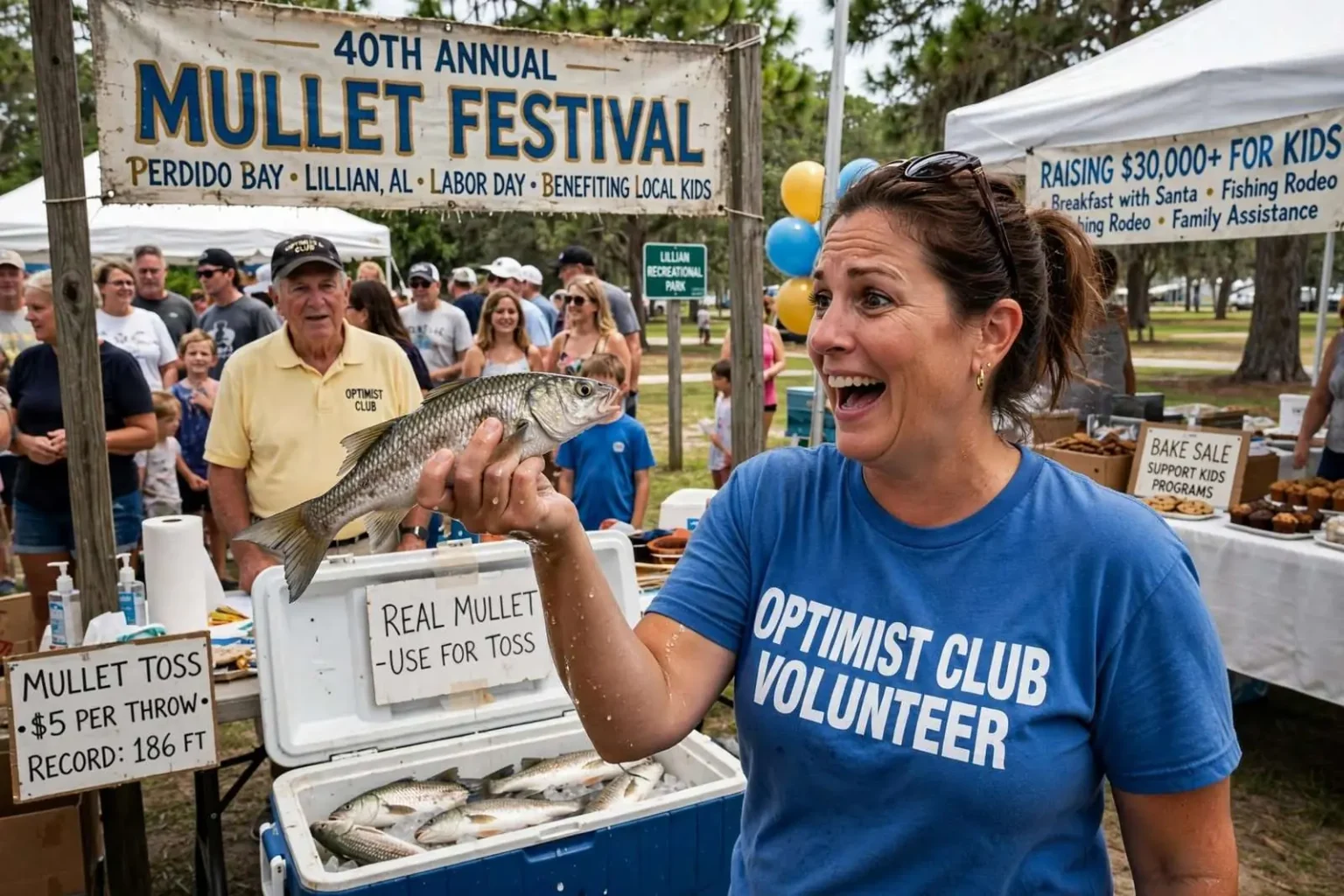
LILLIAN, Ala. — Karen Marrero drove over from Pensacola to throw a fish for the first time, having been assured by her husband that the fish would not be a real one.
“My husband told me it was going to be plastic or fake, they couldn’t have real ones for that many people, but they did,” Marrero said. “Surprise! I didn’t realize how sloppy and slimy they were.”
They were real. They are always real. That is rather the point.
The Optimist Club of Perdido Bay hosted its 40th annual Mullet Festival on Labor Day morning in Lillian, running the event it has run for four decades: a community gathering that funds programs for local children.
Where the Money Goes
Jeff Keener, president elect of the Optimist Club of Perdido Bay, laid out the club’s year in concrete numbers rather than mission statements.
“Like Breakfast with Santa, we’ll serve 325 meals and we’ll give away almost 200 Christmas gifts,” Keener said. “The fishing rodeo, it’ll be about 150 kids. Not many kids have a fishing pole. We will take care of individual families who have need.”
That last sentence carries more than the others. A club that funds a Christmas breakfast and a fishing rodeo is running programs. A club that quietly handles individual families in need is running something closer to a safety net, and the discretion in the phrasing is deliberate.
The Optimist Club expects the Mullet Festival to raise between $30,000 and $40,000, making it the organization’s largest fundraiser of the year.
Carole Hayden, watching the morning unfold, said the need is real.
“It’s wonderful. It’s a community that really needs a lot of help. There’s people who need help,” Hayden said.
The Race Has Quadrupled
The day started with a 5K, and organizers said the race has grown from about 50 runners a few years ago to more than 120.
Geoffrey Wilkins came from Foley to run it for the fifth time.
“It’s a fun, fun group of people,” Wilkins said. “It’s a fun run, a little hot today but other than that it’s just great for the community too.”
A Labor Day 5K on the Alabama Gulf Coast is an exercise in early starts for a reason. September mornings here begin warm and humid and get worse quickly, which is why community races in this region are almost universally scheduled at or before dawn.
Growth from 50 to 120-plus runners in a few years is substantial for a small-town race. Registration fees and the associated foot traffic feed directly into the fundraising total, and a race that draws participants from Foley, Pensacola and the Orange Beach area pulls in people who might otherwise never come to Lillian on a holiday morning.
Breakfast, a Bake Sale and a Silent Auction
Beyond the race, the day carried the full complement of small-town fundraising machinery: breakfast, lunch, a bake sale and a silent auction.
Each of those serves a distinct function, and long-running festivals tend to keep all of them for that reason. Food sales produce reliable per-head revenue and, more importantly, keep people on the grounds. A bake sale converts volunteer labor directly into cash at essentially no cost of goods. A silent auction extracts substantially larger individual contributions from a small number of attendees, and it gives local businesses a way to support the event without writing a check.
The Mullet Toss
The main event was the mullet toss, in which participants of all ages attempt to throw a whole mullet as far as they can. The course record stands at 186 feet.
Several people took a run at it. Some had impressive throws. Others, in the organizers’ assessment, needed practice.
The mullet toss is a Gulf Coast institution with a genuinely practical origin. Mullet is the region’s most abundant nearshore fish, a schooling species that jumps clear of the water and has been a staple of Gulf Coast diets and bait buckets for as long as anyone has been fishing here. A fish that is cheap, plentiful and locally iconic is a natural centerpiece for a community fundraiser, and throwing one for distance is the kind of idea that only sounds strange to people who did not grow up with it.
It is also, as Marrero discovered, considerably harder than it looks. A whole mullet is slick, floppy and aerodynamically hopeless. Distance comes from technique rather than arm strength, which is why children occasionally out-throw adults and why the record has stood where it has.
Forty Years in a Small Place
Lillian sits on the eastern edge of Baldwin County, hard against the Florida line at Perdido Bay, and it is small enough that a single festival can meaningfully move the year for local children’s programs. The community’s civic life runs through a handful of institutions — the Optimist Club, the community club, Lillian Recreational Park — each of which depends on volunteers and on events like this one.
Forty consecutive years is a real achievement for a volunteer-run event. Community festivals typically fail in one of two ways: the founding volunteers age out and no one replaces them, or a bad year financially ends the run. Surviving four decades means the Optimist Club has handed the work down more than once.
Marrero, having recovered from the discovery that the fish were real, came around to what the morning was actually for.
“That’s absolutely wonderful,” she said of the fundraising total. “It just touches my heart because kids are our future generation.”
What Comes Next
The Optimist Club’s calendar continues past Labor Day. Its fishing rodeo serves roughly 150 children, many of whom do not own a rod, and its Breakfast with Santa event serves 325 meals and distributes nearly 200 gifts. Those programs are what Monday morning’s proceeds pay for.
Lillian’s festival season is not finished either. Lillian Recreational Park’s Fall Fest returns Sept. 19, running 11 a.m. to 7 p.m. with barbecue, live music, a beer tent, vendors and a children’s fun zone.
Optimist International and the Local Club Model
The Optimist Club of Perdido Bay belongs to a service organization structure that is common across small-town America and increasingly under strain.
Optimist International is a volunteer service organization built around youth programming, organized into autonomous local clubs that raise and spend their own money in their own communities. The model’s strength is that decisions are made locally by people who know the families involved — which is why Keener could describe the club taking care of individual families in need without a formal application process.
The model’s vulnerability is demographic. Service clubs of this type across the country have faced declining and aging membership for decades, as the social patterns that fed them — long tenure at a single employer, denser local social ties, fewer competing demands on discretionary time — have shifted. A club that has run an event for 40 consecutive years has, by definition, solved the succession problem repeatedly.
What $30,000 to $40,000 Buys
The club’s expected haul from the Mullet Festival is worth translating into the programs it funds, because the arithmetic is unusually direct at this scale.
Keener described a Breakfast with Santa event serving 325 meals and distributing close to 200 Christmas gifts, and a fishing rodeo serving roughly 150 children, many of whom do not own a rod. Add the discretionary assistance to individual families, and the festival’s proceeds are effectively the club’s operating budget for the year.
A dollar raised by a volunteer organization with no paid staff and no facility overhead goes considerably further than a dollar raised by an institution with either. Nearly all of it reaches the program.
“Not many kids have a fishing pole,” Keener said — a sentence that describes both the need and the intervention in ten words.
Mullet, the Fish
For readers outside the region, some background on the festival’s namesake.
Striped mullet are abundant throughout the northern Gulf, schooling in bays, bayous and nearshore waters, and they are unmistakable to anyone who has spent time on the water here because they jump — repeatedly, for reasons still debated among biologists.
They are a genuine food fish in this region, smoked or fried, and they occupy a specific cultural position along the Gulf Coast as working-class table fare. They are also the standard bait for a wide range of larger species. Cheap, plentiful, culturally embedded and easy to acquire in quantity: everything a community fundraiser needs in a mascot.
The throwing itself is genuinely difficult, as first-timers discover. A whole mullet has no aerodynamic properties worth mentioning, and it is slick enough that grip fails before arm strength does. The course record of 186 feet represents technique.
The Rest of the Calendar
Lillian’s event season continues. Lillian Recreational Park’s Fall Fest returns Saturday, Sept. 19, from 11 a.m. to 7 p.m., with barbecue from Garlock Processing, a beer tent, arts and crafts vendors, a children’s fun zone with laser tag and a petting zoo, pumpkin painting and pumpkin smashing, and live music from Cowboy Johnson and Jon Cook from noon to 3 p.m. and Gary Story and Bad Habit from 4 to 7 p.m. A $5 parking donation goes toward repaving the park’s lot.
Anyone interested in supporting the Optimist Club of Perdido Bay’s youth programs, or in volunteering for its fishing rodeo or Breakfast with Santa, can reach the club through its local channels.