Orange Beach Adds Third Enclosed Lifeguard Tower at Gulf State Park’s Romar Beach Access
Orange Beach Surf Rescue has installed a new enclosed lifeguard tower at Gulf State Park's Romar Beach Access, giving lifeguards better visibility and storm protection as the city expands its beach safety network.
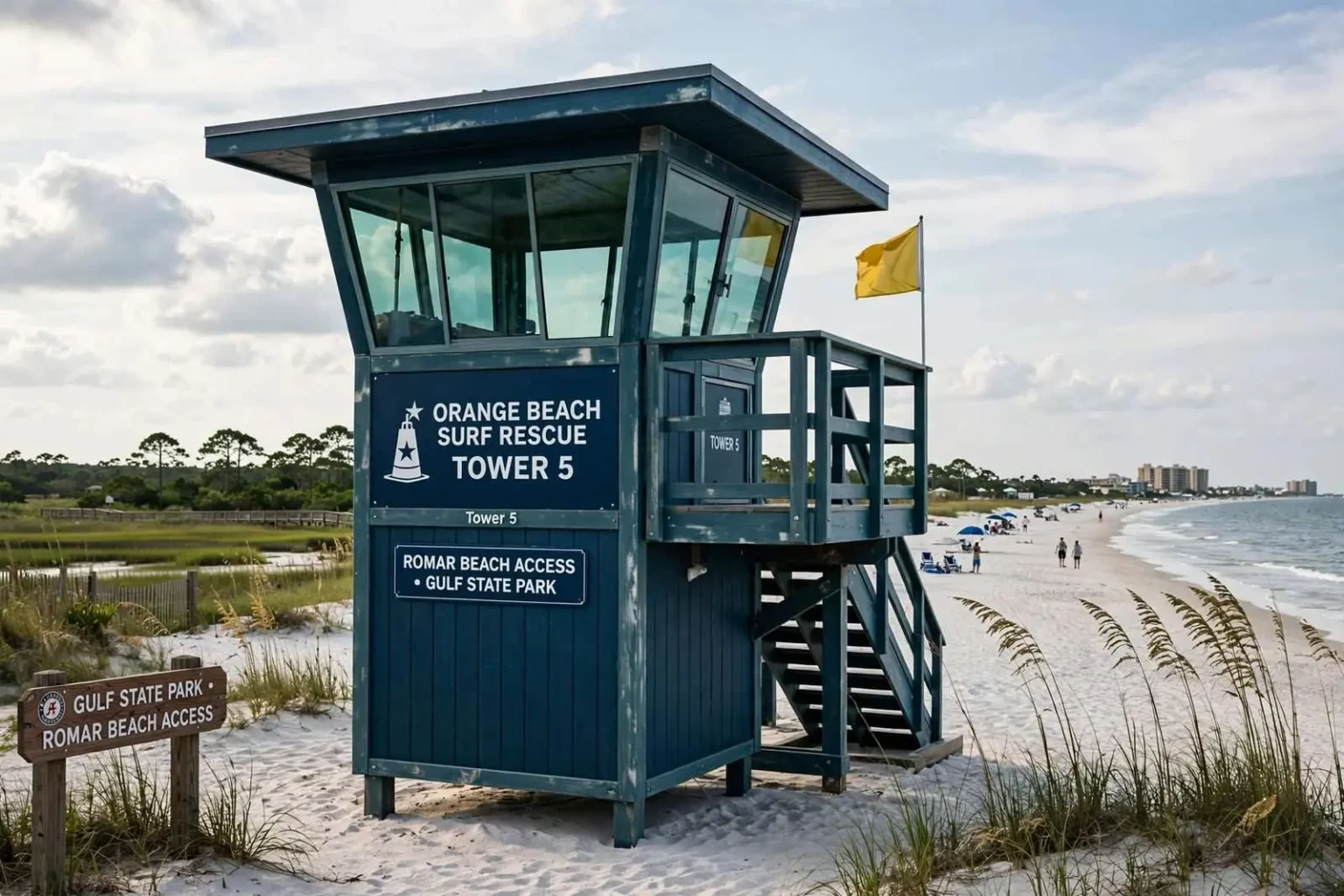
Orange Beach Surf Rescue has added a new enclosed lifeguard tower at the Gulf State Park Romar Beach Access, giving lifeguards a wider field of view over the shoreline and better protection during severe weather. The structure, known as Tower 5, was built with support from the mayor and City Council as part of the city’s ongoing effort to improve beach safety and working conditions for lifeguards.
The new tower puts an elevated, weather-hardened lookout over one of the busiest stretches of sand in Baldwin County. Romar Beach, along Perdido Beach Boulevard on the city’s eastern end, draws heavy crowds through the summer, and the access point sits within the boundaries of Gulf State Park, one of Alabama’s most visited outdoor destinations. For the surf rescue team, the enclosed design means a clearer vantage over swimmers and sandbars alike — and a safe place to ride out the afternoon thunderstorms that roll off the Gulf on summer days.
The Orange Beach City Council unanimously approved the purchase of Tower 5 in March 2026 for $82,835. The tower is the third enclosed structure added to the city’s lifeguard network, following Tower 2 at Alabama Point East in 2024 and Tower 3 at Cotton Bayou Beach in 2025. Orange Beach now operates six lifeguard tower locations along its coastline.
A Growing Lifeguard Network
In addition to the three enclosed towers, the city maintains Tower 1 at Shell Beach, Tower 4 at the Resident Beach Access in Coastal Orange Beach, and Tower 6 near The Oasis. The spread of towers along Perdido Beach Boulevard means that swimmers are rarely far from a guarded stretch of shoreline, and it lets Surf Rescue position personnel at the access points that see the heaviest use. Each new structure represents a deliberate investment in a program that has grown alongside the city itself.
Orange Beach, on Alabama’s Gulf Coast at the Florida line, has seen its visitor numbers climb steadily as the region’s reputation as a beach destination has grown. Condominium towers, vacation rentals, and the state park’s beach access points put tens of thousands of swimmers on the city’s shoreline at the height of summer, and a professional lifeguard force has become essential infrastructure. The tower program mirrors what visitors might see at major beach destinations elsewhere on the Gulf and Atlantic coasts — purpose-built stations that give guards the height, visibility, and shelter they need to do the job.
The enclosed design matters for two reasons. First, elevation: a guard in an enclosed tower can scan a wider arc of water, spot swimmers in trouble sooner, and track changing conditions at distance. Second, protection: Gulf weather changes fast, and lightning is a constant summer threat. An enclosed station lets lifeguards stay on site and watch the water through weather that would drive an open platform clear, shortening the time it takes to resume coverage once a storm passes.
Why Beach Safety Infrastructure Pays Off
Rip currents remain the deadliest hazard on the Gulf Coast, and they form without warning along sandy-bottom beaches like those in Orange Beach. The channelized currents pull swimmers away from shore, and panicking swimmers who fight the current directly exhaust themselves — which is why safety officials hammer the same advice every season: swim near a lifeguard, and if caught in a rip current, stay calm and swim parallel to shore. Guarded beaches statistically see dramatically fewer drownings than unguarded ones, which is the arithmetic behind the city’s tower investment.
Alabama’s beach flag system gives the public a daily read on conditions, and the towers serve as its physical outposts. A single green flag signals calm conditions, a yellow flag warns of moderate surf, a red flag means strong surf and high hazards, and double red flags close the water entirely. Purple flags signal dangerous marine life. Lifeguards raise and change the flags as conditions shift, and the towers keep that information visible up and down the beach.
Gulf State Park’s Romar Beach Access is one of several public gateways to the park’s two-plus miles of sugar-white shoreline, and it sits in the stretch of coastline where Orange Beach meets the park’s western boundary. The park, which spans thousands of acres across Baldwin County, draws visitors for its trails, lake, campground, and beaches, and its beach access points see heavy use from both park guests and day visitors. Placing an enclosed tower at a park access point required coordination between the city and park officials, and the finished structure reflects that shared interest in safe beaches.
The tower program has rolled out in deliberate steps. Tower 2 at Alabama Point East came first in 2024, covering the rocky pass at Perdido Pass where the beach meets the inlet. Tower 3 followed at Cotton Bayou Beach in 2025, a popular access near the heart of the city’s condo district. Tower 5 at Romar extends that coverage eastward, closing gaps in the network and putting enclosed stations at the access points with the heaviest seasonal traffic. With six towers now in place, the city has coverage across the developed length of its beach, from Shell Beach on the west end to the accesses near The Oasis.
Staying Informed on the Sand
City officials continue to urge beachgoers to swim near lifeguards and stay informed about conditions. Residents and visitors can text “ALBEACHES” to 888777 for daily beach condition and flag status updates, or call 251-981-SURF (7873) for a recorded report on current weather and surf conditions. The daily report is the fastest way for visitors to check conditions before they leave their rental or hotel, and it reflects the same observations the lifeguard staff uses to set the flags each morning.
Officials also ask visitors to remove all belongings from the beach at the end of each day to help keep the shoreline clean. The request matters more than it might seem: items left overnight — chairs, umbrellas, toys, tents — can become hazards during nighttime beach driving and debris when storms or high tides move through, and they clutter a shoreline the city works hard to keep pristine. Evening sweeps of the beach go more smoothly when visitors pack out what they packed in.
The investment in towers and safety communications fits a broader pattern in Orange Beach city government, which has treated its coastline the way inland cities treat their roads and utilities — as critical infrastructure requiring continuous maintenance and upgrade. The city’s lifeguard and beach safety operations have expanded as tourism has grown, and the enclosed towers are the most visible piece of that expansion.
What It Means for Visitors
For the typical beach visitor, the practical takeaway is simple: the guarded stretches of Orange Beach are easier to find than ever, and the enclosed towers make guards more effective in the conditions that matter most. Families planning a beach day can pick a tower location, check the flag and surf report before they go, and set up within sight of professional rescuers. During the summer season, that combination — flags, daily reports, and a growing tower network — gives Orange Beach one of the more complete beach safety systems on the Alabama coast.
The 2026 season will be the first with three enclosed towers standing guard over the city’s sand. Surf Rescue officials say the structures are already changing the way the team works, giving them shelter during pop-up storms and a better platform for watching the water at peak hours. As visitation continues to climb along the Alabama Gulf Coast, the city has signaled that Tower 5 will likely not be the last investment of its kind.
Lifeguarding on the Alabama coast is a seasonal discipline with a serious training backbone. Surf Rescue personnel train in ocean rescue techniques — swimming and board rescues in surf, spinal management in breaking waves, and the use of rescue equipment suited to the Gulf’s conditions. The job demands constant vigilance even on quiet days, because the difference between calm water and a dangerous rip current can be a matter of minutes and a shift in the wind. Enclosed towers give those guards a professional workplace commensurate with the responsibility they carry.
The tower placements also reflect the geography of Orange Beach’s shoreline. The city’s beach runs east from Perdido Pass toward the Florida line, interrupted by condominium complexes, public accesses, and the state park’s holdings. Swimmers cluster at the public access points, which is precisely where the towers stand. Alabama Point East and Cotton Bayou anchor the western and central stretches, and Romar now extends that coverage to the park’s popular eastern access — a logical progression as the program has matured year by year.
A Regional Safety Leader
Among Alabama’s beach communities, Orange Beach and neighboring Gulf Shores handle the bulk of the state’s coastal visitation, and both have invested heavily in beach safety over the years. The flag system, daily surf reports, and lifeguard coverage form a layered defense that safety officials credit with saving lives during each busy season. Enclosed towers put the city’s program in line with the standards seen at established destinations across the Gulf, where purpose-built lifeguard stations have long been part of the beach landscape.
The text-alert system deserves particular attention from visitors. Tourists arriving from inland areas often have little experience reading surf conditions, and a green-looking Gulf can hide dangerous currents. The ALBEACHES text updates and the recorded surf line put expert assessment in every visitor’s pocket, translated into the simple language of flags and hazards. Safety officials say the visitors who use those tools — and swim near a tower — stack the odds overwhelmingly in their favor.
As the summer season wears on, the new tower at Romar will settle into the routine of the rest: flags raised each morning, guards scanning the water through the hottest hours, storms watched from inside the enclosure, and swimmers directed safely back to the sand when conditions turn. It is unglamorous work, performed in heat and sun, and the city’s investment in it signals how much value Orange Beach places on the people who do it — and on the millions of visitors who swim beneath their watch.