Orange Beach and Gulf Shores Set New E-Bike Rules: Speed Caps, Power Limits and $1 Million Rental Insurance
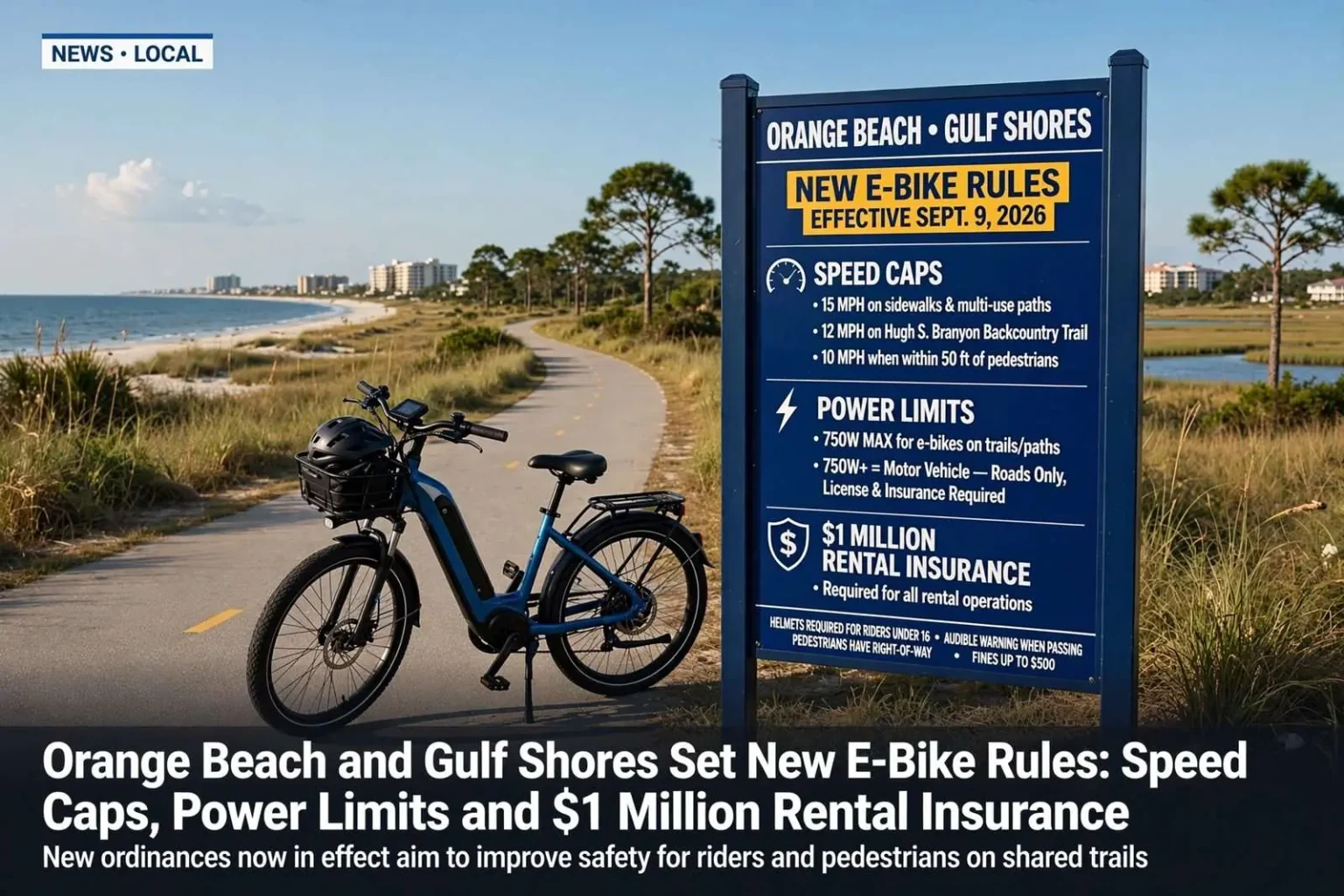
Orange Beach’s new e-bike and micromobility rules take effect Sept. 9, 2026, with 15 mph sidewalk and path limits, 12 mph on the Backcountry Trail, helmets under 16, pedestrian right-of-way and fines up to $500. Gulf Shores caps all paths at 10 mph.
ORANGE BEACH, Ala. — Electric bicycles, scooters and other personal motorized devices have grown rapidly in popularity across the United States, and coastal resort cities like Orange Beach and Gulf Shores have seen a sharp rise in their use on shared trails and sidewalks.
Both cities have responded by passing new local ordinances addressing speed limits, equipment standards and rental business requirements. Municipal leaders say the regulations are intended to reduce conflicts between riders and pedestrians on public pathways.
Orange Beach Rules Take Effect Sept. 9
The Orange Beach City Council has adopted a new set of regulations covering bicycles, e-bikes and other micromobility devices, and the rules take effect Wednesday, Sept. 9, 2026.
Orange Beach Police detailed the new requirements publicly ahead of that date, laying out the specific limits riders will be held to rather than waiting for the first citations to explain them. The department asked parents to sit down with young riders in their households and go over the rules before they take effect.
“These rules are intended to reduce conflicts between riders and pedestrians and help keep everyone using our sidewalks, trails and pathways safe,” the department said, closing its announcement with a three-line summary: “Slow down. Stay alert. Share the path.”
The timing is deliberate. A Sept. 9 effective date lands after Labor Day weekend, at the front edge of the shoulder season, which gives the city several quieter months to establish the rules with residents and off-season visitors before the spring break and summer crowds arrive.
Orange Beach: Speed Limits on Trails
Orange Beach has established a speed limit of 15 mph on sidewalks and multi-modal paths, and 12 mph on the Hugh S. Branyon Backcountry Trail.
The lower limit on the Backcountry Trail reflects its character. That trail is a nature-oriented recreational corridor with curves, wildlife crossings and heavy pedestrian use, rather than a transportation route — conditions where sight lines are shorter and stopping distance matters more.
Rules for Approaching Pedestrians
To protect walkers, riders must reduce speed to 10 mph or less when approaching a pedestrian within 50 feet, and must give an audible warning before passing from behind.
The ordinance also settles the underlying question of priority: pedestrians have the right-of-way. That single provision does a great deal of work, because it removes the ambiguity that produces most path conflicts. On a shared path without an established hierarchy, a walker and a rider each assume the other will adjust. Written down, the rule tells a rider that yielding is not a courtesy but an obligation, and it gives an officer a clear standard to enforce against.
The audible warning requirement addresses the single most common source of conflict on shared paths. An electric bicycle produces almost no sound, and a pedestrian who does not know a rider is behind them can step sideways at exactly the wrong moment. A bell or a spoken “on your left” eliminates most of that risk. The Orange Beach rule applies to passing other riders as well, not just pedestrians.
Power Limits and Class Restrictions
Devices with motors of 750 watts or higher — including high-powered “e-motos” — are legally classified as motor vehicles under the Orange Beach rules.
That classification carries real consequences. Those devices require a state driver’s license and insurance to operate, and are restricted entirely to public roadways. They are prohibited from sidewalks, multi-use paths and the Backcountry Trail, and are restricted to the areas permitted by law.
The 750-watt threshold is a meaningful line. Below it, a device functions roughly like a bicycle with assistance. Above it, particularly with the high-powered e-motos now widely sold, a device can reach speeds and carry mass comparable to a small motorcycle — which is precisely why the ordinance treats it as one.
Fines of Up to $500
Violations of the Orange Beach rules may result in fines of up to $500.
That ceiling puts the city’s enforcement authority in the same range as its neighbor’s, and it is high enough to matter in a market where a large share of riders are visitors on a one-week stay. A fine that is smaller than the cost of a rental is a fee; a fine that approaches the cost of the trip is a deterrent.
The practical effect of a ceiling rather than a fixed amount is discretion. It lets an officer distinguish between a rider drifting a few miles per hour over the limit on an empty path and one weaving through a crowded sidewalk at full speed, without the ordinance having to enumerate every scenario in advance.
Rental Business Requirements
Rental businesses face stricter rules, including a requirement to maintain a physical location within city limits or the police jurisdiction, and to carry $1 million in general liability insurance.
The physical-location requirement targets a specific problem in resort markets: rental operations that deliver devices to vacation rentals without a local presence, leaving no accountable business for the city or an injured party to reach. Requiring an address inside the jurisdiction gives enforcement somewhere to go.
Youth Safety and Enforcement
Riders and passengers under 16 must wear a helmet under the Orange Beach rules — a requirement that covers the child riding on the back of a device as well as the one steering it.
Under the enforcement framework, police officers will target reckless behaviors — failing to yield, excessive speeding, or performing stunts — and will notify or cite parents for juvenile violations rather than impounding devices.
Citing a parent rather than seizing a device is a deliberate enforcement choice. It puts responsibility on the adult who purchased or permitted the device, avoids the administrative burden of impound and release, and generally produces faster behavioral change than confiscation does.
It also explains why the police department directed its pre-effective-date message at parents specifically. In a household where a teenager rides daily and the adults have never read the ordinance, the citation arrives at an address where nobody knew the rule existed. A few minutes of review beforehand is the cheapest form of compliance available.
Gulf Shores Goes Further
Just down the coast, Gulf Shores has enacted more restrictive speed limits to protect beachgoers and pedestrians.
Gulf Shores passed an ordinance capping the speed limit on all designated multi-use paths and sidewalks at 10 mph — a full 5 mph below the Orange Beach limit for equivalent facilities.
The Gulf Shores Penalty Structure
Gulf Shores enforces a tiered fine system for unsafe riding: $250 for a first violation, $400 for a second and $500 for subsequent offenses.
Devices ridden by minors under 18 without helmets may also be impounded, with a $50 release fee.
The escalating structure is designed to separate the one-time offender from the repeat one. A $250 first violation is significant enough to register with a visitor, while the $500 tier is aimed at riders who have already been warned twice.
What Riders Should Know
The practical differences between the two cities matter for anyone riding between them, since the Backcountry Trail network connects the communities.
A rider traveling from Gulf Shores into Orange Beach moves from a 10 mph limit to a 15 mph limit on sidewalks and multi-modal paths, and to 12 mph on the Backcountry Trail. A rider on a device at or above 750 watts is not permitted on those paths in Orange Beach at all.
Before renting, visitors should ask what class of device they are getting and what its motor wattage is — the answer determines where it can legally be ridden.
The short version of the Orange Beach ordinance, for a rider trying to stay inside it: 15 on sidewalks and multi-use paths, 12 on the Backcountry Trail, 10 or slower within 50 feet of anyone on foot, a bell or a shout before every pass, a helmet on everyone under 16, pedestrians first, and no e-motos on the paths at all.
The Broader Push
With coastal tourism and local residency at high levels, these measures reflect a regional effort to prioritize safety on multi-use paths.
By combining speed reductions, rental accountability and strict power classifications, local leaders hope to keep public pathways usable and safe for pedestrians and riders alike — a balance that has become harder to strike as device power and popularity have both increased faster than the rules governing them.
Update: Orange Beach Rules Now in Effect, With Fines Up to $500
The Orange Beach portion of these rules is now in force. Riders who violate the ordinance can be cited, and the ordinance allows for fines of up to $500.
Orange Beach Police Chief Trent Johnson said the ordinance was a response to how quickly e-bike use has spread through the city, across every age group.
“It seems to have exploded down here and it’s all ages. We see adults. We see kids. They’re everywhere, so we needed something,” Johnson said.
Age, Helmet and Speed Requirements
Riders and passengers under 16 must wear helmets. Speed limits vary by location:
- 15 miles per hour on sidewalks and multi-use paths
- 12 miles per hour on the State Park’s Backcountry Trail
- 10 miles per hour when within 50 feet of a pedestrian, with an audible warning required when passing
How It Will Be Enforced
Johnson said officers will not enforce the new rules aggressively at the outset unless they witness an egregious offense, and that the department is still working out the practical mechanics.
“It’s a safety thing. That’s the main reason we want it. We now have a reason we can actually stop you and say, hey, slow down, be careful, watch out for pedestrians and that type of thing,” Johnson said. “We’re also still figuring out how we want our officers to enforce it. Are we going to put them on bikes with radar guns on our trails? It’s a possibility. We just don’t know yet.”
The Orange Beach ordinance closely tracks rules already adopted in Fairhope and Gulf Shores, part of a broader move among Baldwin County cities to write micromobility devices into their traffic codes.
Gulf Shores Acted First, in the Spring
Orange Beach’s ordinance followed a similar move by Gulf Shores, which updated its own rules governing electric bicycles on public property and on private property open to the public earlier in the year.
The Gulf Shores ordinance applies to bicycles and to what the city calls regulated mobility devices — a category that sweeps in Segways, hoverboards, electric skateboards, motorized scooters and e-motos. On multi-use paths and sidewalks approved by the city, the maximum speed is 10 mph. Fines start at $200 and rise with additional violations.
Equipment requirements mirror those applied to conventional bicycles at night: a white front headlamp and a red rear reflector or light, plus a bell or horn to signal when passing.
What Gulf Shores Defines as ‘Unsafe Operation’
Rather than leave enforcement to an officer’s judgment, the Gulf Shores ordinance spells out what unsafe operation means on streets, sidewalks, bike paths, trails, parks and private property open to the public. The list includes:
- Violating traffic laws or posted signs
- Riding against traffic
- Using drainage facilities or other areas not intended for travel
- Carrying extra passengers, or riding a device in a way it was not designed for
- Riding more than two devices side by side
- Exceeding posted speed limits
- Riding on sidewalks not designated for mobility devices
- Hitching to a vehicle, or allowing someone else to cling to the device
- Performing stunts, such as lifting wheels off the ground
- Failing to yield to pedestrians or vehicles
- Passing without warning — riders must ring a bell or call out “passing on your left”
Writing the prohibited conduct out in a list does two things. It gives officers something specific to cite, which makes citations easier to sustain if challenged. And it gives parents and riders a document they can actually read, rather than a general standard whose meaning only becomes clear after a ticket.
‘These Are Not Toys’
Gulf Shores Police Chief Dan Netemeyer framed the ordinance to the council as a safety measure rather than a restriction.
“This is not about restricting people’s freedoms or personal preferences,” Netemeyer said when the ordinance was presented. “It’s something that needs to be done.”
He pointed to a death that shaped how the department views the issue. In May 2023, a 13-year-old boy was killed on Highway 59 after his e-bike veered in front of a moving dump truck.
“These are our roads, and everyone has to co-exist within the limits of the law,” Netemeyer said. “These are not toys. I cannot go anywhere in town, on or off duty, without someone coming up to me and complaining about e-bikes. The general consensus is we have a problem, and something needs to be done.”
Orange Beach Plans a Video for Every Student
In Orange Beach, officials said the rules are intended to reduce conflicts between riders and pedestrians on shared paths — and that enforcement is not the primary plan for getting compliance.
“We’re also putting together a video that will be shown to every student to help make sure everyone understands the rules and, more importantly, why they’re in place,” Councilman Jack Robertson said after the meeting.
“I hope everyone understands that our goal is simply to keep these kids safe,” Robertson added. “I believe most of them will follow the rules, especially with a little help and encouragement from their parents.”
The approach acknowledges something both cities face: the riders most affected by these ordinances are largely children and teenagers, a group that does not read council agendas and cannot be reached by a legal notice in a newspaper.