Orange Beach Islands Stay Open to Boaters Even as Gulf Beaches Close Under Coronavirus Order
Robinson Island, Walker Island and Bird Island near Perdido Pass have drawn heavy boat traffic even as Orange Beach's Gulf-front beaches remain closed under the state's coronavirus order, prompting a back-and-forth between residents, the mayor and Gov. Kay Ivey over whether the islands should be shut down too.
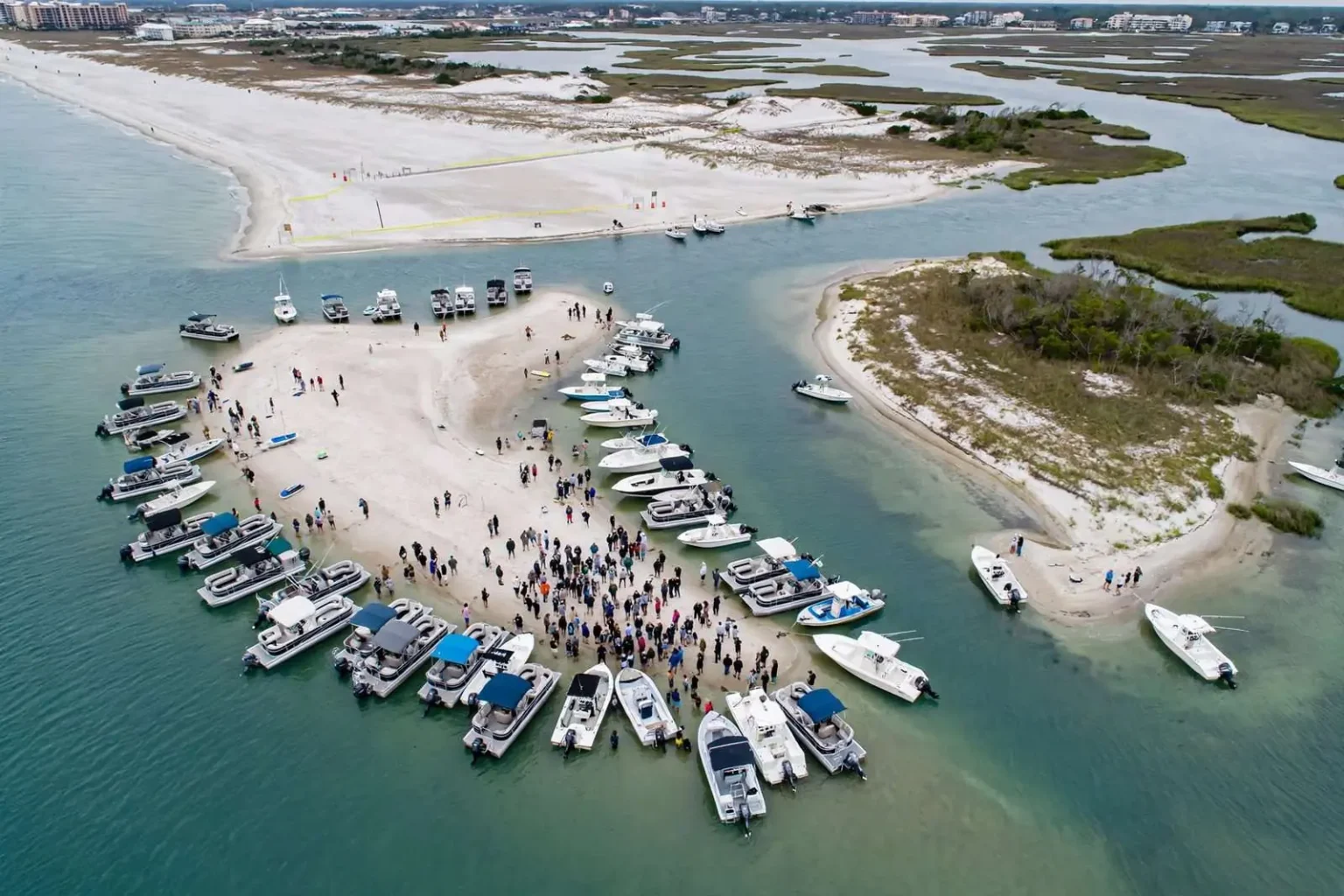
While the sand along the Gulf of Mexico in Orange Beach has sat empty under Governor Kay Ivey’s coronavirus closure order, a handful of islands just off the coast near Perdido Pass have remained a magnet for boaters, raising questions about whether the state’s social distancing rules can reach water that never technically touches the beach.
Robinson Island and Walker Island, both owned by the city of Orange Beach, along with the state-owned Bird Island, sit in and around Perdido Pass and have drawn heavy boat traffic on recent weekends, with vessels anchoring close together despite the ongoing push to slow the spread of the coronavirus.
Photos and video circulating from the past two weekends show crowds of boaters gathered shoulder to shoulder on the sandbars, a scene starkly different from the deserted public beaches nearby. By Monday, city officials said conditions around the islands had eased considerably, describing boat traffic and the number of people on the sandbars as light compared to the weekend rush.
Still, the pattern has repeated itself weekend after weekend since the governor’s order took effect, prompting residents to press both Orange Beach Mayor Tony Kennon and Ivey’s office to explicitly extend the beach closure to cover the islands and surrounding waterways.
Why the islands fall outside the order
The islands have so far fallen outside the scope of the state’s public health order because the order applies specifically to beaches that touch Gulf of Mexico waters, and the sandbars near Perdido Pass do not meet that definition. The distinction is a drafting technicality with real consequences: Robinson and Walker Islands sit inside the pass, on the bay side of the barrier, where the water that laps their sand comes from Perdido Bay and the Intracoastal rather than the open Gulf.
Alabama Marine Police officers have been monitoring the islands and say they remain in close contact with the governor’s office as the situation develops. Mayor Kennon said the city is enforcing the governor’s directives to the extent its authority allows, but noted the islands and waterways were not included in the original closure.
“With the manpower we have available we are enforcing the governor’s mandates and directives along with social distancing during this time,” Kennon said.
The manpower point matters in a resort city of Orange Beach’s size. A police department scaled for a population of a few thousand residents absorbs an enormous seasonal burden from visitors, and during the pandemic closure the department was simultaneously enforcing rental restrictions, beach closures and business limitations along the Gulf front. Patrolling a scattered set of islands reachable only by boat, with crowds that materialize on weekend afternoons and scatter by evening, stretches those resources further.
The governor’s answer
Asked directly about the loophole, Ivey acknowledged that the islands do not legally qualify as beaches touching the Gulf, but said that does not exempt the people on them from social distancing requirements.
“You are correct that those islands do not ‘abut the Gulf of Mexico’ as the Public Health Order specifies. However, social distancing orders must be applied and adhered to in all cases,” Ivey said.
She added that Orange Beach has the authority, through the existing order and the statewide state of emergency, to close the islands outright if it chooses. “If not closed, social distancing orders must be enforced,” she said.
The statement pushed the decision back to City Hall. A city closure of the islands would be an exercise of the emergency powers the governor’s order delegates to local governments, and it would resolve the definitional gap the state order left open. But it would also make Orange Beach the city that closed its most popular boating destination while neighboring communities left comparable waters open — a choice with consequences for the boating economy that fills the city’s marinas, restaurants and launch ramps in ordinary spring seasons.
Boaters push back
For boaters like Tim Powell, the islands have become one of the few remaining outlets for recreation now that schools and many workplaces have shut down. Powell said he understands the concern but pushed back on the idea that the sandbars should be treated any differently than the closed beaches.
“I still think it’s the beach,” Powell said, arguing that with no work and no school, getting out on the water is one of the few ways families can pass the time while still keeping their distance from others.
At the same time, Powell said he recognizes the tension between giving people an outlet and protecting public health, and that the responsibility ultimately falls on boaters themselves to keep their groups separated once they reach the sandbars.
“It’s important that they keep their distance. It’s sort of a catch-22 between maintaining a certain level of sanity for the public and maintaining safety, and right now we kind of need to watch our safety,” Powell said.
That view — recreation as a release valve, with responsibility resting on the users — is the argument the boating community has made since the closures began. A family that arrives by private boat, spreads out on its own section of sandbar and returns home has, in that framing, had less contact with strangers than a trip to a grocery store. The counterargument is the weekend footage itself: vessels rafting together, groups mingling across boats, and crowds dense enough that the photographs became the story.
The islands and their ordinary season
Robinson, Walker and Bird Islands occupy a special place in the local boating culture, and the closure fight cannot be understood without it. The islands sit at the mouth of Perdido Pass, minutes from the boat launches and marinas of Orange Beach, and on a normal spring or summer weekend their sandbars host hundreds of vessels — pontoon boats, center consoles and kayaks rafted in groups, with families wading between them at low tide.
The city of Orange Beach acquired Robinson and Walker Islands through its conservation and land acquisition efforts, preserving them as public open space after years of development pressure along the pass. Bird Island, owned by the state, completes the cluster. The islands function as the boating equivalent of a city park: free to reach, unprogrammed and heavily used. On holiday weekends the crowd is a defining feature of the Perdido Pass area, as identifiable to locals as the Flora-Bama to the east.
That popularity is exactly what made the pandemic scene jarring. The same geography that makes the islands easy to reach — a short run from every launch in the area — makes physical separation on their sandbars nearly impossible at peak traffic, and the photographs from the first weekends of the order showed crowds at densities no beach ordinance would tolerate on land.
Enforcement on the water
For now, no formal closure of Robinson Island, Walker Island or Bird Island has been announced, leaving enforcement of social distancing on the water largely dependent on voluntary compliance and periodic checks by Alabama Marine Police.
Marine Police enforcement carries its own complications. Officers on the water can disperse crowds, order anchors pulled and cite violations of navigation or boating laws, but social distancing is a public health directive rather than a boating statute, and a sandbar is a difficult place to define a violation. The agency’s approach so far has been monitoring and presence — patrols that concentrate on the peak hours and report conditions back to the governor’s office.
City and state officials are expected to continue monitoring boat traffic around Perdido Pass in the coming weekends as the coronavirus pandemic response in Baldwin County continues to evolve.
What comes next
The coming weekends amount to a test of whether the islands can police themselves. If boat traffic and sandbar crowds stay light, as officials described on Monday, the pressure for a formal closure ebbs; if the weekend rush returns, the choice Ivey laid out — close the islands or enforce distancing — returns to the city with sharper urgency.
Either path carries risk for a city whose economy is built on access to the water. A closure would be enforceable in a way the current patchwork is not, and it would align Orange Beach with the strictest reading of the state’s health order. Leaving the islands open preserves one of the few recreation outlets remaining to residents of a county under stay-at-home guidance, but it leaves the city enforcing a rule on a landscape — shifting sandbars, scattered vessels, crowds that form and dissolve with the tide — that was never designed for lines of separation.
For the boaters of Baldwin County, the question is simpler and closer to home: whether a spring on the water can coexist with a pandemic, or whether the sandbars of Perdido Pass will join the empty beaches of the Gulf front until the order lifts.