Orange Beach Offers Free Rabies Vaccines and Pet Microchipping at April Clinic
Orange Beach Animal Control hosts a free rabies vaccine and microchip clinic Saturday, April 8 at Unleashed Dog Park. Pre-registration is required.
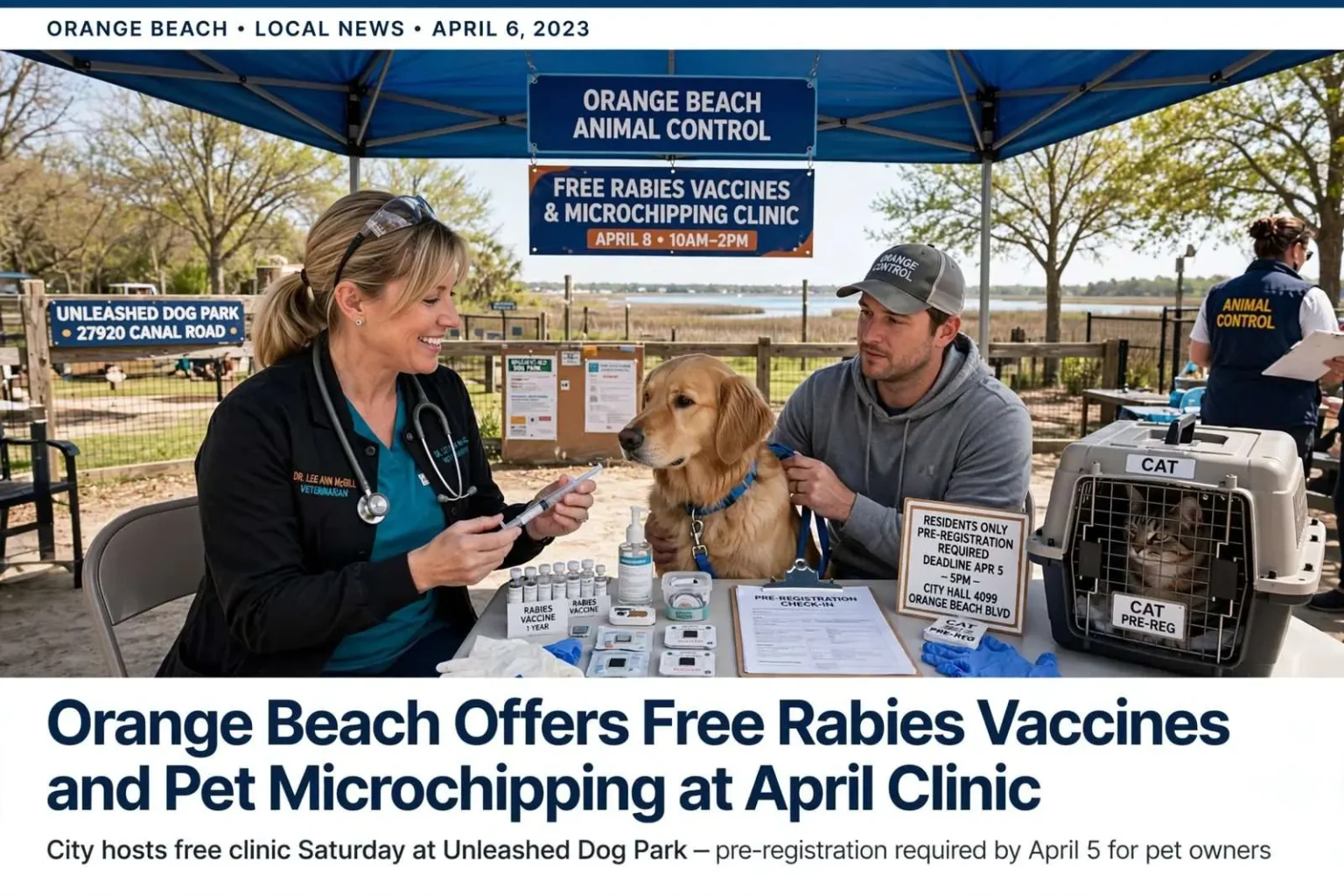
Orange Beach pet owners will have a chance to protect their dogs and cats at no cost this weekend, as the city’s Animal Control division hosts a free rabies vaccination and microchipping clinic on Saturday, April 8 — an event that bundles two of the most important steps in pet ownership into a single morning visit.
The clinic runs from 10 a.m. to 2 p.m. at Unleashed Dog Park, 27920 Canal Road. Veterinarian Dr. Lee Ann McGill will administer one-year rabies vaccines and microchips free of charge, courtesy of the City of Orange Beach, with the park’s pavilion serving as a open-air clinic for the day.
Participation is limited and pre-registration is required. Residents can stop by Orange Beach City Hall, 4099 Orange Beach Blvd., to complete the necessary forms ahead of the deadline, which is 5 p.m. Wednesday, April 5. The clinic is open to Orange Beach residents only, and supplies are capped, so early sign-up is encouraged — in past clinics around the area, slots have filled as the deadline approaches, leaving latecomers on a waiting list.
How the clinic works
The format is designed for speed and low stress, for pets and owners alike. Pre-registered residents arrive at the dog park during the four-hour window, check in with Animal Control staff and cycle through the vaccination and microchipping stations in minutes. Dogs should be on leashes and cats in carriers, and owners should bring proof of residency along with any prior vaccination records they have — records matter because they determine whether a pet needs a one-year shot or qualifies for the longer interval on a subsequent visit.
Each pet vaccinated at the clinic will receive a rabies tag and certificate, the paperwork Alabama owners are required to keep current. The microchip, a grain-of-rice-sized transponder injected under the skin between the shoulder blades, gives every pet a permanent ID that any shelter or veterinary office can scan. For a coastal city where storms can scatter pets and vacation traffic can sweep an unlocked gate open, the chip is the difference between a lost dog coming home and a dog becoming a shelter statistic.
Questions about the clinic can be directed to Animal Control Officer Tiffany Long at 251-424-5073.
Animal Control staff recommend arriving early in the four-hour window rather than near the 2 p.m. close, both to beat the line and to leave time for paperwork questions. Owners with multiple pets can bring them together, and staff ask that pets who do not get along with other animals be noted at check-in so the flow can be arranged around them. The event has become one of the division’s most popular services of the year, and the pre-registration cap exists precisely so that the line stays moving and every signed-up resident gets served before supplies run out.
Why rabies vaccination matters
Rabies affects all mammals, including humans, and is considered fatal once symptoms appear unless preventive treatment follows an exposure. The virus spreads primarily through bites or scratches from an infected animal, or when contaminated saliva contacts the eyes or mouth. Once symptoms begin, the disease is virtually untreatable, which is why the entire public health response to a potential rabies exposure — for a person or a pet — moves fast and takes no chances.
The Gulf Coast carries its own rabies risks. Raccoons, foxes, bats and skunks are the region’s most common wild carriers, and along the beaches and bayous of Baldwin County, pets and wildlife cross paths constantly — in yards, on trails, around unsecured garbage and along the dunes where unvaccinated cats roam. A dog that tangles with a rabid raccoon on a Saturday night can, weeks later, expose an entire household before anyone knows what happened. The vaccine breaks that chain.
Keeping household pets current on vaccinations does more than protect the animal itself — it builds a buffer between wildlife rabies and people. Public health officials call this the buffer concept: when the majority of dogs and cats in a community are immunized, the virus has a much harder time crossing from wildlife into the human environment. That is why Alabama law requires dogs, cats and ferrets to stay up to date on rabies shots, and why municipalities such as Orange Beach go a step further and make the vaccination free.
What Alabama’s rabies law requires
Alabama’s rabies vaccination statute is among the older and more durable animal laws on the state’s books. It requires every dog, cat and ferret owner to have the animal vaccinated by a licensed veterinarian once it reaches the age of three months, and to keep the vaccination current at the interval the vaccine’s label allows. The certificate and tag that come with the shot are not optional paperwork — animal control officers can cite owners whose pets are found without current vaccination, and the requirement applies in every county.
The law also spells out what happens after a suspected exposure. A dog or cat that bites a person must be confined and observed for a period determined by local health officials, whether or not the animal is vaccinated, and an unvaccinated pet that tangles with a rabid animal faces quarantine or, in some circumstances, euthanasia testing. Current vaccination is often the only thing standing between a exposed pet and those outcomes, which is why veterinarians and animal control officers repeat the same advice: keep the shots current, keep the paperwork handy.
The microchip side of the clinic
Microchipping has become standard practice across the Gulf Coast for reasons that go beyond stray dogs. The region’s hurricane seasons regularly separate pets from owners — fences fail, doors blow open, families evacuate with animals that slip loose in unfamiliar cities. After a storm, scanned microchips have reunited animals with their families from shelters hundreds of miles away, cases that would have ended in adoption or euthanasia a generation ago.
The chips themselves require nothing from the owner beyond registration. Each transponder carries a unique number linked to a national registry, and the clinic’s staff will walk owners through the registration step that makes the chip useful — a chip that is implanted but never registered is a chip that cannot bring a pet home. Owners who move or change phone numbers are reminded to update the registry, the single most common failure point in microchip reunifications.
Pairing the chip with the rabies shot in a single visit makes practical sense: the pet is already restrained, the paperwork is already in hand, and the owner walks away with an animal that is both legally compliant and permanently identifiable.
Why cities do this for free
The economics of a free clinic work in the city’s favor, even though each vaccine and chip costs money. Rabies prevention is a shared public expense — when a person is bitten, the health department investigates, the animal control division quarantines or tracks the animal, and the public picks up the tab for post-exposure treatment that can run into thousands of dollars for the patient. Every pet vaccinated at a Saturday clinic is a bite investigation that may never happen, a stray that can be returned instead of impounded, and a health risk quietly retired.
Orange Beach’s Animal Control division has used the free-clinic model to lift compliance across the city, particularly among owners who would put off a veterinary visit that costs money but not one that costs nothing. The pre-registration requirement keeps the event manageable for Dr. McGill and the animal control staff, and the residents-only rule ties the service to the city budget that funds it.
Unleashed Dog Park itself, on Canal Road along the Intracoastal Waterway side of the city, has become a familiar gathering point for the city’s dog owners — fenced run areas, water stations and a regular crowd that makes it a natural venue for a clinic. Holding the event there also puts the service where the animals already are: a park where hundreds of dogs socialize every week is, in a quiet way, the front line of the city’s rabies prevention effort, since an unvaccinated animal at a dog park is exactly the contact point the vaccine campaign exists to close off.
April timing matters too, arriving just ahead of the season when the coast’s animal risks climb. Spring brings more wildlife activity, more puppies and kittens reaching vaccination age, and the first wave of tourist-season traffic that fills the city’s streets and beaches. A pet population that heads into that season vaccinated and chipped is easier for the city to manage through the summer, when strays, lost vacation dogs and storm season all arrive together.
For pet owners who miss the deadline, the message from the division is straightforward: the clinic is the easiest path, but not the only one. Local veterinarians administer rabies vaccines year-round, and Baldwin County’s shelters periodically host low-cost vaccination and microchip events of their own. What no owner can do is skip the requirement — the state law does not have a grace period, and the wildlife along Canal Road does not check vaccination records.