Orange Beach Softball Claims Second Straight State Title With Another Walk-Off Thriller
Orange Beach High School's softball team won its second consecutive AHSAA Class 2A state championship with a walk-off single in the seventh inning, capping a repeat title run for the young program.
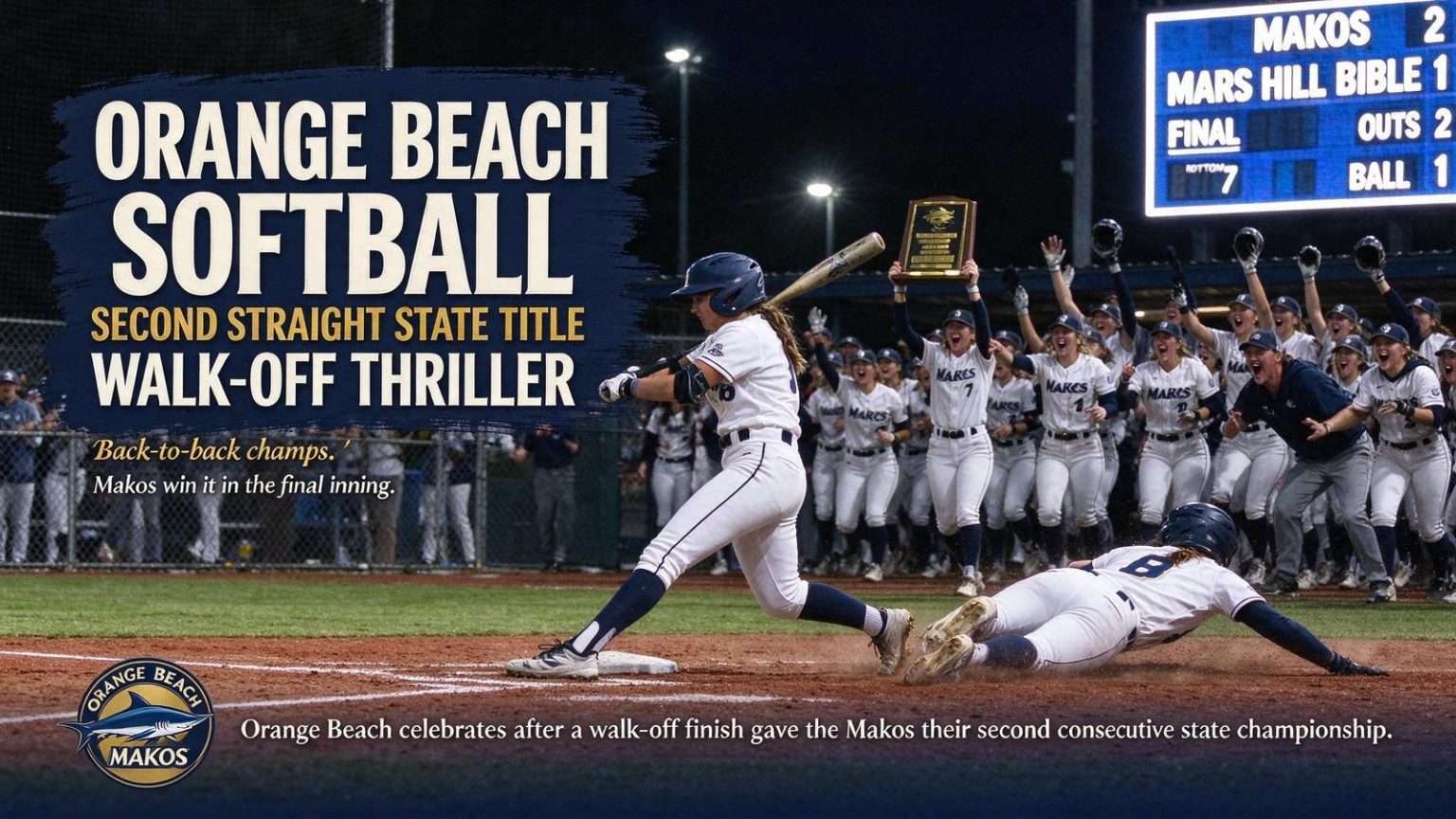
Orange Beach High School’s softball program has built a habit out of finishing games in dramatic fashion, and its second state championship run ended no differently than its first. The Makos claimed their second consecutive Alabama High School Athletic Association Class 2A state championship over the weekend, edging Mars Hill Bible 2-1 in a game that stayed tied until the final inning at Oxford’s Choccolocco Park. For the second year in a row, Orange Beach delivered the winning run in walk-off fashion, sending a program that has existed for only two seasons into rare company among the state’s smallest classifications.
With the score knotted at 1-1 heading into the bottom of the seventh, leadoff hitter Falyn Beebe singled to put the potential winning run on base. Georgia McDonald followed with a bunt intended simply to advance Beebe to second, but Beebe read the play, kept running past second and slid headfirst into third ahead of the throw, putting herself in scoring position with less than two outs.
That set the stage for Daigle Wilson, who stepped into the batter’s box knowing exactly what was needed. Wilson lined a single into the outfield, scoring Beebe from third and setting off a celebration on the field as Orange Beach secured its second straight title.
Head coach Shane Alexander, stationed in the third-base coaching box, said his reaction mirrored the one from a year earlier — hands in the air and a sprint toward the dugout to celebrate with his players.
Choccolocco Park has become the proving ground for Alabama’s best softball teams, and the AHSAA’s decision to stage its championship tournaments there has turned the Oxford complex into an annual destination for programs from every classification. For a young program from the coast, the trip north to play on the state’s biggest softball stage is a benchmark of how far the Makos have come in a short time, and both of their visits have ended with the same scene: a dogpile in the infield at the bottom of the seventh.
The finish echoed the program’s first championship, won a year earlier at the same Oxford ballpark. In that game, Orange Beach trailed 2-1 in the bottom of the seventh before a home run in the final at-bat delivered a 3-2 win over a veteran Class 2A program, capping the debut season for a roster that had entered the tournament with little pressure or expectation.
A Different Kind of Title Defense
This year’s team carried a very different profile. After winning it all as an unproven newcomer the year before, Orange Beach returned to the tournament as the top-ranked Class 2A team in the state, a target rather than a surprise. Every opponent on the schedule knew exactly what the Makos were, and few teams in any classification play a full season with the kind of attention a defending champion draws from its own classification.
Alexander said that shift in expectations made the second title feel harder to earn than the first, even though the Makos again found a way to close out the deciding game in their final at-bat. The psychological toll of a repeat chase is something coaches across every sport describe the same way: the first championship is free, and the second is earned against teams that have spent a year preparing specifically for you.
Getting back to the championship game required the Makos to work through a state tournament bracket that included wins over other regional contenders before the matchup with Mars Hill Bible, which had fought through its own bracket to reach the title game and nearly forced extra innings before Orange Beach’s final rally. Mars Hill’s pitching kept the Orange Beach lineup quiet for most of the afternoon, holding the state’s top-ranked 2A offense to single runs until the last possible moment.
Alexander praised the base-running instincts that put his team in position to win, saying the decision to send Beebe to third on the bunt attempt was the turning point of the inning. Mars Hill Bible called a timeout to regroup, and Alexander said his coaching staff considered calling for a suicide squeeze before deciding to let Wilson swing away and try to drive the run in herself.
The choice to play for the hit rather than the bunt reflected the confidence Alexander has placed in his hitters all season. A squeeze play converts with a good bunt and fails with a bad one; giving Wilson the chance to swing kept the pressure on the Mars Hill defense without turning the at-bat into a one-pitch gamble.
Only Two Seniors Depart
Orange Beach will graduate only two seniors from this year’s championship roster, second baseman Madison Cogswell and center fielder Krystin Kennell, leaving much of the core group intact heading into next season. For a program built on young talent, the continuity is significant: the players who delivered both championship-winning swings — and the pitcher staff and defense that kept two title games within reach in the seventh inning — will be back in the lineup together.
The Makos won’t have a chance to defend the Class 2A title specifically, however, as the school has been reclassified to compete in Class 4A going forward. The AHSAA periodically reshuffles its classification lines based on enrollment figures, and Orange Beach’s growth has pushed the school into a larger class where the competition pool will include bigger programs from across south Alabama.
Coaches and players say the jump in classification shouldn’t be a major adjustment, since the team already scheduled most of its non-region games this season against opponents from Class 5A through Class 7A. That scheduling philosophy — common among successful coastal programs seeking strong competition — has effectively given the Makos a head start on the level of play they will face in the new classification.
Alexander, who coached previously at Hartselle High School, a large Class 6A program in north Alabama, said he recognized early on that this group of players had the ability to compete regardless of classification, and that building their confidence to match that talent was as much a part of the job as the softball instruction itself.
His background at a 6A school gives the reclassification conversation a grounded voice. Coaches who have worked at the state’s largest schools know the difference between classes is real but not absolute, and the best small-school programs routinely prove they can play with anyone when the schedule allows the matchup.
Two Titles, Two Stories
With back-to-back state titles now secured in the program’s first two seasons of existence, Alexander said he doesn’t try to rank one championship above the other, since each carried its own challenges — the first defined by the freedom of being an unknown underdog, the second by the pressure of chasing a repeat as the team every opponent circled on its schedule.
That framing captures what makes the Makos’ rise unusual. Most Alabama programs spend years, sometimes decades, chasing a single state title in softball. Orange Beach arrived at two in two tries, in a sport where pitching depth and tournament endurance decide the outcomes, and did it while transitioning from an expansion roster with no history into a program that opponents treat as the measuring stick.
Alexander also credited the surrounding community, including support from Orange Beach city leadership and school administrators, for helping build the environment that has allowed the young softball program to develop so quickly into a back-to-back state champion.
Orange Beach is one of Baldwin County’s newer schools, serving a rapidly growing beachside community where the student population has expanded alongside the city itself. That growth is precisely what drove the move up in classification, and it means the Makos’ future opponents in Class 4A will include programs with far longer athletic histories. If the program’s first two seasons are any indication, the Makos intend to make that history rather than inherit it.
What comes next is the harder road. A Class 4A schedule will stretch the Makos against deeper pitching staffs and larger talent pools, and every opponent will carry the memory of what Orange Beach did in Class 2A. The program’s foundation — a championship culture, a nearly intact roster, a coach with big-school experience and a community that has invested in its teams — gives the Makos as strong a starting position as any program making the same jump could ask for.
For the returning players, the next season begins with a change in what is possible. In Class 2A, the Makos could win a title on talent alone, outplaying opponents whose rosters were drawn from smaller enrollment pools. In Class 4A, the depth of the field means the tournament itself will be longer and stiffer, and the marginal difference between advancing and going home will be sharper. Teams that win in the larger classifications typically do so with deep pitching rotations and lineups that can manufacture runs even when the big hits are hard to come by — a style the Makos have already shown they can play, given how many of their two championship games stayed tight until the final swings.
The senior departures of Cogswell and Kennell will open two spots in the lineup, and Alexander will look to the championship-tested underclassmen to fill them. Continuity matters most in the middle of the field, and with both corner positions, the pitching staff and the heart of the batting order returning, the Makos lose less production than most two-time champions would when facing a classification jump at the same time.
For the Orange Beach community, the run has already outpaced anything a two-year-old program could reasonably promise. The city that grew up around the Gulf State Park beaches now has a softball program with two state championship flags, a coach with a 6A pedigree, and a group of young players who have learned how to win when the game is on the line. The Choccolocco Park celebration is now a two-year tradition, and the Makos will carry it into a new classification in the fall.