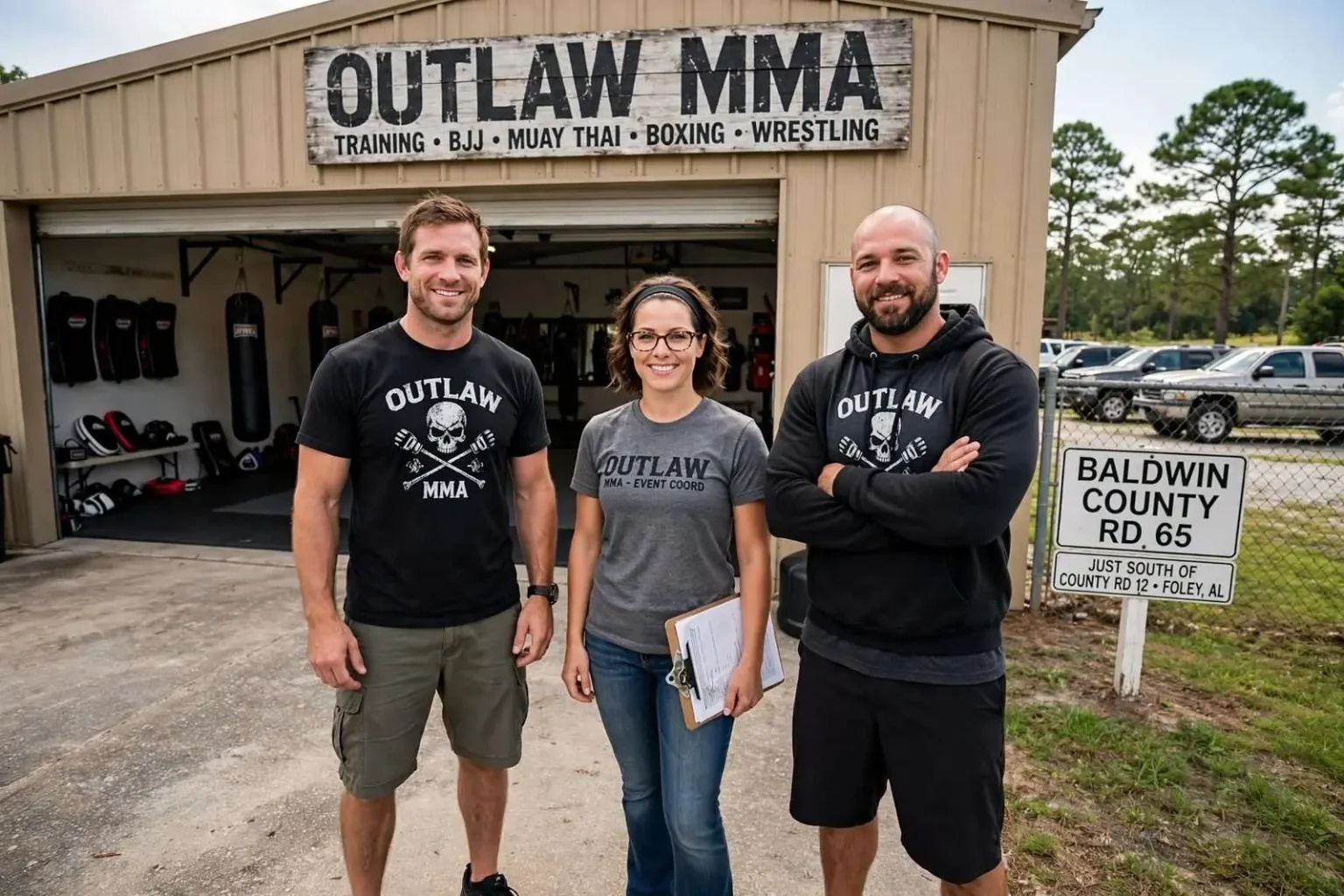
Amateur mixed martial arts was picking up real momentum in Baldwin County in mid-2012, and a Foley-area gym was at the center of it. Outlaw MMA, a training facility on Baldwin County Road 65 just south of County Road 12, has become both a working gym and a civic gathering spot for the region’s growing fight community. The facility is co-owned by Matt Halfacre and Andy Law, who have pushed for years to get amateur MMA recognized alongside more established amateur sports in Alabama. Kristina Jones-Halfacre, Matt’s wife, handles event coordination for the gym.
Every sport that has ever taken root in Alabama needed a starting point — a gym, a field, a group of people willing to organize while the paperwork caught up. For mixed martial arts on the Gulf Coast, that starting point is a training facility in the Foley area, where fighters have been drilling wrestling, Brazilian jiu-jitsu, boxing, and Muay Thai for years without the reward of a sanctioned home-state bout. The gym’s story in 2012 is the story of amateur MMA in Alabama itself: long waiting, sudden change, and a summer in which everything the owners worked toward finally came together.
Inside the Gym on County Road 65
The facility sits on Baldwin County Road 65 just south of County Road 12, a location that puts it within easy reach of Foley, Summerdale, Elberta, Robertsdale, and the growing residential corridors between them. That geography matters. South Baldwin County has been one of the fastest-growing parts of Alabama for two decades, drawing new families from across the region, and those families have brought with them an appetite for athletic options beyond the traditional lineup of football, baseball, and basketball. The gym has absorbed that demand, running classes that serve everyone from first-day beginners to experienced amateurs sharpening their skills for competition.
Trainers there teach newcomers through repetition of fundamentals and group encouragement, in what one visitor described as a “baseball practice” approach. The comparison is deliberate and telling. Instead of the intimidating, every-man-for-himself atmosphere outsiders often imagine at fight gyms, the room operates like a youth sports practice: lines of athletes working the same movement, coaches circling to correct form, experienced members spotting the new ones. That culture has made the gym accessible to people who would never walk into a fighting facility on their own, and it is a large part of why the operation has endured long enough to see the sport sanctioned.
The gym’s civic role extends past its membership. Baldwin County has also directed youthful offenders to the gym for structure and a disciplined outlet, an arrangement built on the idea that the mat is an honest teacher. A young person who skips drills gets exposed in training; one who commits to the process sees measurable progress. For the county, it is a low-cost complement to formal programs, and for the gym it is a continuation of the co-owners’ belief that the sport builds character outside the cage as much as inside it.
The Owners Behind the Push
The facility is co-owned by Matt Halfacre and Andy Law, who have pushed for years to get amateur MMA recognized alongside more established amateur sports in Alabama. Their advocacy was never a single campaign but a sustained effort — correspondence with state officials, conversations with other gym owners, and a willingness to operate as a visible example of what a responsible MMA program looks like. Kristina Jones-Halfacre, Matt’s wife, handles event coordination for the gym, managing the detail-heavy work of matching opponents, arranging venues, and keeping events on schedule. That division of labor — two trainers building the program and an organizer making the events real — gave the gym a foundation most small fight operations never build.
Their argument to the state was straightforward. Amateur boxing, wrestling, and karate all operated under recognized frameworks in Alabama; mixed martial arts, which combines elements of all three, deserved the same treatment rather than being pushed across state lines. Every Alabama fighter forced to debut in Florida or Mississippi was revenue, experience, and momentum leaving the state. As the national profile of the sport rose through the late 2000s and early 2010s, that argument became harder and harder for regulators to ignore.
January’s Breakthrough and the ISKA Detour
State sanctioning has been the big storyline for the sport in Alabama this year. January 2012 saw the first fight permits issued by the Alabama Athletics Commission, the state’s top authority on sanctioned bouts. For the first time, promoters could legally stage mixed martial arts events in Alabama under commission oversight, with the medical and safety infrastructure that comes with it. Fighters across the state suddenly had a home circuit — and gyms like the one in the Foley area had a reason to plan seasons instead of single shows.
The commission’s first partnership was with the International Sport Karate Association (ISKA), a sanctioning organization with a long history in kickboxing and sport karate. But complaints grew over what some described as inconsistent and exorbitant pricing, according to AAC fight inspector Rick Piel. For grassroots promoters, sanctioning costs are the single biggest variable in whether an event breaks even, and unpredictability was as damaging as the price itself. The complaints set the stage for a change at midyear.
On June 18, the commission brought in MMA Solutions, a sanctioning body that has run fights more regularly in Florida and Mississippi. The change generated real enthusiasm at Outlaw. MMA Solutions owner Paul Domenech has become something of a champion for the gym’s staff and fighters, many of whom will now have a chance to compete in front of a home crowd. With a partner that knew the Gulf Coast market and priced its services for small promoters, the commission had solved the problem that had frustrated the sport’s earliest Alabama supporters.
A Summer Season and a Homecoming Card
The first Outlaw Fighting Championship is scheduled for August 18 at The Wharf in Orange Beach, and the gym is organizing six events around the state with MMA Solutions on board. The Wharf gives the sport a marquee stage: the Orange Beach entertainment complex along the Intracoastal Waterway already draws Gulf Coast crowds for concerts and festivals, and an amateur fight card there signals that MMA is being treated as a legitimate civic attraction rather than an underground curiosity. For the gym, staging its first championship at a venue of that caliber is both a reward for years of advocacy and a statement about where the sport is headed.
The statewide six-event plan matters as much as the venue. A dependable calendar transforms how amateur athletes train and how the sport grows. Fighters can build camps around known dates, coaches can match development to the schedule, and fans can plan to attend instead of hearing about shows after the fact. It also spreads the sport beyond one city or one gym, seeding interest in communities that have never hosted a sanctioned bout. With MMA Solutions overseeing the cards, the gym effectively becomes a founding organizer of Alabama’s modern amateur MMA era.
Amateur MMA was also recently accepted into the 2013 Alabama Sports Festival’s State Games. The State Games gather amateur athletes from across Alabama in an Olympic-style multi-sport format, and MMA’s inclusion places it in the company of sports that have anchored the state’s amateur athletic tradition for decades. The owners have their sights set further, hoping amateur MMA eventually reaches the Olympics. International recognition remains a distant goal that depends on global federation decisions far beyond Baldwin County, but every sanctioned bout, every state competition, and every organized gym moves the sport one step along the path Olympic dreams require.
What the Fighters Get Back
For the fighters at the Foley-area gym, the August event is the main focus, a chance to walk to the ring to cheers from friends and family instead of competing as anonymous names in someone else’s hometown. That distinction is easy to underestimate. Amateur athletics runs on local support — the crowd that knows your name, the coach in your corner, the family section near the cage. Before sanctioning, Alabama fighters gave up that experience by necessity, debuting hours away in front of strangers. Now the homecoming is built into the season, and the gym’s roster will fight knowing the loudest voices in the building came with them from Baldwin County.
The changes also improve safety and fairness. Commission oversight means medical requirements, qualified officials, and matched bouts rather than mismatches of convenience. Sanctioning through an experienced body gives amateurs a legitimate record that follows them, which matters for anyone hoping to turn professional later. The amateur era that is beginning in Alabama this summer will produce the professional fighters of the next decade, and the structure being built now determines how well prepared they will be.
A New Chapter for South Baldwin County
From a training room on a county road to a championship card at The Wharf, the distance traveled in a single year captures how quickly the sport’s fortunes turned. The co-owners’ years of pushing, the January arrival of state permits, the midyear switch to a workable sanctioning partner, and the acceptance into the State Games have all converged at once. If the August event delivers the kind of night the gym’s staff expects — a full house, competitive bouts, and home fighters winning in front of their own — Baldwin County will have established itself as one of the founding homes of amateur MMA in Alabama, and the six events that follow will keep the momentum building across the state.