Pace man accused of sexually abusing child decades ago, authorities say
A 52-year-old Pace man has been arrested and accused of sexually abusing a 9-year-old girl between 1990 and 1993, deputies said.
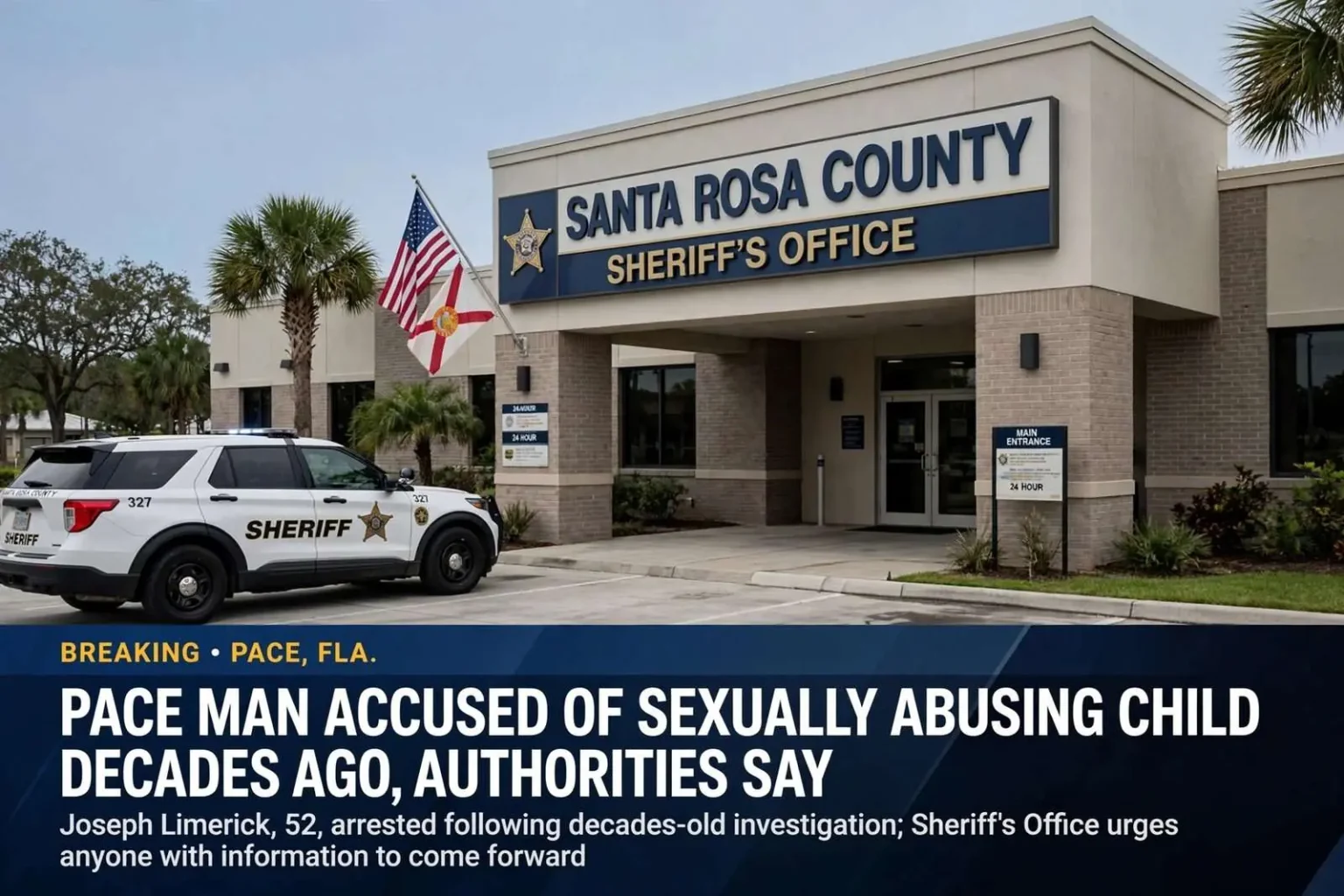
PACE, Fla. — A Pace man has been arrested after being accused of sexually abusing a child decades ago, according to the Santa Rosa County Sheriff’s Office. Joseph Limerick, 52, is accused of repeatedly abusing a 9-year-old girl between 1990 and 1993, authorities said. The alleged victim told investigators the abuse happened multiple times over those years and that she was threatened into silence. The case was recently presented for prosecution following a lengthy investigation. Limerick was taken into custody and booked on the charges. The Santa Rosa County Sheriff’s Office encourages anyone with information about similar cases to come forward. Limerick is presumed innocent until proven guilty in a court of law.
The arrest is the outcome of an investigation that stretched across years and across decades of distance from the alleged crimes themselves. Cases built on childhood abuse from the early 1990s require investigators to reconstruct a period long past: locating records, identifying witnesses, and carefully interviewing an alleged victim who has carried the account since childhood. The sheriff’s office described the case as recently presented for prosecution, meaning investigators developed the file to the point where it could move into the court system, and Limerick was then taken into custody and booked.
Pace sits in southern Santa Rosa County, the growing suburban stretch between Milton and Pensacola that has become one of the fastest-developing parts of the Florida Panhandle. The Santa Rosa County Sheriff’s Office serves the county from its Milton headquarters, and its investigations division handles everything from current crimes to cold cases reopened as new information surfaces. An arrest in a decades-old child abuse case is the kind of work that unfolds quietly, without the immediate press attention an active abduction or assault receives, until the day handcuffs go on.
Why These Cases Surface Decades Later
Delayed disclosure is the defining feature of child sexual abuse, and the pattern in this case — abuse alleged in the early 1990s, silence maintained through threats, an account that reached investigators only years into adulthood — matches what researchers and victim advocates describe as typical rather than exceptional. Children who are abused frequently know their abuser, are often threatened or manipulated into silence, and commonly do not disclose until well into adulthood, if they disclose at all. Studies of abuse survivors have found average delays of many years, sometimes decades, between the abuse and the first full disclosure to anyone.
The reasons are layered. Perpetrators are frequently trusted adults with authority over the child’s daily life. Threats, as the alleged victim in this case described, reinforce the silence. Shame, fear of not being believed, and the protective instinct children feel toward family members all weigh against disclosure. And when disclosure finally comes in adulthood, survivors often report that the decision was triggered by a milestone — a confrontation with the abuser, the safety of distance, their own children reaching the age they were when the abuse began.
The legal landscape has shifted to meet that reality. Florida, like many states, has progressively extended the time available to prosecute sexual offenses committed against children, recognizing that the traditional short windows of limitation were built on an assumption of prompt reporting that the evidence shows is rarely how these cases unfold. Prosecutors in cases alleging decades-old abuse work closely with investigators to establish what the law permits in each specific case, because the rules have changed at different points in time and their application can turn on the details.
Building a Case From Long Ago
Investigating alleged abuse from the early 1990s presents distinct evidentiary challenges. Physical evidence is generally long gone, so cases rest heavily on interviews, documentary records — school files, medical records, photographs, correspondence — and the accounts of anyone who observed the circumstances at the time. Investigators look for corroboration in the details: consistency of the account over multiple interviews, facts the alleged victim could only know from experience, and the reactions of people who were told, even partially, along the way.
The sheriff’s office did not disclose what evidence it accumulated, which is standard practice in an active prosecution. What the office did disclose is the shape of the allegation: repeated abuse of a 9-year-old between 1990 and 1993, threats to keep the child silent, and a lengthy investigation that culminated in a recent decision to present the case for prosecution. Limerick, now 52, was booked into custody on the charges and now enters the court process, where the state will have to prove its allegations to the standard required of every criminal case.
The Presumption of Innocence
The sheriff’s office paired its announcement with the standard reminder that Limerick is presumed innocent until proven guilty in a court of law. That presumption carries real weight in cases built on delayed disclosure, because defense counsel will scrutinize the age of the allegations, the reliability of childhood memories recovered decades later, and any gaps in the investigative record. Courts have wrestled with these questions in high-profile cases for years, and the trial process is where the evidence either holds or does not.
For the accused, an arrest in a decades-old case is itself a serious event — booking, an initial court appearance, the setting of bond and release conditions, and the long process of preparing a defense. For the community, the case serves as a reminder that the passage of time does not close these files. Sheriff’s offices across the region review cold cases continuously, and allegations of child abuse from any era can be presented for prosecution whenever the investigation supports it.
The Sheriff’s Office Appeal
The Santa Rosa County Sheriff’s Office used the announcement to encourage anyone with information about similar cases to come forward. That appeal has a specific audience: survivors of childhood abuse who have never reported, and witnesses who held fragments of information they never connected. Investigators pursuing historical cases frequently find that a single phone call from someone who remembered a detail — a car, a residence, an incident observed and discounted at the time — becomes the thread that moves a stalled file forward.
Reporting channels for such cases run through the sheriff’s office directly, and through the Florida Department of Children and Families’ abuse hotline when the concerns involve ongoing risk to a child. Advocates emphasize that reporting is possible at any age: there is no statute of limitations on speaking to investigators, and even if prosecution is not ultimately possible in a given case, the report can corroborate others, alert families, and prevent future abuse by the same person.
Support resources for adult survivors of childhood sexual abuse are available across Northwest Florida, from community mental health providers to national survivor organizations that offer crisis lines, counseling referrals and guidance through the reporting process. Advocates who work with survivors making first disclosures decades after the abuse stress the same points: the decision to report belongs to the survivor, disclosures can be made gradually, and support people — a counselor, an advocate, a trusted friend — make the process materially easier.
The Pace case now moves into the courts, where its allegations will be tested. What the arrest already demonstrates is the sheriff’s office’s position that the age of an allegation is not a barrier to presenting it for prosecution — and its message to anyone else carrying a similar history, in Santa Rosa County or anywhere else, that investigators will listen, at any distance in time.
How Santa Rosa County Investigates
The Santa Rosa County Sheriff’s Office investigations division carries a caseload that ranges from fresh reports to files decades old, and its investigators work with prosecutors from the State Attorney’s Office for the First Judicial Circuit, which covers Santa Rosa, Escambia, Okaloosa and Walton counties. In historical abuse cases, that partnership matters from the start: investigators build the file knowing what the state will need to prove, and prosecutors weigh the legal questions of time and evidence before a case is presented for formal charging. The office’s description of this case — a lengthy investigation recently presented for prosecution — reflects that sequence.
Arrests in old cases also follow a deliberate order. Once charges are authorized, deputies take the accused into custody, the person is booked into the county jail, and an initial appearance before a judge follows within the period the rules require. Bond, release conditions and no-contact provisions are set at that stage, and the case then moves through arraignment and discovery toward disposition. The months that follow an arrest in a decades-old case are often the hardest stretch for everyone involved — the survivor whose account is now public, the accused facing old allegations in court, and families learning for the first time what one side has carried for thirty years.
Communities like Pace absorb these announcements with a particular weight, because the alleged conduct, whatever the court ultimately finds, touches on the subject families are least prepared to discuss. Sheriff’s offices that announce such arrests pair them with encouragement to report, and with the reminder that the criminal justice process — not rumor — is where allegations are tested. That is the posture the Santa Rosa County Sheriff’s Office took in this case: the facts of the investigation announced, the arrest confirmed, the appeal to other potential reporters issued, and the presumption of innocence stated plainly.
Anyone with information about this case or similar cases can contact the Santa Rosa County Sheriff’s Office, where investigators continue to review information connected to historical child abuse allegations. For children in immediate danger, the reporting obligations and the emergency channels — 911 and the state abuse hotline — remain the fastest routes to help, and they are open around the clock.