Pace Water System Lifts Boil Water Notice After Safety Tests Confirm Water Is Clean
Pace Water System has rescinded a boil water notice that had been in effect since Aug. 12 after safety testing confirmed the water is safe.
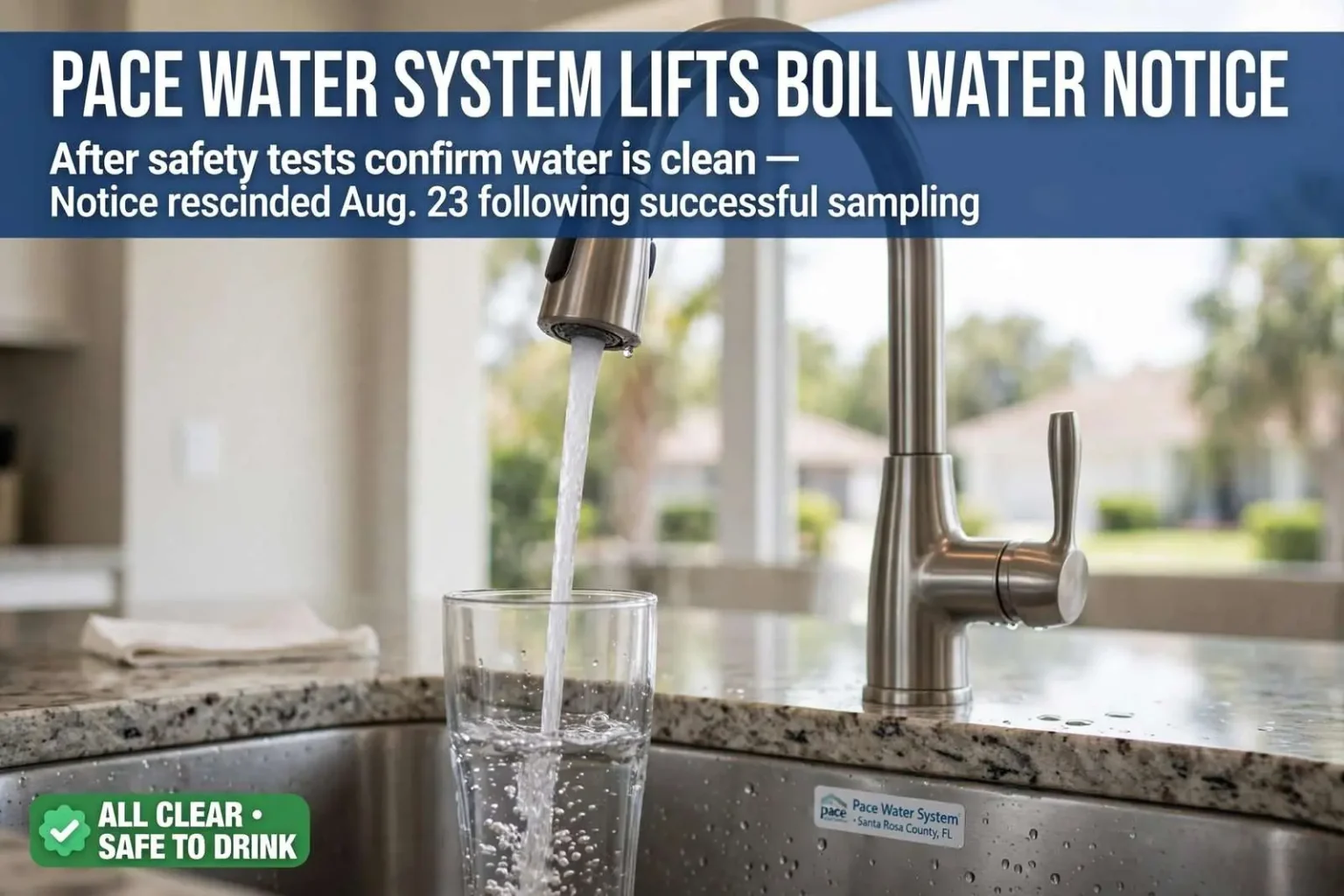
Customers of the Pace Water System can once again drink tap water without concern after a boil water notice covering parts of the community was lifted, according to a news release from Pace Water System. The notice, which had been in effect since Aug. 12, was rescinded after safety testing confirmed the water met required standards. For households in the affected areas, the rescission ends more than a week of boiling water before drinking, cooking or brushing teeth — and closes out an episode that disrupted daily routines across the growing Pace community.
Boil water notices are typically issued as a precaution following a loss of water pressure or other disruption that could allow contaminants to enter the system, and are lifted once follow-up testing shows the water is safe to consume. The sequence is a standard safeguard under state drinking water regulations: when pressure drops, the possibility of contaminated water being drawn into distribution lines cannot be ruled out, so customers are told to boil until samples prove otherwise.
Clearing a notice is not a single test but a series of them. Utilities must collect bacteriological samples from points across the affected portion of the system — often on consecutive days — and those samples must come back clean before state health and environmental agencies sign off on the rescission. Only after that clearance does the utility notify customers that normal use can resume, usually through news releases, website updates and door notices in the affected neighborhoods.
For the Pace Water System, the Aug. 12 notice meant flushing lines, collecting samples and coordinating with regulators while customers managed without tap water they could trust. The Aug. 23-style resolution — a clean bill of health after sustained testing — is the outcome every utility hopes for: an inconvenience, but no confirmed contamination.
Why notices happen at all
Loss of pressure is the most common trigger. A main break, a pump failure or a power outage can drop pressure inside distribution lines, and when that happens, water already in the pipes can be joined by anything the break lets in — soil, groundwater, contaminants from surrounding ground. Because utilities cannot visually inspect miles of buried pipe, the regulatory response is precautionary: assume the water may be unsafe until testing says it is not.
The requirements that follow are strict. Under state and federal drinking water rules, a utility under a boil water notice must demonstrate through laboratory testing that the water meets bacteriological standards before the notice can be lifted. Customers are typically advised during the notice to boil water for at least a minute before drinking it, preparing food with it, brushing teeth or giving it to pets, and to use bottled water for infants or anyone with a weakened immune system.
Ice, too, is part of the guidance — ice made during the notice period is discarded, and automatic ice makers are flushed once the notice clears. Water softeners and filters may need attention as well. None of it is complicated, but all of it is disruptive, which is why utilities work to lift notices as quickly as testing allows.
The utility behind the notice
Pace Water System serves the Pace area of Santa Rosa County, one of the fastest-growing communities in the Florida Panhandle. Rapid residential growth places steady demands on any water utility: new subdivisions extend distribution lines, new meters join the system every month, and maintenance work — main repairs, relocations, upgrades — becomes a routine part of keeping service reliable. Each interruption of pressure carries the same regulatory consequence, which is why boil water notices appear in growing communities more often than residents might expect.
The utility’s relationship with its customers depends on communication as much as infrastructure. A notice that is announced clearly, updated promptly and lifted as soon as testing permits builds trust; a notice that lingers without explanation erodes it. Pace Water System’s news release announcing the rescission follows the standard playbook — state when the notice began, confirm that testing cleared the water, and thank customers for their patience.
For residents, the practical question after a notice lifts is what to do first. The standard advice: flush household plumbing by running cold taps for several minutes, discard ice made during the notice, and replace water filter cartridges if the manufacturer recommends it. Hot water heaters and appliances generally need no special action, but a first cycle of coffee or cooking water is often run to the drain as a matter of habit.
What the testing involves
The samples that clear a boil water notice are collected under chain-of-custody procedures and analyzed for coliform bacteria, the standard indicator group used in drinking water regulation. Total coliform testing, with follow-up testing for E. coli when indicated, gives regulators a reliable picture of whether the distribution system has been compromised. The samples must be drawn from representative locations — not just the point of the original problem — to confirm the whole affected area is clean.
State health and environmental agencies oversee the process. In Florida, the Department of Health’s county offices and the Department of Environmental Protection share oversight of public water systems, reviewing sample results and authorizing rescissions. The utility cannot simply declare its own water safe; the notice ends when the data supports it and the regulators agree.
That rigor is why notices last days rather than hours. Bacteriological culture takes time, repeat samples are often required on consecutive days, and any inconclusive result restarts the clock. From a customer’s perspective the process can feel slow; from a public health perspective, it is the system working as designed.
Life during a notice
The Aug. 12-to-rescission stretch tested household routines across the affected parts of Pace. Boiling water for drinking and cooking is manageable for a day; sustaining it for more than a week changes how a household operates. Families stocked bottled water, restaurants in the affected area adjusted their food-handling procedures, and schools and businesses posted guidance for staff and visitors.
Local reaction to notices follows a familiar arc: initial stocking up, then adaptation, then relief when the all-clear arrives. Utilities generally remind customers during the notice to check on elderly neighbors and anyone who may miss the announcements — a small step that matters in communities where not everyone follows local news or social media updates.
The economic side is real but contained. Bottled water purchases spike, and food-service operators bear added costs for boiling or switching to bottled supply. Most homeowners, though, experience the notice chiefly as a nuisance — the kettle on the stove, the bottled cases in the pantry, the reminder not to fill the dog’s bowl from the tap.
Looking past the notice
With the rescission in place, Pace returns to normal — and the episode joins the record of a utility managing a fast-growing service area. Infrastructure investment, main replacement and system upgrades are the long-term answers to pressure losses, and utilities across the Panhandle are pursuing them as growth continues. For customers, the takeaway is simple: the water is again safe to drink straight from the tap, and the boil water notice that began Aug. 12 is officially history.
The episode also highlights how much modern life depends on an invisible system. Distribution mains run beneath every street in the affected area, and customers rarely think of them until something interrupts pressure. When that happens, the boil water notice is the public face of a much larger operation: crews locating and repairing the break, operators adjusting flows, lab technicians processing samples, and state reviewers checking the results before the water can be declared clean again.
Growth pressures make that background work constant in Santa Rosa County. Pace’s population growth has been among the fastest in the Florida Panhandle, and every new roof tap adds demand to mains and pumps sized years earlier. Utilities in boom corridors typically respond with phased expansion plans — new wells, elevated storage tanks, upsized transmission lines — and each construction project carries the same brief disruption risk that leads to precautionary notices like the one Aug. 12 triggered.
Customers can reduce their own risk during any future notice by keeping a small emergency reserve on hand. A few gallons of bottled water per person covers the first day of a notice easily, and a camp-style method of boiling on the stove covers the rest. Utilities also recommend signing up for alert notifications where offered, since notices are most disruptive for households that learn about them late.
The rescission notice, like the boil order before it, will circulate on the same channels — the utility’s news release, local media reports, and word of mouth through a community that had spent more than a week boiling first and asking questions later. Pace Water System’s message was straightforward: testing confirmed the water meets required standards, the notice is lifted, and customers can drink from the tap again with confidence.
For now, the kettles go back on the shelf and the ice makers run without a second thought. The Aug. 12 notice did its job — a precaution taken seriously, tested thoroughly, and lifted as soon as the data allowed — and the water system that serves one of the Panhandle’s fastest-growing communities is back to doing its quiet daily work beneath the streets of Pace.