Pascagoula toddler battles rare brain tumor as community rallies to help
A 2-year-old Pascagoula girl is battling a rare pediatric brain tumor, and a local foundation is rallying community support for her family.
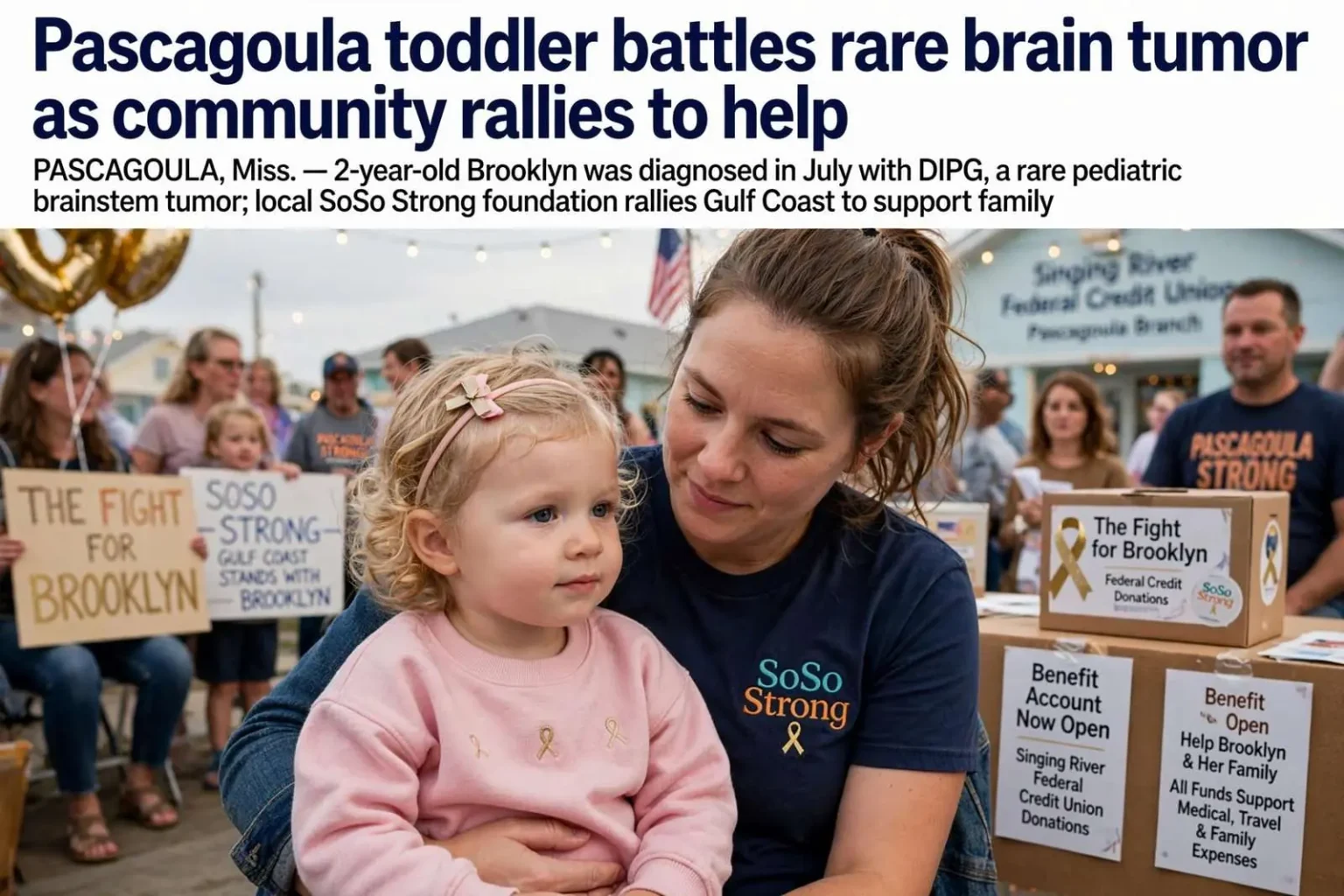
PASCAGOULA, Miss. — A 2-year-old Pascagoula girl is battling a rare and aggressive form of pediatric brain cancer, and a local foundation is rallying the Gulf Coast community to support her family through the fight ahead. The toddler, Brooklyn, was diagnosed in July with diffuse intrinsic pontine glioma, or DIPG, a rare cancerous tumor of the brainstem.
The SoSo Strong Pediatric Brain Tumor Foundation, based in Ocean Springs, is asking the community to help the family both financially and emotionally as they face the diagnosis. The organization, which exists to support families confronting pediatric brain tumors across the Gulf Coast, has made Brooklyn’s fight one of its focal causes and has been spreading word of the family’s needs across the region.
The family has established a benefit account at Singing River Federal Credit Union under the name “The Fight for Brooklyn” to help cover the road ahead. Donations to the account go toward the costs that accompany a childhood cancer diagnosis — treatment-related travel, medical expenses not covered by insurance, and the everyday bills that pile up when parents step away from work to care for a sick child.
Understanding DIPG
Diffuse intrinsic pontine glioma is among the most difficult diagnoses in all of pediatric medicine. The tumor forms in the pons, a structure deep in the brainstem that controls many of the body’s most essential functions — breathing, heart rate, swallowing, and the nerve pathways that carry signals between the brain and the body. Because the tumor cells spread diffusely through that delicate tissue rather than forming a discrete mass, surgeons cannot remove them, and the tumor’s location makes it unreachable by the treatments that work for other childhood cancers.
The standard treatment for DIPG is radiation to the brainstem, which can shrink the tumor temporarily and ease symptoms, but the disease almost always progresses. Children diagnosed with DIPG are typically of preschool age — Brooklyn’s age at diagnosis fits the pattern — and the diagnosis upends a young family’s life in a matter of days: a child who was learning to run and talk is suddenly in treatment at a major hospital, often far from home, with parents navigating a crash course in neuro-oncology.
That combination of rarity and resistance to treatment is why DIPG research receives dedicated attention from foundations and advocacy groups across the country. Progress has been slow by the standards of other cancers, in part because the tumor’s rarity limits the number of patients available for clinical trials and in part because its location has made studying it extraordinarily difficult. Families confronting the diagnosis often travel to major research hospitals for clinical trial access, adding financial strain to an already devastating situation.
The SoSo Strong Foundation’s Role
The SoSo Strong Pediatric Brain Tumor Foundation takes its name and mission from the Gulf Coast’s own experience with pediatric brain tumors. Based in Ocean Springs, the organization works with families across the Mississippi Gulf Coast and neighboring stretches of south Alabama and northwest Florida, providing direct financial help, connecting families to resources, and raising community awareness of a disease most people have never heard of until it touches their own circle.
For families like Brooklyn’s, that support takes practical shapes. A foundation’s assistance can cover a tank of gas to a treatment center, a month’s rent while a parent is out of work, or simply the reassurance that the community is shouldering part of the load. Foundation leaders emphasize that emotional support matters as much as money: families facing a DIPG diagnosis are thrust into an isolated, terrifying landscape, and connections to other families who have walked the same road can make the difference between enduring it alone and enduring it together.
Local organizations like SoSo Strong fill a gap that national charities and hospital programs cannot always reach. Gulf Coast families treated at hospitals in Mobile, New Orleans, or beyond still live at home in Pascagoula, Ocean Springs, and the surrounding towns, and the costs of daily life continue in both places at once. Community-based fundraising keeps those families afloat at home while they fight the disease away from it.
How the Community Can Help
The most direct route for people who want to help is the benefit account itself: “The Fight for Brooklyn” at Singing River Federal Credit Union. Contributions to the account support the family directly, and credit union staff can direct donors who visit a branch in person. Benefit accounts like this one have become a standard way Gulf Coast communities channel generosity efficiently — the funds go where the family needs them, without overhead, and the family can draw on them for whatever the fight demands, from hospital bills to travel to time away from work.
Beyond money, the foundation’s call for emotional support is more than a formality. Families in treatment describe the value of meals delivered, siblings looked after, prayers offered, and simple messages of encouragement that remind them the community has not looked away. Sharing the family’s story — as the foundation has done across the coast — also widens the circle of people who understand what DIPG is, which builds support not just for Brooklyn but for the next family that receives the same diagnosis.
Singing River Country Rallies
Pascagoula and the communities along the Mississippi Gulf Coast have a long habit of closing ranks around their own in moments of crisis, and the response to Brooklyn’s diagnosis has followed that pattern. The region’s civic and church networks, its schools and businesses, and its long-standing institutions like the Singing River Federal Credit Union — which serves members across the Gulf Coast — form the scaffolding on which community benefit efforts are built.
The rallying also reflects the specific grip a young child’s illness takes on a small city. Pascagoula is a community of neighborhoods and families that have lived side by side for generations, and a 2-year-old fighting a brainstem tumor is not an abstraction to the people around her — it is somebody’s granddaughter, somebody’s Sunday school class, somebody’s neighbor. The foundation’s appeal has tapped that instinct, giving people who feel helpless in the face of the diagnosis concrete ways to act.
What Families Facing DIPG Endure
A diagnosis like Brooklyn’s sets a family on a road with few good maps. Treatment typically means weeks of daily radiation sessions, often at a hospital hours from home, followed by monitoring and decisions about further therapy or clinical trials. Parents manage medication schedules, symptom changes, insurance battles, and the needs of the patient’s siblings, all while holding jobs and households together on threads. The financial dimension is relentless even for insured families, because the costs of travel, lodging, and lost income never appear on a hospital statement.
Families who have been through it describe the logistics as a second full-time job. Appointments are scheduled weeks in advance and changed in a day; a child’s comfort on a long drive or a hospital ward becomes the family’s daily project; and every major decision — where to seek treatment, whether to pursue a trial, how to balance hope with honesty — lands on parents who are also simply trying to be Mom and Dad. The days are measured in small victories: a meal eaten, a nap taken, a giggle that sounds like the child everyone remembers.
Communities that support these families learn to help in ways that fit that reality. Unrestricted benefit funds let parents pay whatever the next week actually demands; flexible, no-questions help with groceries or utilities matters more than anyone predicts; and continued attention after the initial wave of news fades is often the support families say they needed most. Foundations like SoSo Strong exist to organize exactly that kind of sustained, practical care, and to remind a community that its role does not end when the fundraisers do.
This is the landscape the SoSo Strong Pediatric Brain Tumor Foundation was built to ease, and the one the “Fight for Brooklyn” account is meant to fund. The foundation’s message to the community has been that no family should face a pediatric brain tumor alone when the Gulf Coast is full of people willing to help — and Brooklyn’s family, like the families before them, is learning that the coast takes that message seriously.
For now, the community’s task is the one the foundation has laid out: give if you can to “The Fight for Brooklyn” at Singing River Federal Credit Union, and hold the family in whatever way each person can. A 2-year-old from Pascagoula is fighting one of the hardest battles in medicine, and the Gulf Coast — as it has before — is choosing to make sure she and her family do not fight it by themselves.