Pass Christian man killed in Interstate 10 crash in Mobile County
ALEA says Coty Charles Mitchell, 25, of Pass Christian died when a Toyota Tundra collided with a tractor-trailer on I-10 west near mile marker 4.
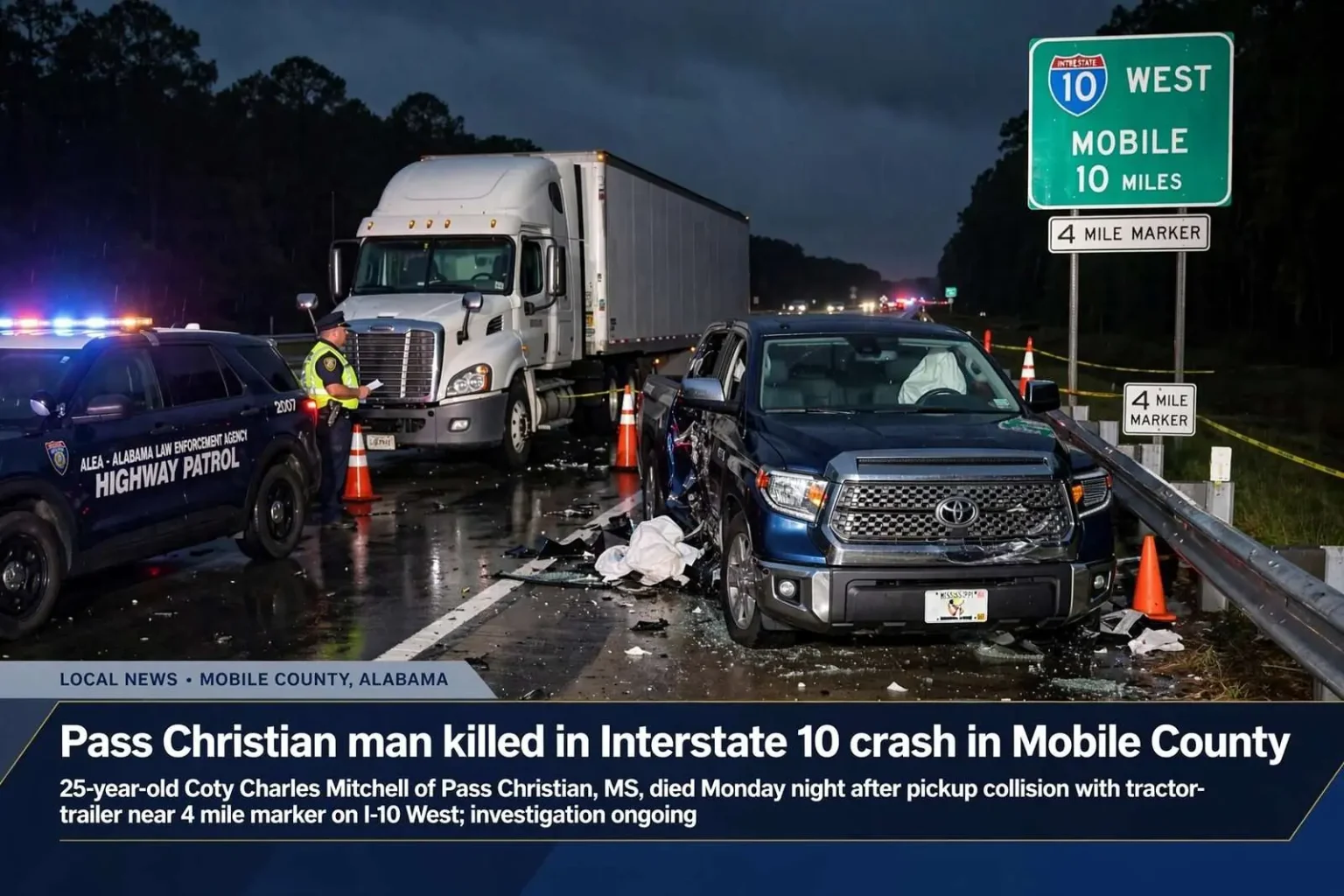
MOBILE COUNTY, Ala. — A 25-year-old Mississippi man died after the pickup truck he was riding in collided with a tractor-trailer on Interstate 10 in Mobile County, according to the Alabama Law Enforcement Agency. Troopers said the two-vehicle crash happened at about 9:22 p.m. on Monday, Oct. 19, on Interstate 10 westbound near the 4 mile marker, a stretch of the interstate on the eastern edge of Mobile near the Alabama-Mississippi line. A 2018 Toyota Tundra struck a 2007 Freightliner tractor-trailer, and the collision claimed the life of one of the pickup’s occupants.
Coty Charles Mitchell, 25, of Pass Christian, Mississippi, was pronounced dead following the collision. ALEA later clarified that Mitchell was a passenger in the Tundra, and that the pickup was being driven by 23-year-old Myles Logan French, also of Pass Christian. The Freightliner was driven by Raul Ernesto Guzman, 53. ALEA’s Highway Patrol Division continued to investigate the circumstances of the crash.
The crash and its correction
The sequence of the investigation itself illustrates how major-crash reporting unfolds. Initial ALEA statements about fatal crashes are drafted at the scene, often in the hours before investigators have sorted out who was driving which vehicle, and the first account of this collision listed details that the agency later clarified: Mitchell, initially described in some accounts as the driver, was in fact a passenger, and French — the Tundra’s actual driver — survived the crash. The clarification mattered for the record and for the families involved, and it was issued as the Highway Patrol Division’s investigation continued.
What remained constant through the corrections was the core of the event: a nighttime collision between a pickup and a tractor-trailer on westbound Interstate 10 near the 4 mile marker, at 9:22 p.m. on a Monday in October, with one occupant of the pickup dead and two drivers — French and the Freightliner’s Guzman — surviving. The investigation into the circumstances, including the elements any two-vehicle fatal crash review covers — speed, lane position, visibility, impairment screening, and the commercial vehicle’s mechanical and log compliance — remained open as ALEA continued its work.
The 4 mile marker and its corridor
The crash site sits on one of the most consequential stretches of highway on the Gulf Coast. Interstate 10 westbound near the 4 mile marker lies just west of the Mississippi line, where the interstate descends toward the Pascagoula River basin and the coastal counties of Mississippi. For drivers entering Alabama from the Mississippi Gulf Coast, this segment is the front door to the Mobile metropolitan area — and it is a segment that carries everything the interstate carries: commuter traffic between coastal Mississippi and Mobile’s jobs, port freight, cargo moving between the region’s military installations, and the constant flow of vacationers driving to and from the beaches.
The stretch of Interstate 10 through Mobile County is one of the Gulf Coast’s busiest freight corridors, carrying heavy truck traffic between the port cities of Mobile and Pensacola, and — beyond them — connecting the entire region’s commerce to the interstate system. Freightliner tractors of the vintage involved in this crash are fixtures of that corridor, hauling the container traffic that moves through the Port of Mobile, the timber and paper products of the piney woods, and the general merchandise that keeps the Gulf Coast’s stores stocked. Any collision between a light truck and a fully loaded commercial vehicle on this road carries a predictable severity profile, and the outcome of this one was no exception.
How ALEA investigates a fatal crash
The Alabama Law Enforcement Agency’s Highway Patrol Division handles fatal crash investigations across the state, and a nighttime fatal on Interstate 10 mobilizes a defined sequence. Troopers secure the scene and document it — final rest positions, vehicle damage, debris, skid evidence — while the interstate’s through lanes must be managed, since Interstate 10 cannot simply close while investigators work. Fatal crashes on the interstate routinely produce hours of one-lane operation or full closure, with traffic backing up for miles through the evening, and the Oct. 19 collision was no exception to that regional rhythm.
The investigative work that follows the scene work is where the clarified details emerge. Determining who was driving, who was belted, which vehicle crossed which line, and what each driver’s condition was requires interviews, physical evidence analysis, and in commercial cases, inspection of the truck’s records and components. ALEA’s clarification that Mitchell was a passenger in the Tundra came out of that process, and the agency’s continued investigation means the full account — including any contributing factors and any charges, if any are warranted — had not been completed when the agency’s updates were issued.
Commercial vehicles involved in fatal crashes also draw federal regulatory attention. The 2007 Freightliner’s driver, Raul Ernesto Guzman, was subject to the standard post-crash review that covers hours-of-service records, vehicle maintenance files, and load documentation, part of the parallel oversight structure that governs interstate trucking. None of those reviews’ results had been announced while the investigation remained open, and the report here records only what ALEA released.
Pass Christian’s loss
The victims and survivors of the crash shared a hometown. Coty Charles Mitchell, 25, and the Tundra’s driver, Myles Logan French, 23, were both from Pass Christian, Mississippi, the small coastal city in Harrison County whose residents routinely cross into Alabama for work, commerce, and travel along the Interstate 10 corridor. Mitchell’s death, at 25, was the kind of loss that lands on a small community with particular force — and the fact that the crash’s survivor in the same vehicle was his hometown contemporary adds a dimension the official record does not capture.
For Pass Christian families, the crash was also a reminder of the corridor’s price. Interstate 10 is the lifeline of the Mississippi Gulf Coast — the road to Mobile’s hospitals, airports, and employment — and it is also, statistically, one of the most dangerous stretches of highway in the region, with truck traffic volumes that few corridors of its length match. The nightly mix of passenger vehicles and heavy freight, at highway speeds, in darkness and weather, produces collisions of exactly this kind with sad regularity on both sides of the state line.
The interstate’s broader record
The Mobile County stretch of Interstate 10 has long been the focus of safety and capacity conversations on the central Gulf Coast. The George Wallace Tunnel and the Bankhead Tunnel pinch the interstate through downtown Mobile, the western approaches carry some of the highest truck percentages in the state, and the eastern segments toward the Mississippi line — where this crash occurred — carry the full weight of the coast’s commuter and freight movement. State and federal studies have repeatedly examined the corridor’s congestion and crash record, and the region’s growth keeps the question of how to improve it on civic agendas in both Mobile and coastal Mississippi.
Against that backdrop, the death of Coty Charles Mitchell enters the corridor’s long ledger of losses. What ALEA’s Highway Patrol Division establishes in its continued investigation — the circumstances, the contributing factors, and any legal consequences — will be the official answer to how a 25-year-old passenger from Pass Christian came to die on a Monday night in October, a few miles from the state line, in a pickup that crossed paths with a loaded Freightliner on the Gulf Coast’s busiest road.
What the record establishes
Stripped to its documented facts, the case stands as ALEA released it. At about 9:22 p.m. on Monday, Oct. 19, on Interstate 10 westbound near the 4 mile marker in Mobile County, a 2018 Toyota Tundra driven by 23-year-old Myles Logan French of Pass Christian struck a 2007 Freightliner tractor-trailer driven by Raul Ernesto Guzman, 53. Coty Charles Mitchell, 25, also of Pass Christian, was a passenger in the Tundra and was pronounced dead following the collision. The two drivers survived. The agency’s initial account was later clarified on the question of who was driving, and the Highway Patrol Division’s investigation of the circumstances continued.
That is the full extent of the verified record — and it is worth stating plainly what it does not include. ALEA’s releases did not assign fault, did not announce charges, did not detail the mechanism of the collision, and did not report the condition of the two drivers beyond their survival. Readers encountering this crash through the corridor’s steady drumbeat of fatal-crash reports should treat those open questions as exactly that: open, pending the investigation’s completion.
A corridor’s recurring story
The crash joined a grim annual pattern on the Gulf Coast’s interstate. Fatal collisions between passenger vehicles and tractor-trailers recur along Interstate 10 from the Mississippi line through downtown Mobile to the Baldwin County line, and each follows the same arithmetic: a commercial tractor-trailer at highway speed weighs twenty to forty times what a pickup weighs, stops several times farther, and gives no ground in a collision. When the two meet — at night, at speed, in a corridor this busy — the outcome is determined before responders arrive.
The safety response, such as it is, runs along familiar lines: enforcement of speed and following-distance laws along the corridor, commercial vehicle inspections at the region’s weigh stations, and the long-term engineering questions about Interstate 10’s capacity and configuration that Mobile’s civic leadership continues to press. None of it changes the immediate grief of a Pass Christian family, for whom the statistics of a freight corridor became a specific loss on a specific Monday night — a 25-year-old riding west toward Mobile, in a Tundra that met a Freightliner near the 4 mile marker, and did not survive the difference in their weight.
The region will keep reading these reports as long as the corridor carries its present load. For now, the record holds what ALEA established: the time, the place, the vehicles, the drivers, the passenger who died, and an investigation that continued after the agency corrected its account — the official work that follows every death on the Gulf Coast’s busiest road.