Pedestrian killed by freight train in Atmore
A pedestrian was struck and killed by a CSX freight train near Martin Luther King Avenue in Atmore, Alabama, on Wednesday afternoon.
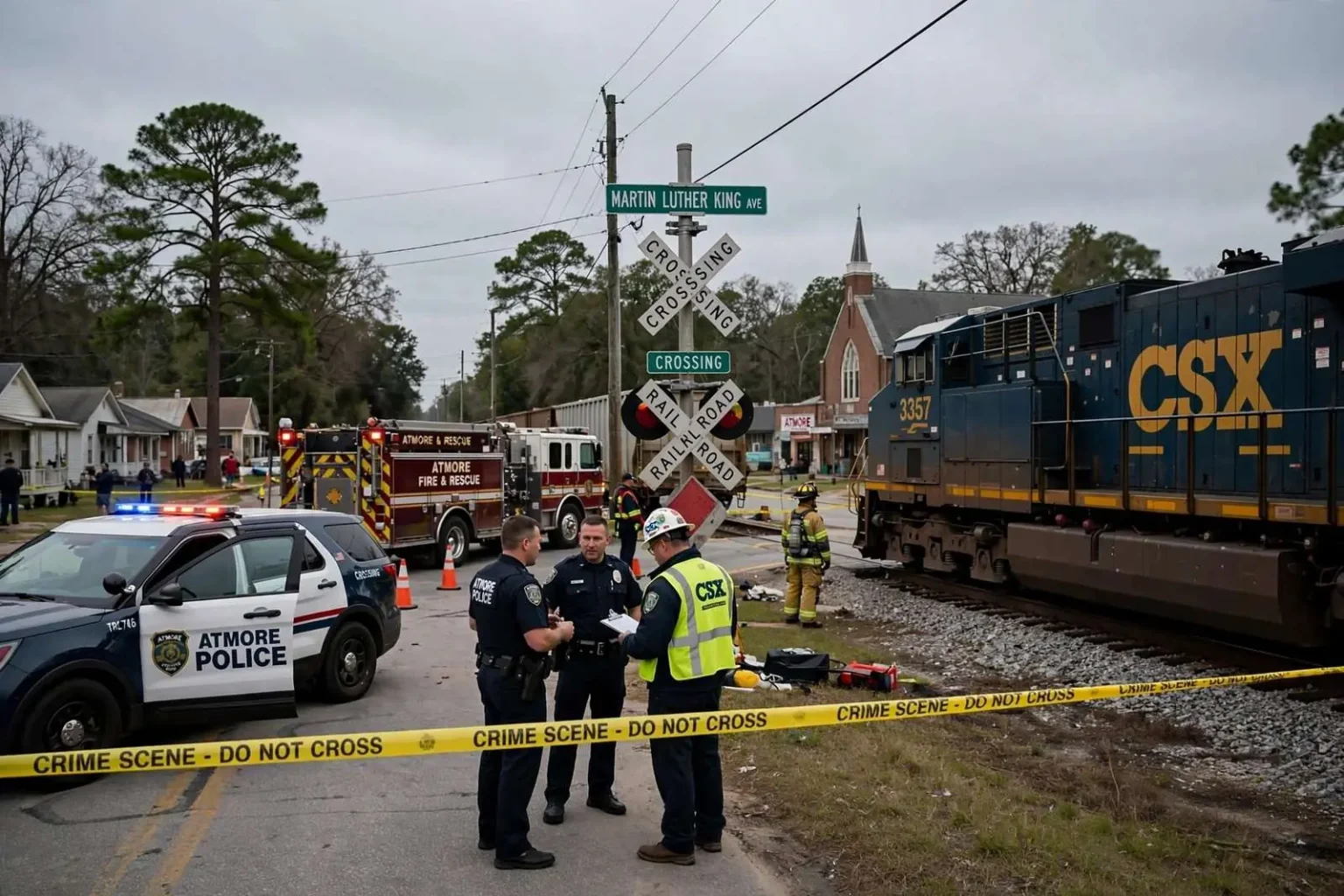
ATMORE, Ala. — An investigation is underway after a pedestrian was struck and killed by a CSX freight train in Atmore on Wednesday afternoon. The fatal incident occurred along the railroad tracks near Martin Luther King Avenue in Escambia County. Authorities have not released the victim’s name. Details about the circumstances of the crossing were not immediately available. The death remains under investigation.
The crash brought police, firefighters, and railroad officials to the tracks that run through the heart of Atmore, halting rail traffic on the line while investigators documented the scene. Freight trains on the main line through town move at speeds that make stopping impossible once an engineer sees someone on the tracks — a loaded freight train can take more than a mile to stop under full emergency braking, a fact that railroad safety officials repeat after every such incident.
The victim’s identity has not been released pending notification of family, and investigators have not said what the person was doing near the tracks or whether the crossing was being used lawfully when the train approached. Those questions will shape the final determination of how the death occurred.
Atmore and its railroad
Atmore is a city of roughly 8,000 people in Escambia County, near the Florida line in south Alabama, and the railroad is woven into its history and geography. The town grew up around the rail line in the late 1800s, taking its name from a railroad official, and for generations the depot and the trains passing through defined the rhythm of daily life. The line through Atmore is a CSX main line — part of the rail network connecting New Orleans to Jacksonville — and it remains a busy freight corridor today.
Main line railroads through small cities present a safety challenge that communities like Atmore live with daily. Dozens of freight trains pass through town around the clock, crossing streets at grade and running within sight of homes, churches, and businesses. Martin Luther King Avenue sits in the residential area along the tracks, where the distance between the street and the rail line is measured in yards, not fields.
Railroad officials and local police have long urged residents to treat the tracks with care: to cross only at designated crossings, never to walk along the rails, and to remember that trains cannot swerve and cannot stop quickly. Trespassing on railroad property is both illegal and, statistically, one of the leading causes of rail-related deaths in the United States.
How these investigations proceed
When a person is struck by a train, several agencies become involved at once. Atmore police secure the scene and lead the local investigation, the Escambia County coroner handles the death investigation and identification, and CSX sends its own personnel to assess the incident and cooperate with authorities. The train crew is typically removed from service pending standard drug and alcohol testing, a routine part of every rail fatality investigation, and the locomotive’s event recorder is reviewed to confirm speed and braking.
Investigators reconstruct the circumstances from the train’s data, the engineer’s statements, physical evidence along the tracks, and any witnesses. They determine where the person entered the right of way, whether crossing gates or signals were functioning, and whether visibility at the location may have played a role. The findings distinguish between accidental crossings, deliberate acts, and instances where a person on or near the tracks was unaware of an approaching train.
Railroad corridors are private property, and anyone on them outside a marked crossing is technically trespassing — but investigators and railroad officials stress that the legal question is secondary to the human one, and each death prompts renewed appeals for caution around the tracks that cut through Alabama’s towns.
The toll on the community and the crews
A rail fatality in a town the size of Atmore touches many people at once — the family awaiting word, the neighbors along Martin Luther King Avenue who witnessed the aftermath, and the train crew, for whom striking a person is among the most traumatic experiences the job contains. Railroad engineers have described the helplessness of seeing someone on the rails ahead and knowing the train’s braking distance makes a collision unavoidable.
Local responders carry their own burden. Atmore police and firefighters handle the scene alongside the coroner, and the tight-knit nature of the community means the victim is often someone they know or will come to know in the course of the investigation. Counseling and peer support resources exist for both railroad crews and first responders after such incidents.
Rail safety across south Alabama
Escambia County’s rail lines are among the busiest in south Alabama outside the port cities, and rail safety advocates work continually to reduce deaths along them. Operation Lifesaver, the national rail safety education organization, conducts outreach in Alabama schools and communities, teaching drivers and pedestrians the risks: never race a train, never walk on tracks, and never assume a train’s schedule or route from familiarity alone.
Trains today are longer and quieter than earlier generations of rail equipment, and they can approach a crossing or a person standing between crossings with less warning than intuition suggests. Modern locomotives, freight cars, and even passenger equipment produce far less noise at speed, and the sound of an approaching train can be masked by wind, traffic, or the surroundings — a danger that safety educators emphasize in towns like Atmore where residents live close to the rails.
Authorities said the investigation into Wednesday’s death remains active, and additional details — including the victim’s identity and the findings about the circumstances — will be released as they are confirmed. Until then, the tracks through Atmore carry the same warning they always have, made stark by the afternoon’s loss.
The coroner’s role and the family’s wait
As with any death in Escambia County, the coroner’s office will establish the victim’s identity through identification methods appropriate to the circumstances and notify next of kin before any name is made public. Families who have not heard from a loved one often learn of rail fatalities through unofficial channels, which is why authorities hold names back until notification is complete. Once the family has been reached, the coroner and police typically release the name along with any preliminary findings about the manner of death.
The wait is hard on small communities, where word of a death near a known location spreads quickly and residents begin asking whether it could be someone they know. Officials ask for patience during that process and caution against speculation while the investigation is underway.
Freight rail’s place in the regional economy
The CSX line through Atmore is part of the arterial freight network that moves goods between the Gulf of Mexico ports and the eastern seaboard. Trains passing through Escambia County carry chemicals, aggregates, forest products, and intermodal containers, serving industries along the Gulf Coast and connecting rural Alabama to national markets. The volume of that traffic is why the line through town sees trains at all hours, and why the railroad maintains its tracks and crossings as heavily used infrastructure.
For Atmore, the railroad has been both an economic foundation and an enduring hazard. The city’s original growth around the depot brought jobs and commerce; the same corridor today divides neighborhoods and demands constant vigilance from everyone who lives and works beside it. City officials and the railroad periodically review crossings, signal maintenance, and vegetation along the right of way to keep sight lines clear.
What witnesses and residents can do
Authorities typically ask anyone who witnessed the incident or who has information about the person’s movements before the crash to come forward to Atmore police. Witness accounts help investigators establish the timeline and can bring certainty to a family trying to understand what happened. Even small details — a person seen walking near the tracks, the timing of a train’s passage — can be significant.
Residents are also reminded to report any problems they observe along the corridor: damaged or unlit crossing signals, blocked sight lines, or people who appear disoriented or endangered near the tracks. Railroad emergency numbers posted at crossings connect callers directly to dispatchers who can stop trains, and police said the fastest way to prevent the next tragedy is for residents to treat the tracks as the dangerous industrial corridor they are rather than a shortcut or a place to linger.
Awaiting the findings
The investigation into Wednesday afternoon’s death will conclude with a report from Atmore police and the coroner’s findings, reviewed for any safety lessons the location may hold. Railroad officials will examine whether signals and crossings near Martin Luther King Avenue functioned properly, and the train’s crew and equipment will be cleared through the standard review process.
For now, Atmore mourns another life lost along the tracks that built the city — and authorities renew the appeal they make after every rail fatality: stay off the tracks, cross only where crossings are marked, and give every train the room and respect that its speed and weight demand.