Pen Air Card Program Delivers $8,800 to Baldwin County Classrooms
Pen Air Federal Credit Union gave $8,827.53 to the Baldwin County Education Coalition through its Share It debit card program, funding classroom.
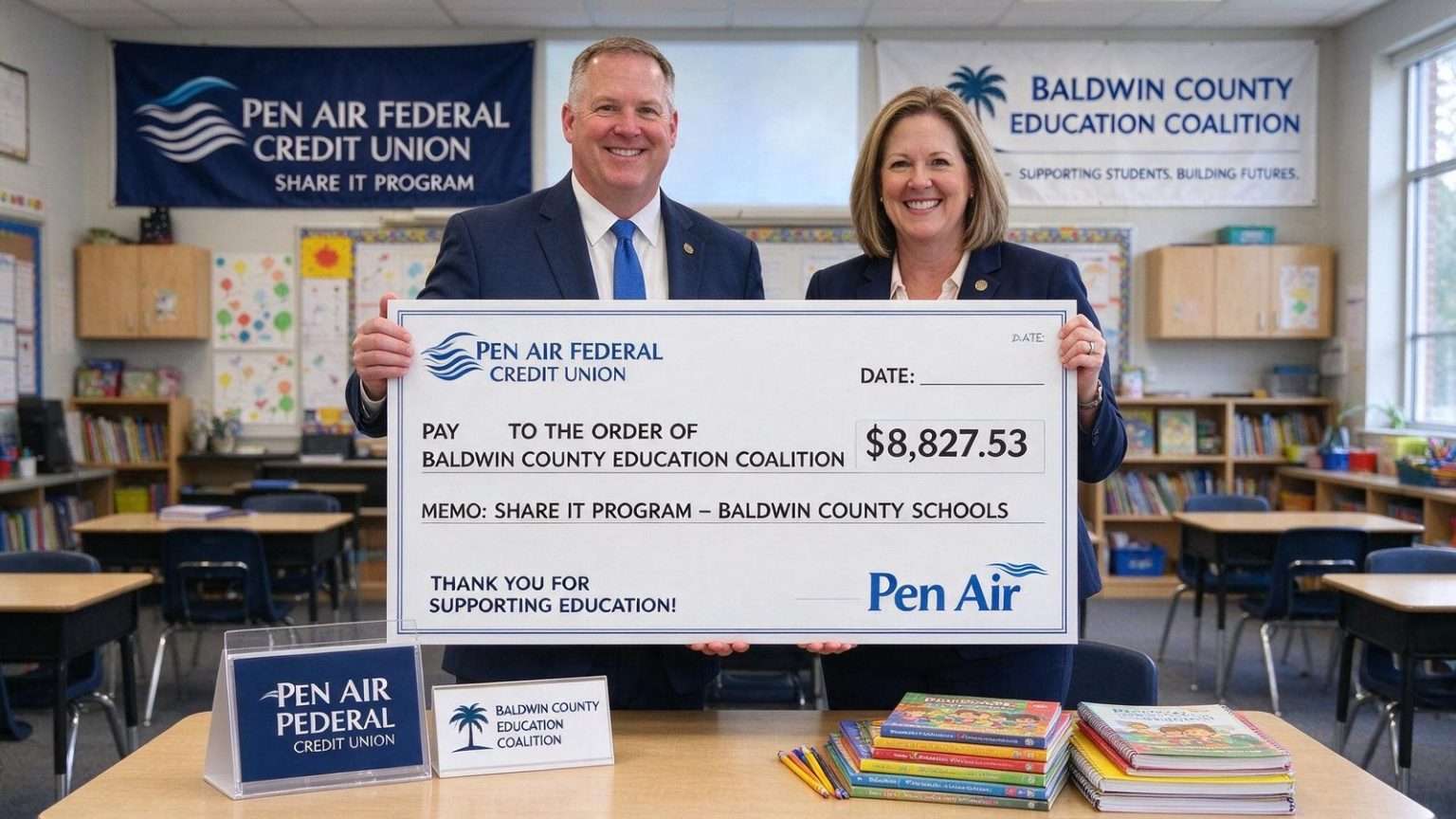
BALDWIN COUNTY, Ala. — Baldwin County students are getting a boost in the classroom thanks to a credit union debit card program that turns everyday swipes into school funding. The check presented to the Baldwin County Education Coalition represents the quiet accumulation of thousands of small transactions — a penny at a time — into a contribution that will reach classrooms across the county’s public schools.
Pen Air Federal Credit Union presented the Baldwin County Education Coalition with a check for $8,827.53 generated by its Share It program, which donates a penny per signature-based debit card transaction to the school district a member chooses — at no cost to the cardholder. The model is simple: members enroll, swipe their cards on everyday purchases, and the credit union routes a cent from each signature-based transaction to the school system the member has selected.
“Pen Air’s pledge to support education is directly shown through our Share It program,” said Casey Brueske, community education development specialist for the credit union. “This program offers our members a chance to partner with us and enhance the lives of students in their local community by funding programs, like the Palm Project, in Baldwin County Schools. All you have to do is swipe your card.”
The program’s design reflects the community-rooted character of credit unions, which are member-owned nonprofits and have long positioned local giving as a core part of their mission. Rather than a one-time corporate donation, Share It builds school funding into the daily banking habits of thousands of members, letting the balance grow with every grocery run and gas station stop.
Funds Headed to Palm Project Initiative
Terry Burkle, executive director of the Baldwin County Education Coalition, said every dollar of the contribution will support the coalition’s Palm Project, an initiative that supplies Baldwin County students with necessities intended to remove barriers to learning, raise academic achievement and support social-emotional development.
The Palm Project operates on the principle that a child who is hungry, unwell or missing basic supplies cannot learn at full capacity, no matter how strong the instruction in the classroom. School support programs of this kind typically stock closets with clothing, hygiene items and school supplies that teachers and counselors can discreetly distribute to students who need them — work that rarely makes headlines but measurably affects attendance, focus and achievement.
Burkle noted that roughly 49 percent of the district’s students are classified as living in poverty. That figure places the county’s schools among systems where a majority-adjacent share of students qualify for support, and it underscores why necessity-focused programs matter: in classrooms across Baldwin County, teachers routinely absorb the gap between what students have and what they need.
The Baldwin County Public Schools district is one of the largest in Alabama, spanning a county geographically bigger than some states’ entire metro areas — from Bay Minette in the north to Gulf Shores and Orange Beach on the coast, with Daphne, Fairhope, Foley, Robertsdale and Spanish Fort in between. That footprint means the needs the Palm Project addresses are as varied as the county itself, from inland communities facing persistent economic hardship to rapidly growing suburban zones where even middle-class families can be stretched thin.
The Baldwin County Education Coalition, the nonprofit that operates the Palm Project, works across that entire system, connecting community resources with the schools that need them most. The coalition has built its model on partnerships — with businesses like Pen Air, with municipal governments, with civic clubs and individual donors — rather than a single funding stream.
How Share It Works Across the Gulf Coast
Members enrolled in Share It can direct their donations to school systems in Escambia County, Florida; Santa Rosa County, Florida; or Baldwin County, Alabama. The three-district footprint mirrors Pen Air’s field of membership across the central Gulf Coast, where the credit union — headquartered in Pensacola, Florida — serves members on both sides of the state line.
The structure lets members put their pennies where their loyalty is: a Foley parent directs her swipes to Baldwin County schools, while a Pensacola member channels hers to Escambia County. The credit union aggregates the transactions and presents periodic checks to each district’s supporting organization, of which the Baldwin County Education Coalition is the local partner.
Previous rounds of Share It funding have paid for teacher professional development and classroom literacy resources aimed at improving student achievement across Baldwin County’s public schools. Those earlier investments — training that helps teachers sharpen instruction, and materials that put books and reading tools in students’ hands — show the range of uses the coalition has found for the program’s proceeds beyond direct student necessities.
For educators, contributions like this one arrive at a practical moment. School support organizations across Alabama plan their giving calendars around the academic year, and donations received in the fall typically fund the supplies and interventions that carry classrooms through the winter months, when the demands on families tend to be heaviest.
Why Penny Programs Matter in Public Education
The Share It model belongs to a family of community-based funding mechanisms that have become increasingly important to public schools as districts navigate tight budgets. While state and local taxes remain the backbone of school funding, programs that route small, recurring contributions into classrooms fill gaps that public money cannot always reach — the emergency shoes, the hygiene kits, the extra set of classroom books.
The penny-per-transaction approach also carries a civic benefit that goes beyond the dollar amount. Each enrolled member becomes a stakeholder in the school system of their choice, and the credit union’s regular presentations of oversized checks give the community a visible reminder that local education is a shared investment. Credit unions across the country have adopted similar affinity programs, and Pen Air’s version has run long enough to fund multiple rounds of grants in its three supported districts.
The $8,827.53 check will be put to work by the coalition’s Palm Project team, which coordinates with school counselors and administrators to identify needs and distribute supplies. The coalition has emphasized that the program’s reach depends on ordinary participation — every member who chooses a district and swipes a card adds to the total, with no cost or effort beyond their normal spending.
Baldwin County’s growth adds urgency to that work. The county has been one of Alabama’s fastest-growing for years, and its schools have added students — and buildings — accordingly. Supporting a district of that scale requires the kind of broad-based community funding the coalition has made its specialty, and the Pen Air contribution is one more layer in that foundation.
Members who want to direct their Share It contributions to Baldwin County schools can enroll through the credit union, selecting the Baldwin County district as their beneficiary — after which, as Brueske put it, all they have to do is swipe their card.
The Palm Project’s focus on social-emotional development deserves particular attention, because it reflects how Alabama educators have broadened their definition of what students need to succeed. Alongside the tangible supplies — clothing, food, hygiene items — the initiative supports the emotional foundation of learning: students who feel seen, supported and steady enough to engage with their schoolwork.
A Model Built on Small Giving
What distinguishes penny-per-transaction programs from traditional philanthropy is accessibility. A family of modest means can participate on equal footing with a business owner, because the contribution scales with everyday life rather than requiring a check. That inclusiveness is part of the pitch Brueske makes when the credit union promotes the program: the bar to entry is a debit card and a selection.
The numbers bear out the model’s quiet power. Eight thousand dollars represents roughly 880,000 enrolled member transactions — swipes accumulated across months of ordinary commerce, invisible to the cardholders making them but decisive to the classrooms receiving the proceeds. For the coalition, that recurring stream offers something rare in nonprofit fundraising: predictability.
Education advocates in Baldwin County have long argued that community support is the margin between adequacy and excellence for the district. Public funding covers the essentials, but the extras — professional development for teachers, literacy tools, emergency supplies for students in crisis — depend on the kind of partnerships the coalition cultivates with businesses, municipalities and individual donors across the county.
The check presentation itself was part of that cycle of visibility. When the credit union hands over an oversized check, it isn’t merely transferring funds; it’s showing the community what enrolled participation produces, and inviting the next wave of members to join. The result is a fundraising engine that runs on the ordinary rhythm of Gulf Coast life — groceries, gas, coffee — and ends up in classrooms.
As the school year continues, the Palm Project will convert this round of Share It funding into supplies and support for students across Baldwin County’s sprawling district — a transformation measured not in the cents that funded it, but in the barriers it removes, one student at a time.