Pensacola community rallies for Fill The Mayflower holiday food drive
Pensacola's annual Fill The Mayflower food drive is collecting donations at Cordova Mall to help families in need this holiday season.
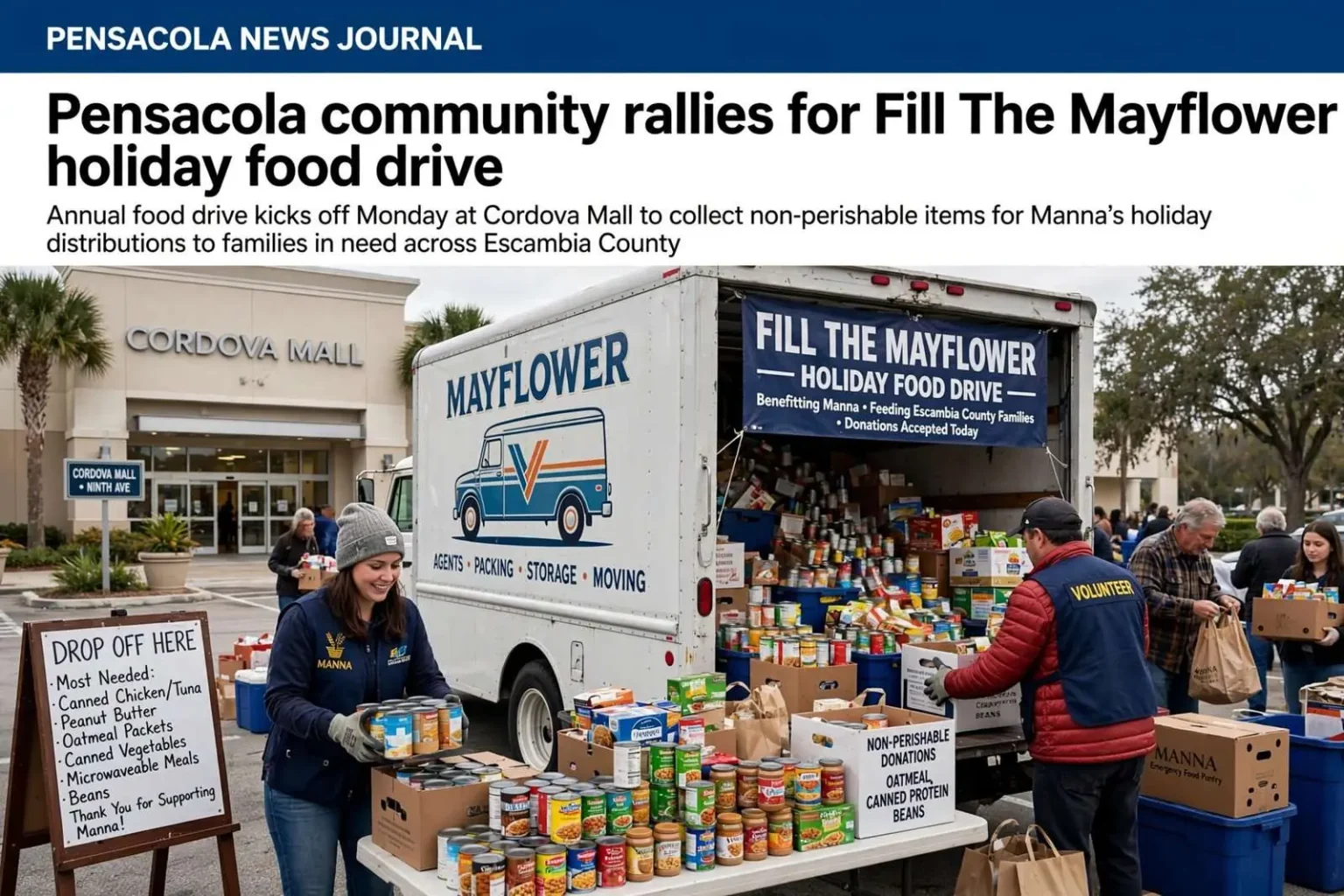
PENSACOLA, Fla. — The Pensacola community is stepping up to make sure no one goes hungry this holiday season as the annual “Fill The Mayflower” food drive kicks off. The event began Monday morning at Cordova Mall on Ninth Avenue.
The drive is one of the Gulf Coast’s most recognizable holiday traditions, and its name tells the story: a vintage Mayflower moving truck, parked at a high-visibility location, gradually filled with donated non-perishable food as residents stop by and contribute. Beginning Monday morning at Cordova Mall — the region’s largest enclosed shopping center, situated on Ninth Avenue in the heart of Pensacola’s main retail corridor — the campaign gives shoppers a drop-off point steps from where they already are, which has always been the key to its success.
The local nonprofit Manna will distribute the donated non-perishable items to families in need during the holidays. Manna has served Escambia County for decades as a primary emergency food pantry, providing groceries to individuals and families facing hunger, and the holiday season is when demand on its shelves is at its highest. Every item collected during the drive moves through Manna’s operation — sorted by volunteers, checked for condition and dates, and placed into the grocery orders that clients receive.
The holiday season also draws out a spirit of giving that ordinary weeks do not, and pantries plan their calendars around it. Supporters who miss the truck at the mall can often give in other ways — monetary donations allow a pantry to purchase exactly the items its shelves lack, usually at wholesale prices through food bank partnerships, which means a modest cash gift can buy more food than the same dollars spent at retail. Volunteers, meanwhile, are needed most in the weeks after the truck leaves, when the collected goods must be sorted and moved onto the shelves ahead of holiday distributions.
Why the drive matters in Escambia County
Holiday food drives meet a need that is easy to underestimate. Food insecurity in the Pensacola area touches households across the community: working families whose wages do not stretch to the end of the month, seniors on fixed incomes facing rising utility bills, veterans, and children whose school meals end during holiday breaks, leaving family pantries to fill the gap. Emergency food providers like Manna report that a grocery order from a pantry can be the difference between a holiday meal and an empty table, and the donations gathered in a single strong drive can carry a pantry’s shelves into the new year.
The timing is deliberate. Food banks and pantries across the country see demand spike from Thanksgiving through the winter holidays, precisely when school kitchens close and seasonal work slows. Donations of staple goods collected in November and December are often what determine whether a pantry can maintain full distributions in January and February, when the donations taper off but the need does not.
Among the most-requested items are canned or pouch chicken and tuna, single-serve oatmeal packets, canned mixed vegetables, microwaveable dinners, peanut butter and canned beans. The list reflects both nutrition and practicality. Protein sources — canned and pouched meats, peanut butter, beans — are the most expensive items for families to buy and the hardest for pantries to keep in stock. Single-serve oatmeal and microwaveable dinners suit households without reliable transportation to shop frequently, and residents who may lack full kitchens, including those in temporary housing. Pop-top lids and shelf-stable items that require no cooking are consistently among the most valuable donations a pantry can receive.
How the drive works
Volunteer labor is the quiet engine of the whole operation. Between the people who unload cars at the truck, the sorters who box donations by category at the pantry, and the distribution teams who assemble grocery orders for clients, a successful drive represents hundreds of volunteer hours in addition to the food itself. Local businesses contribute as well — some run internal collection competitions among employees, others drop off bulk purchases from case-lot sales, and school groups often adopt the drive as a service project, which has the double benefit of collecting food and teaching students about hunger in their own city.
The mechanics of Fill The Mayflower are simple by design. A truck is stationed at the collection site, and donors drop off purchased items as they arrive at the mall. Volunteers staff the effort during collection hours, taking donations, boxing them and staging them for transport to the pantry. The visual of the truck filling up day by day is part of the appeal — it turns giving into a community progress bar, and local media coverage of how full the truck is becoming has long helped keep the drive in the public eye throughout its run.
Shoppers making the drop-off do not need to overthink their selections. Pantry organizers consistently point donors toward the same categories: proteins, whole grains, canned vegetables and fruits, soups and stews, pasta and rice, and shelf-stable milk. Items in unbreakable packaging — cans and pouches rather than glass — are preferred because they survive handling and sorting. Donors should check dates, since pantries cannot distribute expired goods, and opened or homemade items cannot be accepted for safety reasons. A few dollars spent on store shelves translates directly into meals, because the food goes from donor to pantry to client without intermediate purchases.
Cordova Mall’s role in the drive is no accident. Located on Ninth Avenue near the interchange that connects Pensacola’s retail core, the mall draws shoppers from across Escambia County and from neighboring Santa Rosa County communities — Gulf Breeze, Milton, Pace and Navarre among them — during the holiday season. Positioning the collection truck where holiday shopping already happens converts routine errands into donations, and the mall’s management has hosted the drive as part of its community calendar.
Manna’s role in the community
Manna, the drive’s beneficiary, operates as Escambia County’s primary food pantry organization, with a model built on providing groceries directly to people in need. Clients receive nutritionally balanced grocery orders rather than pre-packed identical boxes, an approach that reduces waste and respects dietary needs, medical restrictions and cultural preferences. The organization also works with partner agencies and food banks to extend its reach, and its volunteer corps — from students to retirees — is the labor force that makes holiday distributions possible.
Food drives like Fill The Mayflower are more than a charity gesture; they are a logistics pipeline. A pantry’s purchasing power stretches farthest when donations arrive in the categories it actually needs, which is why the drive publicizes a most-requested list rather than accepting whatever donors happen to grab. Protein, shelf-stable meals and breakfast items fill the gaps between what federal commodity programs supply and what clients actually require to prepare complete meals at home.
The wider Gulf Coast picture
Fill The Mayflower belongs to a broader holiday tradition across the Gulf Coast, where communities from Mobile to Panama City run parallel food drives each winter. The model — an iconic truck, a visible collection point, a trusted pantry beneficiary — has been replicated across the region because it works: it lowers the barrier to giving, it creates a shared public event out of private generosity, and it delivers exactly the goods that pantry operators can put to immediate use. Northwest Florida’s military communities add their own dimension, with airmen and sailors from the area’s bases among both the donors and, at times, the recipients, as young military families stationed far from home are among the populations emergency pantries serve.
Hurricane history gives the region an added appreciation for food security. Pensacola and the surrounding coast have endured repeated hurricane impacts over the past two decades, and the images of neighbors feeding neighbors after storms remain part of local memory. Organizations like Manna were at the center of that response, and the community’s habit of stocking emergency food supplies — in pantries and in homes — traces back to those experiences. A holiday drive in a region that knows how quickly supply lines can be disrupted is more than seasonal charity; it is practice for resilience.
Organizers are encouraging residents to drop off donations so local families can gather around a full table this season. For donors, the ask is modest: pick up a few extra items during a regular shopping trip — canned or pouched chicken or tuna, oatmeal packets, canned vegetables, microwaveable meals, peanut butter or canned beans — and hand them to the volunteers at the truck. For the families who receive those groceries through Manna’s distributions, the result is what every food drive is ultimately about: a pantry that can say yes when a parent walks in worried about the next meal, and a table with something on it when the holiday arrives.