Pensacola Demolition Derby Driver Faces Long Recovery After Serious Crash at Five Flags Speedway
Pensacola driver Camden Sidner faces a long recovery after a serious crash at the Five Flags Speedway Demolition Derby left him with multiple injuries.
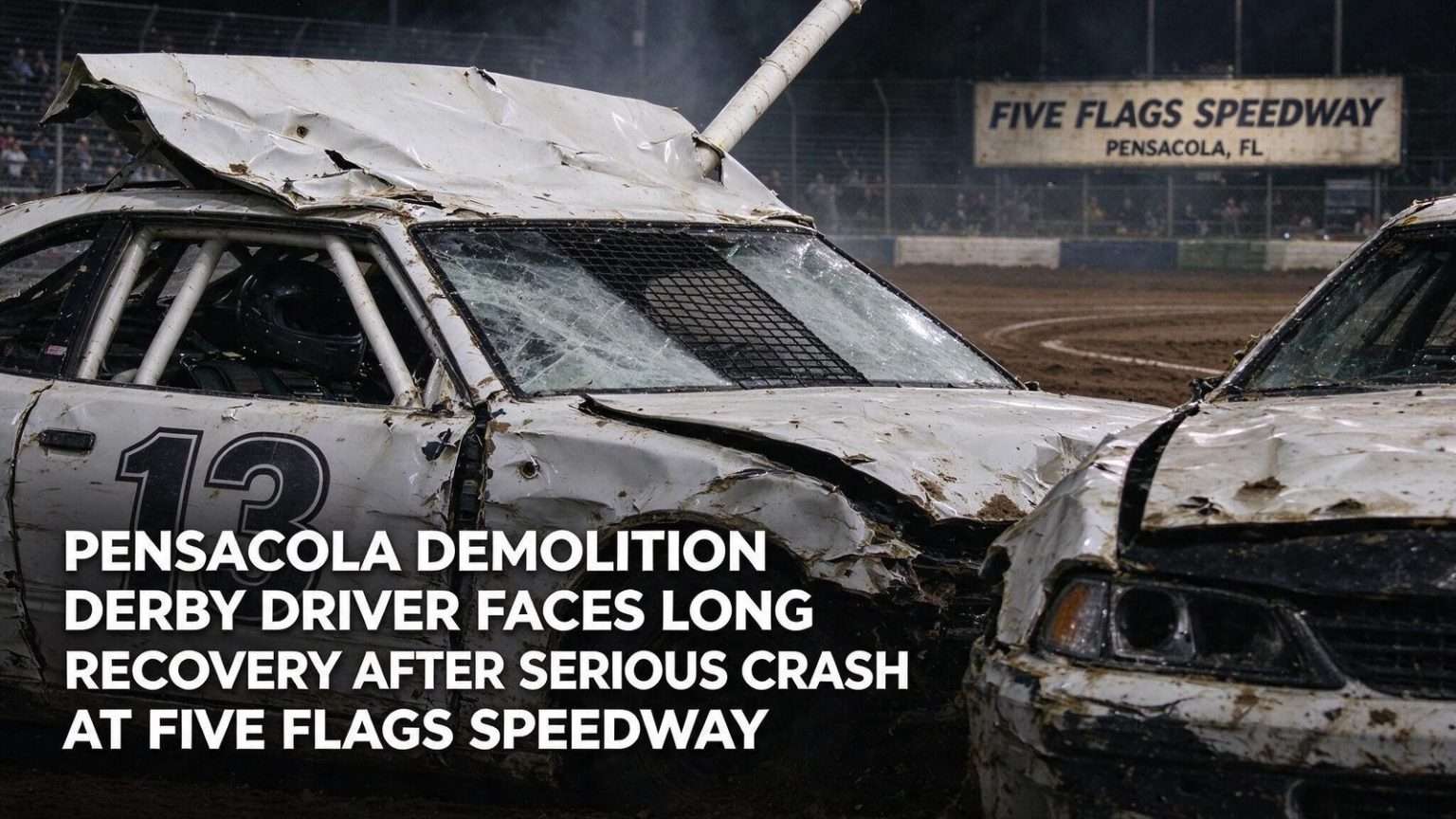
The Demolition Derby at Five Flags Speedway in Pensacola is always a rough-and-tumble affair, but this year driver Camden Sidner is just thankful to be alive after a crash left him with serious injuries. “From waking up in the hospital, I really don’t remember much,” Sidner said. The veteran derby driver’s night at the Pensacola half-mile ended not with a trophy but with surgery, and his family says the speedway’s grandstand crowd witnessed one of the hardest single impacts the annual event has produced.
During last Friday’s derby, Sidner was struck by another car on his driver’s-side door, leaving him with a concussion, a fractured pelvis and a broken sacrum that required surgery. In demolition derby competition, the driver’s door is the one zone every veteran dreads: rules and driver etiquette call for it to be avoided, since the frame there offers the least protection between a competitor and the impact itself. A direct T-bone hit on that door transfers the full force of a full-size car into the driver’s hip and torso, which is precisely the injury pattern doctors documented in Sidner’s case.
His fiancée, Heather Parish, said the hit did not appear intentional but was severe. “We know like the driver’s door was not hit on intentional, like it was not an intentional hit,” Parish said. “He was hit so hard, his door pushed into the driver’s seat and shoved him over pretty much into the passenger’s seat.” The detail matters in derby circles, where deliberate driver’s-door hits are considered the sport’s cardinal sin. By every account from the pit area, the impact came from a competitor caught in the wrong place at the wrong angle during the chaos of the event.
Parish said she and Sidner’s family rushed onto the track after the crash. “He was unconscious for about a minute, wasn’t coming to, and the medics got over there trying to get him and stuff, and he finally came to and they got him out, and I think everyone around was just kind of praying and thankful that were signs of life because like I said, a lot of us thought he was dead in that car,” she said. Emergency responders at the speedway reached the car quickly, and the decision to extract him from the passenger side of his own crushed cockpit reflected the damage to the door he would normally climb out of.
A Nine-Year Veteran’s Last Ride
Sidner, who had competed in demolition derbies for nine years, said the injury will end his time behind the wheel. The announcement closes out nearly a decade of competition in a sport where most participants are part-timers — mechanics, laborers and racing families who build their derby cars in home garages and haul them from fairgrounds to speedways across the region on summer weekends. Nine years in derbies represents dozens of events and multiple cars sacrificed to the scrapyard, a career measured in hits absorbed as much as wins.
He now faces roughly six weeks of recovery before he can walk again. Pelvic and sacral fractures are among the most disruptive injuries a person can sustain short of life-threatening trauma, because the pelvis bears the body’s weight in every step and every transfer from bed to chair. Surgery to stabilize the fracture is followed by weeks of protected healing, then months of gradual weight-bearing and physical therapy before patients regain a normal gait. The six-week estimate covers the first milestone — walking — with full recovery expected to take considerably longer.
A GoFundMe has been set up to help the family during his recovery. The fundraising campaign addresses the practical realities that follow a crash like this one: weeks away from work during the initial healing, ongoing therapy costs and the travel expenses that pile up while family members shuttle between home and hospital.
Safety in a Sport Built on Collisions
Parish added that safety remains essential even in an event built around collisions. “When speaking about a demolition derby, the name within itself, you’re out there to demolish things, but there is still a matter of safety that needs to be followed to keep all of the drivers safe,” she said. Her point lands at the center of a long-running conversation in the sport, where promoters walk a line between the spectacle fans pay to see and the rules that keep drivers from getting hurt.
Derby rules and car construction reflect that balance. Sanctioned events require drivers to wear helmets, seat belts and often neck restraints; cars are stripped of glass and trim, with batteries relocated and fuel lines secured; and most derbies draw deliberate lines around the driver’s door, either prohibiting deliberate contact with it or requiring extra reinforcement there. Officials stop events when a driver is slow to respond over the radio or an obvious injury occurs, and medical crews are stationed trackside for the duration of the night. None of that eliminates danger — Saturday’s crash is proof — but advocates of the sport note that the same impacts occur in street accidents without anyone questioning the format.
Five Flags Speedway, the historic half-mile oval on Pine Forest Road in Pensacola, has hosted stock car racing since the early 1950s and is best known nationally as the home of the December Snowball Derby, one of short-track racing’s most prestigious events. Demolition derby nights fill a different niche on the calendar: they draw the fairground crowd, families with children and first-time race fans, with an entertainment formula that needs no knowledge of racing to enjoy. Cars are entered by local competitors, many of whom spend weeks welding and stuffing the frames in preparation for a single night of controlled destruction.
The crowd’s role in events like last Friday’s is part of the culture of the sport, and Parish’s account of onlookers praying and celebrating the signs of life captured how a demolition derby audience responds when the spectacle turns real. In an arena where the crashes are the entertainment, a genuine injury briefly suspends the show, and the silence that falls over a grandstand in that moment is the sharpest reminder the sport offers of what drivers are risking.
The Road Ahead
Sidner’s recovery will proceed in stages, beginning with the hospital stay following surgery and continuing through weeks of limited mobility at home before the six-week walking milestone. Pelvic fracture patients typically work with physical therapists on range of motion and gradual weight-bearing, and the timelines depend on the specific fracture pattern and the hardware used to stabilize it. For a competitor accustomed to the physical demands of wrestling a derby car through a heat, the enforced inactivity is its own challenge.
His decision to step away from competition after nine years removes from the pit area one of the region’s experienced hands, the kind of driver younger competitors learn from and promoters rely on to fill the field. The sport’s turnover happens exactly this way — not with farewell ceremonies, but with a driver deciding after a crash that the risk no longer makes sense — and the cars that once carried them get parted out or sold to the next generation of builders.
“I think that’s about it — just happy to be alive,” Sidner said. His summary of the crash distilled what his family spent Friday night living through and what the speedway community spent the weekend talking about: a demolition derby driver walked the edge of the worst outcome in his sport, survived it, and is now facing the long, slow work of learning to walk again. The GoFundMe campaign continues to collect contributions as the recovery unfolds, and the derby community across the Panhandle has followed the updates closely.
How Demolition Derby Nights Unfold
For readers unfamiliar with the format, a demolition derby evening typically runs through heats of a dozen or more cars, with drivers reverse-steering and throttling into one another until only one machine remains moving under its own power. Judges score the final moments, awarding points for aggression and control, and the last car running advances to a feature event that closes the night. Heat sheets are drawn up in advance, and drivers draw numbers for their starting positions, but the first thirty seconds of contact reorganize everyone’s plans instantly — which is when positioning errors, like the one that caught Sidner’s driver’s door, tend to happen.
The cars themselves are engineered for exactly one night of work. Builders remove the glass, strip the interiors and weld the doors shut for structural integrity, then chain or bolt the driver’s seat, harness and padding in place to cushion the impacts the frame cannot absorb. The driver’s compartment is the one area the sport’s builders protect with real discipline, which is why a hit that collapses the door into the seat — as Parish described — stands out as the nightmare scenario every builder tries to engineer against.
Drivers compete across a circuit of fairgrounds and speedways through the summer, and the Panhandle’s derby nights at Five Flags draw competitors from across Florida, south Alabama and southern Georgia. The community is small enough that regulars know each other’s cars and families, and the reaction to Sidner’s crash — from the grandstand prayers to the rapid spread of fundraising links — reflected those relationships. Competitors’ relatives routinely work the pit fences during events, which is why Parish and the family were positioned to reach the track so quickly on Friday night.
What Comes Next for Sidner and His Family
The weeks ahead will be defined by hospital discharge planning, insurance paperwork and the slow progression of fracture healing, with the family’s attention fixed on the six-week milestone when Sidner is expected to take his first steps. Injuries of this kind typically allow a return to desk work well before a return to physical labor, and the financial gap between those two dates is precisely what the GoFundMe campaign is designed to bridge. Campaign updates have become the family’s channel for keeping the derby community informed without fielding individual calls during the hardest weeks of recovery.
As for the sport, Friday night’s crash will circulate in derby circles the way serious injuries always do — as a cautionary story about angles, spacing and the split-second decisions that separate a memorable hit from a career-ending one. Veterans retell these stories to rookies not to frighten them off but to transmit the etiquette that keeps the sport survivable: protect the door, avoid the blind side, and check on the driver you just hit before you celebrate the win.
Sidner’s nine years in the sport gave him a full career by derby standards, and his closing words — relief, gratitude, and a wish to simply keep moving forward — captured the sentiment his family and the Five Flags community shared as the weekend ended. The speedway’s season rolls on, the derbies will run again, and somewhere in a garage this week a builder is welding an extra plate over a driver’s door because of what happened last Friday night in Pensacola.