Pensacola Man Accused of Beating Woman in Fight Over Drug Pipe, Police Say
Brandon Kyle Mann faces assault, battery and false imprisonment charges after a Pensacola dispute over a synthetic marijuana pipe, police records show.
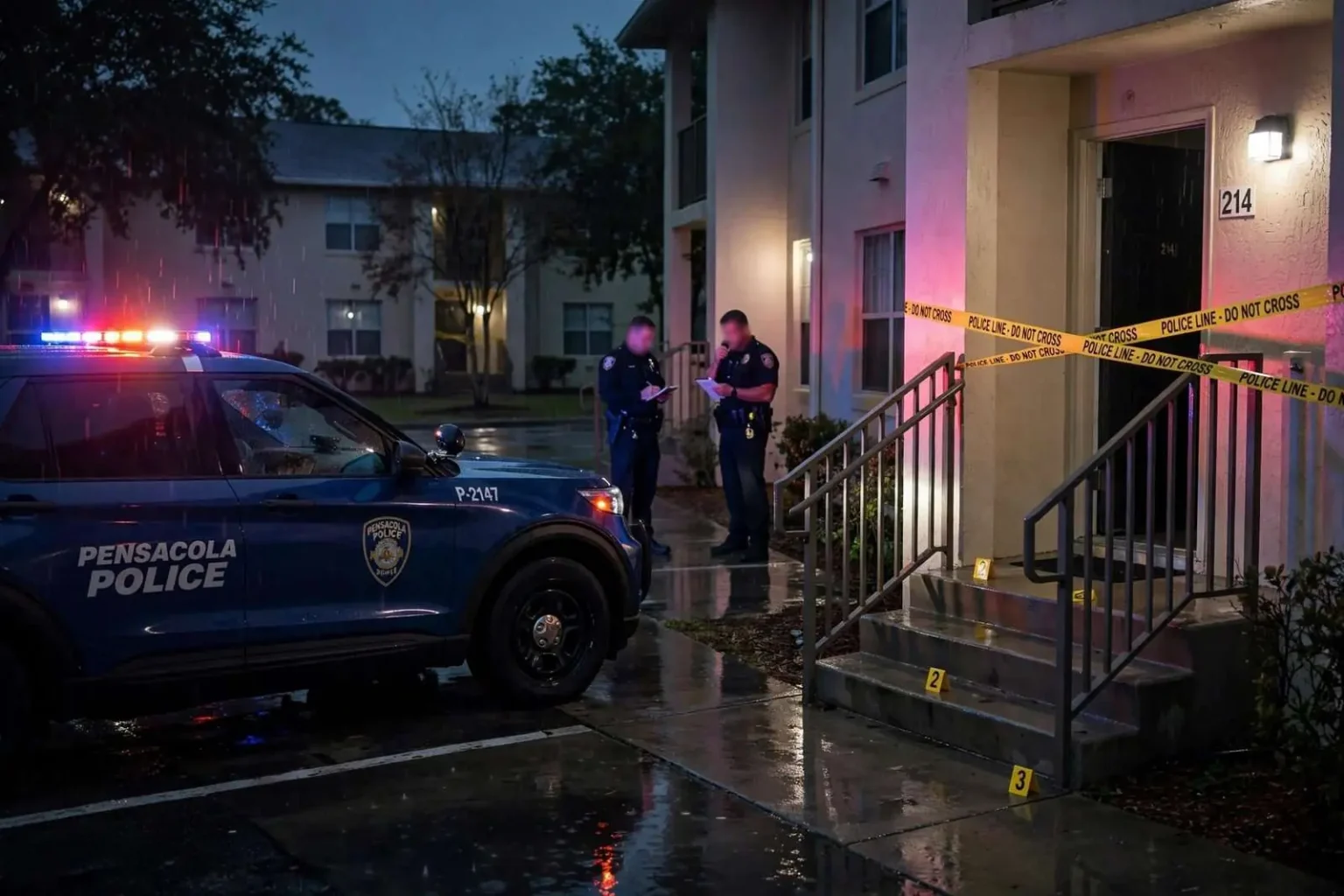
A Pensacola man faces assault charges after investigators say he beat a woman during an overnight dispute that began when she refused to help him find his pipe for smoking synthetic marijuana. The case, documented in an arrest report filed by Pensacola police, describes a confrontation that moved from a late-night argument to a physical attack inside a residence, leaving the victim with visible facial injuries that officers observed when she later arrived at a hospital.
Brandon Kyle Mann, 35, is charged with simple assault, battery and false imprisonment following his arrest, according to the arrest report. The three charges cover distinct parts of the alleged conduct: simple assault for the threat of violence, battery for the physical contact itself, and false imprisonment for preventing the victim from leaving during the incident. Taken together, the charges describe an escalating confrontation that investigators say combined threats, physical attack and restraint.
Investigators wrote that the victim told them Mann woke up searching for the pipe he uses to smoke the drug sometimes called “spice.” When she declined to help look for it, the report states, the argument escalated after she directed a racial slur toward a friend of Mann’s who was asleep nearby. What began as a dispute over a missing drug paraphernalia item quickly turned personal, and the situation deteriorated from a verbal argument into violence within moments, according to the account the victim gave investigators.
According to the arrest report, Mann punched her in the face, slammed her head against a washing machine and then a wall, and threatened to kill her. The level of detail in the report reflects the victim’s statements to investigators along with the physical evidence officers documented at the hospital and at the scene. Prosecutors will review the full case file before the charges move forward in court.
She told investigators she escaped after throwing a glass of water at his feet. That moment, according to the account, gave her the opening she needed to get away from the confrontation. The detail illustrates how quickly domestic disputes can shift, and how victims often escape not because the violence subsides but because a distraction creates a chance to leave.
Injuries Observed at the Hospital
Officers noted she arrived at a hospital bleeding from the mouth, with blood covering her hand and the lower part of her face. Hospital staff are trained to recognize injuries consistent with assault, and their observations are frequently documented in arrest reports as supporting evidence. In cases like this one, medical records can become a significant part of the prosecution’s file, corroborating the victim’s account of what happened and when.
The allegations come from the arrest report, and the charges against Mann have not yet been tested in court. An arrest report captures the probable cause investigators assembled at the time of arrest, but every element of every charge must still be proven before a judge or jury. Defendants are presumed innocent, and the course of the case will depend on evidence presented in proceedings at the Escambia County Courthouse, where felony and misdemeanor cases from Pensacola and the surrounding county are heard.
The Charges and What They Carry
Simple assault under Florida law involves an intentional threat, verbal or by conduct, that creates a well-founded fear that violence is imminent, along with the apparent ability to carry it out. Battery involves actual intentional touching or striking against the will of another person or causing bodily harm. False imprisonment, in its misdemeanor form, involves forcibly confining or restraining someone against their will without lawful authority, blocking their freedom to leave.
The three charges filed together are common in domestic violence cases because they map onto the typical arc of an incident: the threat, the strike, and the restraint that keeps a victim from getting away. Prosecutors in the State Attorney’s Office for the First Judicial Circuit, which covers Escambia County, evaluate these cases based on the arrest report, witness statements, medical documentation and any prior history between the parties before deciding how to proceed.
After an arrest on misdemeanor charges in Florida, a defendant typically appears before a judge for first appearance within 24 hours, where conditions of release are set. In domestic violence cases, courts frequently impose no-contact orders as a standard condition, and violations of those orders can bring additional charges. The case then moves through arraignment and pretrial stages, during which defense counsel and prosecutors negotiate or prepare for trial.
Synthetic Marijuana and Its Role in Local Cases
The dispute began over a pipe used to smoke synthetic marijuana, a category of lab-made chemicals sprayed onto plant material and sold under names like spice or K2. The substances are designed to mimic THC, the active compound in marijuana, but they bind to brain receptors far more strongly and unpredictably, producing effects that can include severe agitation, paranoia, hallucinations and aggression. Emergency rooms along the Gulf Coast, including those in Pensacola, have treated patients for those effects for years.
Because the chemical compounds vary batch to batch and are not regulated for consistency, users and the people around them often cannot anticipate how a given product will affect behavior. Law enforcement officers in Northwest Florida encounter the drug in a wide range of incidents, from erratic public behavior to violent confrontations like the one described in this arrest report. Florida law has expanded over the years to criminalize a growing list of synthetic cannabinoid compounds as controlled substances.
How Domestic Violence Cases Move Through the System
Cases like this one rely heavily on documentation from the earliest moments onward. Responding officers in Pensacola are trained to photograph injuries, interview the parties separately, and record statements in detail, because domestic violence prosecutions often hinge on the victim’s account when there are no other witnesses. The practice of walking victims through their statements while memories are fresh helps preserve the record for prosecutors who will not see the case for weeks or months.
The victim’s decision to seek treatment at a hospital also matters in the legal process. Medical staff document injuries in a clinical setting, creating an independent record that exists apart from law enforcement. In Escambia County and across Florida, hospitals use screening protocols to identify patients whose injuries may stem from violence at home, and staff can connect those patients with advocates and safety resources before discharge.
Advocates note that the period immediately after an arrest can be among the most dangerous for a victim, which is why courts and law enforcement agencies in the region emphasize no-contact conditions and rapid referral to support services. Resources in the Pensacola area include crisis hotlines, emergency shelter programs, and victim advocates based at the State Attorney’s Office who guide witnesses through the court process. Similar services operate across the state line in Alabama and Mississippi, reflecting the regionwide nature of the problem.
For defendants, the presumption of innocence shapes every stage that follows. Defense attorneys scrutinize the arrest report for gaps between the allegations and the evidence, and plea negotiations are common in misdemeanor domestic cases. Outcomes can range from dismissal to diversion programs that include counseling and substance abuse treatment, to convictions that carry jail time, fines and probation. Judges in these cases frequently order batterer’s intervention programs as a condition of any sentence.
What Comes Next
Mann’s case will proceed through the Escambia County court system like any other, beginning with first appearance and continuing through the pretrial calendar until it is resolved by plea or trial. The State Attorney’s Office will assess the strength of the evidence, including the victim’s statements, the medical observations and anything investigators gathered at the scene. Any change to the charges will be documented in public court filings.
Meanwhile, the case stands as a reminder of how quickly disputes that begin over drug use can escalate into serious violence inside a home. Advocates across the Gulf Coast emphasize that anyone in immediate danger should call 911, and that help is available around the clock through the National Domestic Violence Hotline and its local affiliated shelters. For residents of the Pensacola area, the FavorHouse of Northwest Florida operates crisis services specifically for situations like the one described in this arrest report, offering shelter, safety planning and court advocacy to victims in Escambia and Santa Rosa counties.
The charges against Mann remain allegations at this stage. The facts as described come from the arrest report filed by investigators, and the court will determine what the evidence ultimately supports. Until the case is resolved, the report’s account — a late-night argument over a drug pipe, an escalating confrontation, and a woman injured while trying to get away — represents one side of a case now moving into the criminal justice system.