Pensacola Man Accused of Years-Long Sexual Abuse of Young Girl
Larry Snipes faces sexual assault and lewd conduct charges accused of abusing a Pensacola girl from age 11 until she turned 14, per the arrest report.
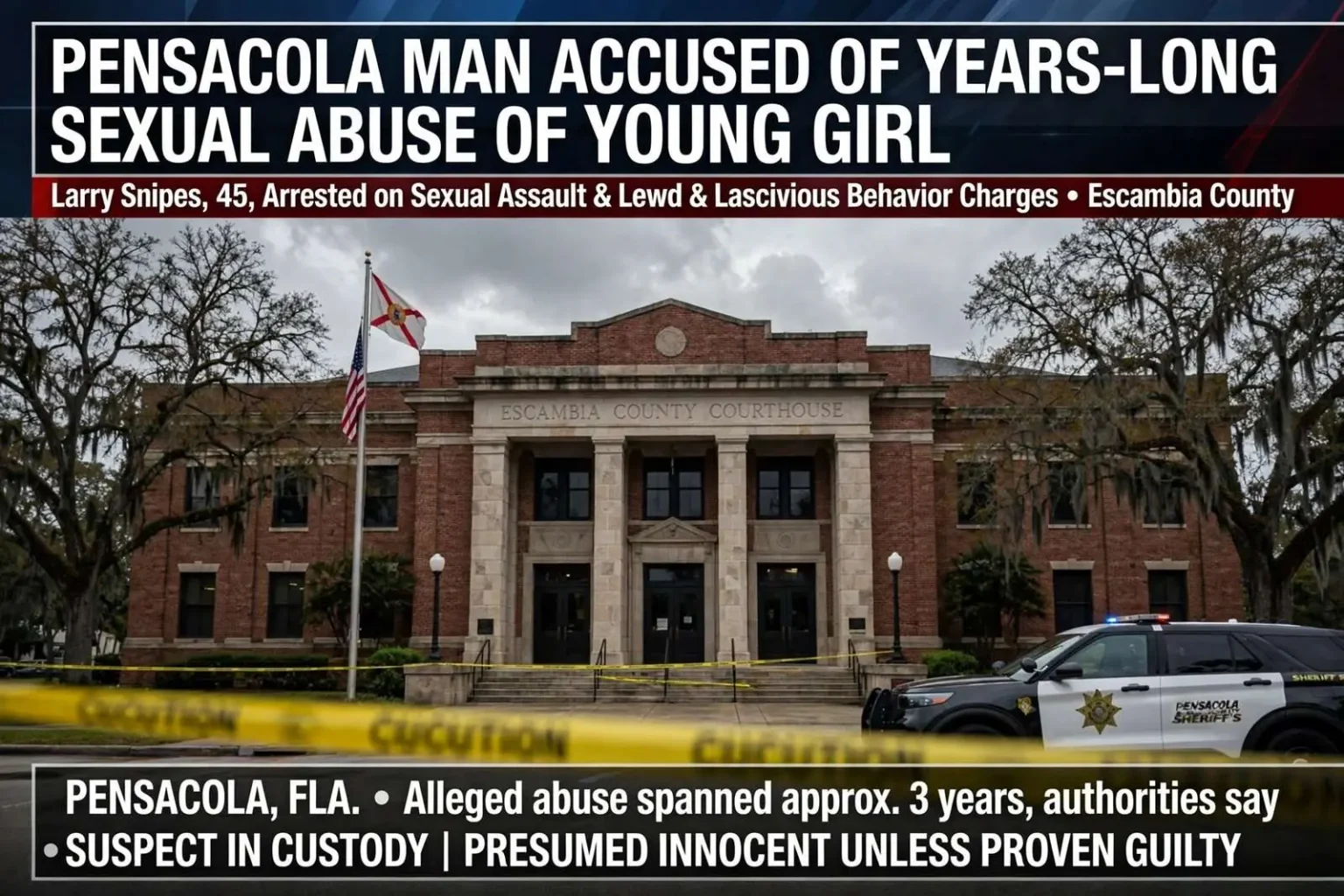
A Pensacola man has been arrested on charges that he sexually abused a young girl over a period of roughly three years, beginning when she was 11 years old, according to authorities in Escambia County.
Larry Snipes, 45, is charged with sexual assault and lewd and lascivious behavior. The arrest follows an investigation that grew out of disclosures made by the victim, who is now 14.
What the arrest report says
Investigators wrote in the arrest report that the abuse took place at Snipes’ home and that he also forced another person to take part in assaulting the girl. The report outlines allegations spanning roughly three years, from the time the victim was 11 until recently, when she turned 14.
According to the arrest report, the victim told detectives Snipes gave her drugs before the initial assault, and that he then forced her into sexual acts every day, sometimes twice a day, until the abuse recently ended. Those statements came from interviews conducted by investigators trained to work with minors, which are documented in the report that supported the arrest.
The allegations come from the arrest report and statements of the victim; the charges against Snipes have not yet been adjudicated in court. He is presumed innocent unless and until prosecutors prove the allegations beyond a reasonable doubt, and the case now moves into the pretrial stages of the Florida court system.
The charges and what they carry
Sexual assault charges involving a child victim are among the most serious offenses prosecuted in Florida, and the state’s sentencing statutes provide for lengthy prison terms upon conviction. Lewd and lascivious behavior charges cover a range of prohibited conduct involving minors and are also felonies that carry substantial potential sentences.
Because the alleged conduct spanned multiple years and involves a child, prosecutors typically consolidate the timeline into a case built around the victim’s statements, any corroborating evidence investigators gathered, and testimony from the specialists who interviewed her. The person the report says was forced to participate may also figure in the proceedings, either as a co-defendant or as a witness, depending on what the investigation established about that individual’s role.
Bond and pretrial release conditions will be addressed at Snipes’ first appearances before a judge. In cases involving child victims, courts frequently impose no-contact orders, electronic monitoring and strict supervision conditions while a case is pending.
How these cases are investigated
Investigations of this kind in the Pensacola area typically involve the Escambia County Sheriff’s Office or Pensacola Police Department working with the Gulf Coast Kids House, the children’s advocacy center that serves Escambia County. Advocacy centers bring law enforcement investigators, child protective investigators, prosecutors and therapists under one roof so that a child describes what happened in a single, carefully recorded forensic interview rather than repeating the account to a series of agencies.
Forensic interviewers use non-leading techniques designed for children, and the recorded interviews become central evidence in the prosecution. Medical examinations, when warranted, are conducted by practitioners specially trained to identify and document signs of abuse.
Those procedures exist both to protect children from additional trauma and to preserve the integrity of the evidence, since defense scrutiny of how a young witness was questioned is a standard feature of trials involving child victims.
Support for the victim and family
Children who come forward in cases like this are connected with counseling and victim services as soon as the disclosure is made, well before any trial. Advocacy centers in the Pensacola area provide trauma-focused therapy for child victims and support for the non-offending family members who must carry them through an investigation and, often, a criminal trial that can take a year or more to conclude.
Victim advocates also guide families through each stage — explaining what to expect at arraignment and trial, helping prepare a child for testimony if the case reaches that point, and connecting the family with financial assistance programs available to crime victims in Florida.
The period after an arrest is often the most disorienting for families. News coverage, community awareness and the slow pace of the court system all add pressure, and advocates stress that recovery is a long process that continues regardless of the legal outcome.
Reporting abuse in Escambia County
Officials urge anyone who suspects a child is being abused to report it immediately. In Florida, reports go to the Florida Department of Children and Families’ statewide abuse hotline, which operates around the clock, or directly to local law enforcement. Florida law requires certain professionals to report suspected abuse, but any adult can file a report, and callers may remain anonymous.
Investigators emphasize that children rarely disclose abuse directly and that warning signs are often behavioral or physical — changes in mood or sleep, fear of a specific person or place, regression in younger children, or knowledge of sexual matters beyond a child’s age. A disclosure to any trusted adult, however fragmentary, should be taken seriously and reported rather than investigated privately.
Delayed disclosure is common in abuse cases, particularly when the abuser is someone the child knows and lives near, as the allegations in this case describe. Investigators say that even disclosures made years after the fact can be prosecuted, and that children who come forward are protecting not only themselves but potentially other children who have not yet told anyone.
The case ahead
Snipes’ case will now proceed through the Escambia County court system, where prosecutors will present the evidence to a grand jury or file formal charges through an information, followed by arraignment and pretrial proceedings. Court records in the case will document motions, rulings and scheduling orders as it advances.
Because the victim is a minor, prosecutors and the court will take steps to protect her identity throughout the proceedings, and portions of the case involving testimony may be handled with the accommodations Florida law provides for child witnesses.
Until the case is resolved, the charges remain allegations, and the community will be watching how the courts handle a case whose arrest report describes one of the most serious categories of offense on the Florida books.
The scope of the problem on the Gulf Coast
Cases like this one reflect a pattern that child protection professionals in the Pensacola area see regularly: the majority of child sexual abuse is committed by someone the child knows, and it takes place in a home rather than in a public setting. That reality is what makes early disclosure — and a credible, trusted adult to hear it — the single most important factor in stopping ongoing abuse.
Advocacy organizations across Northwest Florida provide prevention education aimed at exactly that gap. Programs teach parents and caregivers how to reduce one-on-one isolation between adults and children, how to recognize boundary-crossing behavior early, and how to talk with children in age-appropriate ways about their bodies and about telling a trusted adult when something feels wrong.
Schools, churches and youth sports organizations in Escambia County have increasingly adopted child protection policies — background screening for volunteers, two-adult rules, and training that helps staff spot warning signs — as awareness of how abusers operate has spread through the community.
What happens to a child’s disclosure
When a child in Escambia County discloses abuse, the response follows a defined path. A report to the state hotline triggers an investigation by the Department of Children and Families, often alongside law enforcement. If the allegations involve criminal conduct, investigators coordinate with the advocacy center to schedule a forensic interview rather than having the child questioned repeatedly at home, at school and at a police station.
The recorded forensic interview, conducted by a specialist, becomes the child’s primary statement. Investigators follow up with the suspect and any witnesses, gather medical evidence when appropriate, and build the file that prosecutors use to decide on charges.
In the courtroom phase, prosecutors in cases involving child victims work closely with the advocacy center’s staff to keep the child’s preparation manageable, and courts may use closed-circuit testimony or other accommodations to limit the strain of testifying against the accused in person.
The importance of the first report
Officials in cases like this stress a simple message: the abuse described in the arrest report continued for roughly three years, and it ended only when the victim’s account reached investigators. Every additional month that passes in an ongoing case represents continued harm that a single phone call might have prevented.
The statewide hotline in Florida takes reports at any hour, and deputies and detectives in Escambia County also take reports directly. Callers do not need proof to make a report — reasonable suspicion is the standard, and investigators, not callers, determine what the evidence supports.
As the case against Snipes moves through the courts, the focus for advocates shifts to the victim and to the community’s response. The charges remain allegations until proven in court, but the systems built around children who report abuse — forensic interviewing, advocacy, therapy and prosecution — exist precisely for cases like this one, and they will carry the process forward in the months ahead.